Bank Letter Confirming Account: How to Request One
Learn how to request a bank letter confirming account ownership, what it must include, and how to verify it. Practical guide for finance teams and small
A lender, landlord, visa caseworker, or supplier may ask for written proof that an account exists, holds funds, or belongs to a named business. A screenshot of online banking rarely answers that request. What the recipient usually needs is a bank letter confirming account, issued by the financial institution and dated so its evidence applies to a defined point in time.
The practical challenge has two sides. The account holder must request the exact assertion needed, while the recipient must test whether the document is authentic, sufficiently specific, recent, and supported by underlying records. A polished PDF alone doesn't prove any of those things.
Table of Contents
- When a Bank Letter Confirming Account Becomes Necessary
- What a Bank Confirmation Letter Must Contain
- How to Request the Letter from Your Bank
- Sample Request Text You Can Adapt
- How Recipients Should Validate the Letter
- Reconciling the Stated Balance to the Underlying Statement
- Best Practices for a Defensible Confirmation Process
When a Bank Letter Confirming Account Becomes Necessary
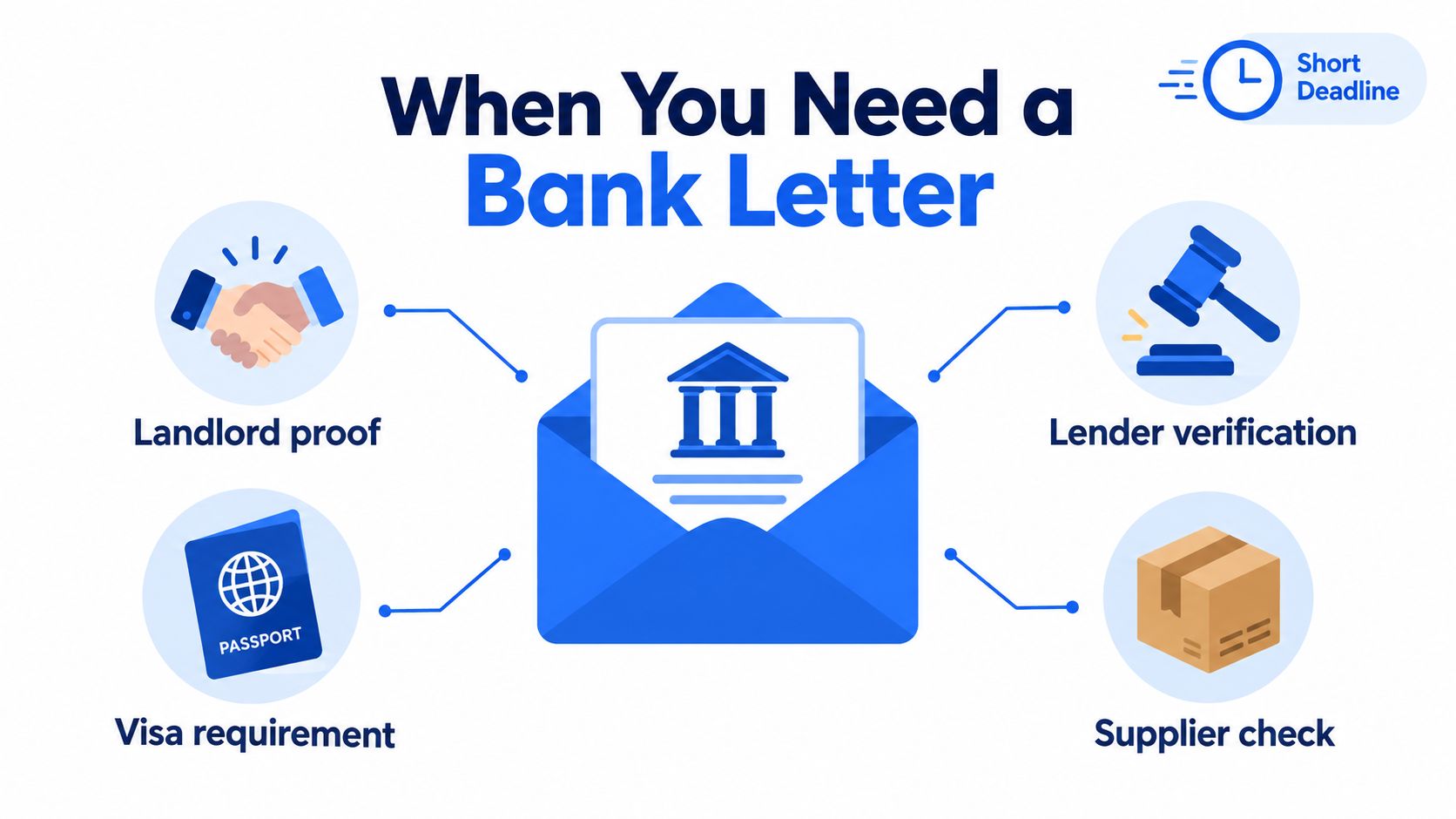
The request often appears just before a deadline. A finance team may be assembling loan documents, a business owner may be completing supplier onboarding, or an immigration applicant may learn that a downloaded statement will not satisfy the file. In each case, a bank letter confirming account provides an institutional attestation tied to the bank's records, rather than a running transaction history.
Common uses include visa and immigration applications, loan underwriting, rental applications, supplier onboarding, proof-of-funds requests, and audits. Depending on the request, the letter may confirm the banking relationship, account ownership, account status, or balance on a specified date. It usually does not authorize withdrawals, debits, or transfers, and it does not create a payment guarantee.
A bank-issued document carries more weight than a customer-created letter because the institution makes the assertion. That difference matters when an auditor, lender, landlord, or caseworker needs evidence independent of the applicant's own preparation. It also gives the recipient something concrete to validate against the account holder's records.
Why the issue date matters
A confirmation is point-in-time evidence. Ownership, status, balance, and withdrawal availability can change after issuance, so the recipient must decide whether the date fits the purpose. Organizations often ask for a confirmation issued within the previous 30 to 90 days, since older information may not reflect the current relationship or available funds.
A bank letter also differs from a mortgage-related verification document. Where property finance is under review, the lender may require separate evidence described in the mortgage verification guidance.
The controlled process is straightforward: define the precise assertion, request the document, validate its source and contents, then reconcile any stated balance to the underlying statement. That final comparison is what tests whether the letter's figure agrees with the account record.
What a Bank Confirmation Letter Must Contain
A useful bank confirmation letter identifies the relationship clearly enough for a third party to verify it. At minimum, we expect the account holder's legal name, the bank's name, relevant branch or institutional details, the account type, account status, routing or sort-code information where applicable, and either the full or partially masked account number.
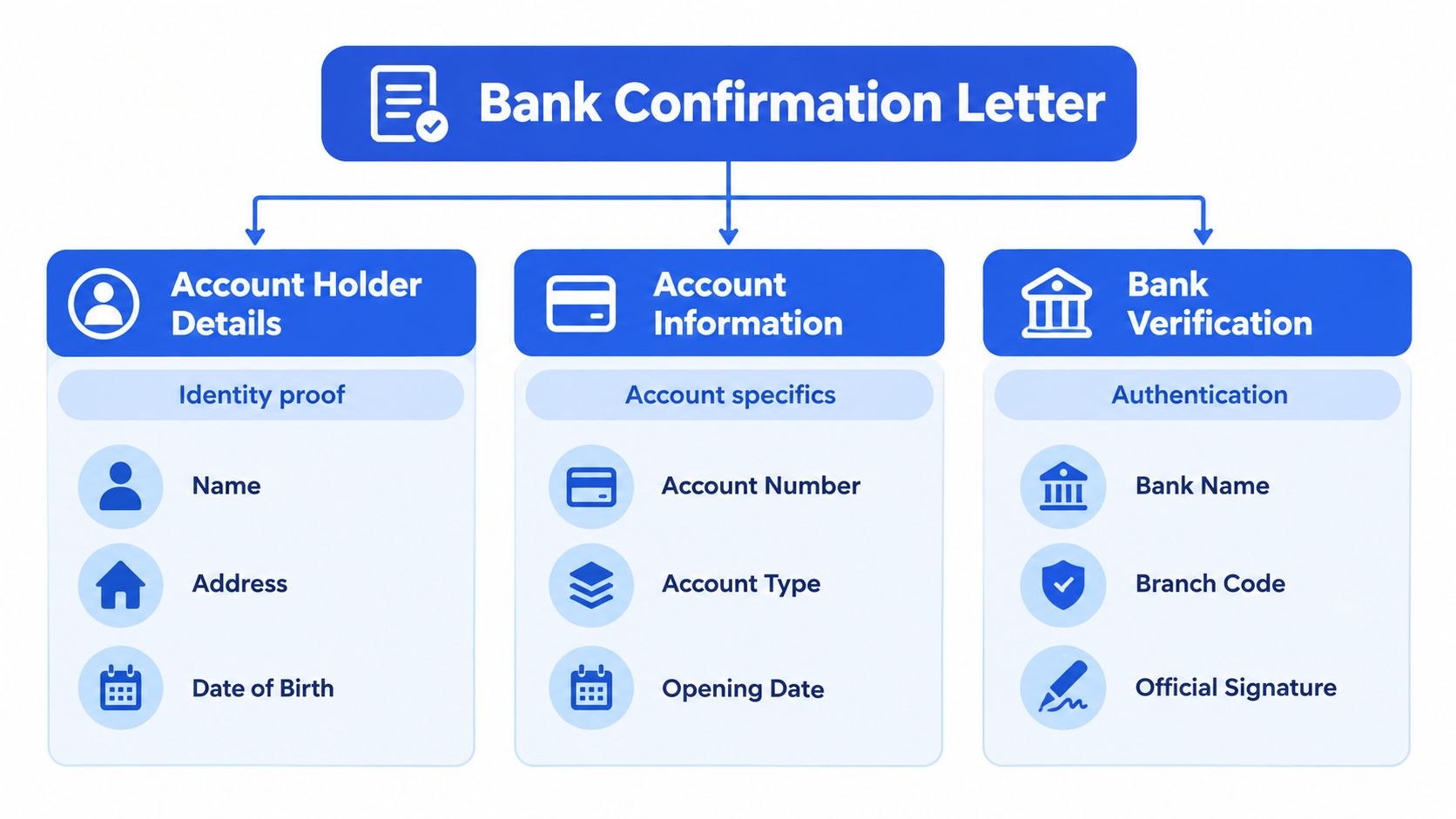
The bank may also state a balance on a specified date, an average balance over a period, the account-opening date, or whether funds are available for a defined transaction. Those additions matter because “the account is active” confirms a relationship but doesn't necessarily confirm liquidity, ownership by a particular legal entity, or funds available for a particular purpose.
The fields recipients actually use
A recipient should be able to answer several questions from the document:
- Who owns the account? The legal name must match the application, contract, audit file, or internal customer record.
- Which account is being confirmed? The account type, number, routing details, and relationship date should identify the correct facility.
- What fact is the bank confirming? The letter should distinguish account existence, ownership, balance, available funds, or another specific assertion.
- When was that fact true? The issue date and any separate balance date define the evidence period.
- Can the institution be contacted independently? Official contact details, an authorized signature, or digital authentication give the recipient a path to verify the document.
For example, “We confirm that Northfield Trading Ltd maintains an active account with us” may establish a relationship. It doesn't establish the account balance, currency, opening date, or availability of funds. A stronger letter names the legal entity, identifies the account, states the requested balance and currency as of a named date, identifies the recipient or purpose, and includes bank contact information and authorized authentication.
Practical rule: A generic account-status sentence is rarely enough for a high-assurance decision. Request the exact fact the recipient needs.
A bank confirmation letter also shouldn't be confused with identity verification. Customer-identification rules require financial institutions to collect identifying information before opening an account or adding a signatory, but a generic confirmation letter isn't automatically equivalent to an independently verified identity record. The FDIC discussion of customer-identification requirements explains why account relationship evidence and identity evidence should be treated as separate controls.
How to Request the Letter from Your Bank
A vague request can leave you with a letter that confirms only an account relationship. Before contacting the bank, identify the exact assertion the recipient needs: account existence, ownership, current balance, available funds, overdraft exposure, or account-opening date. The bank should not have to infer the requirement.
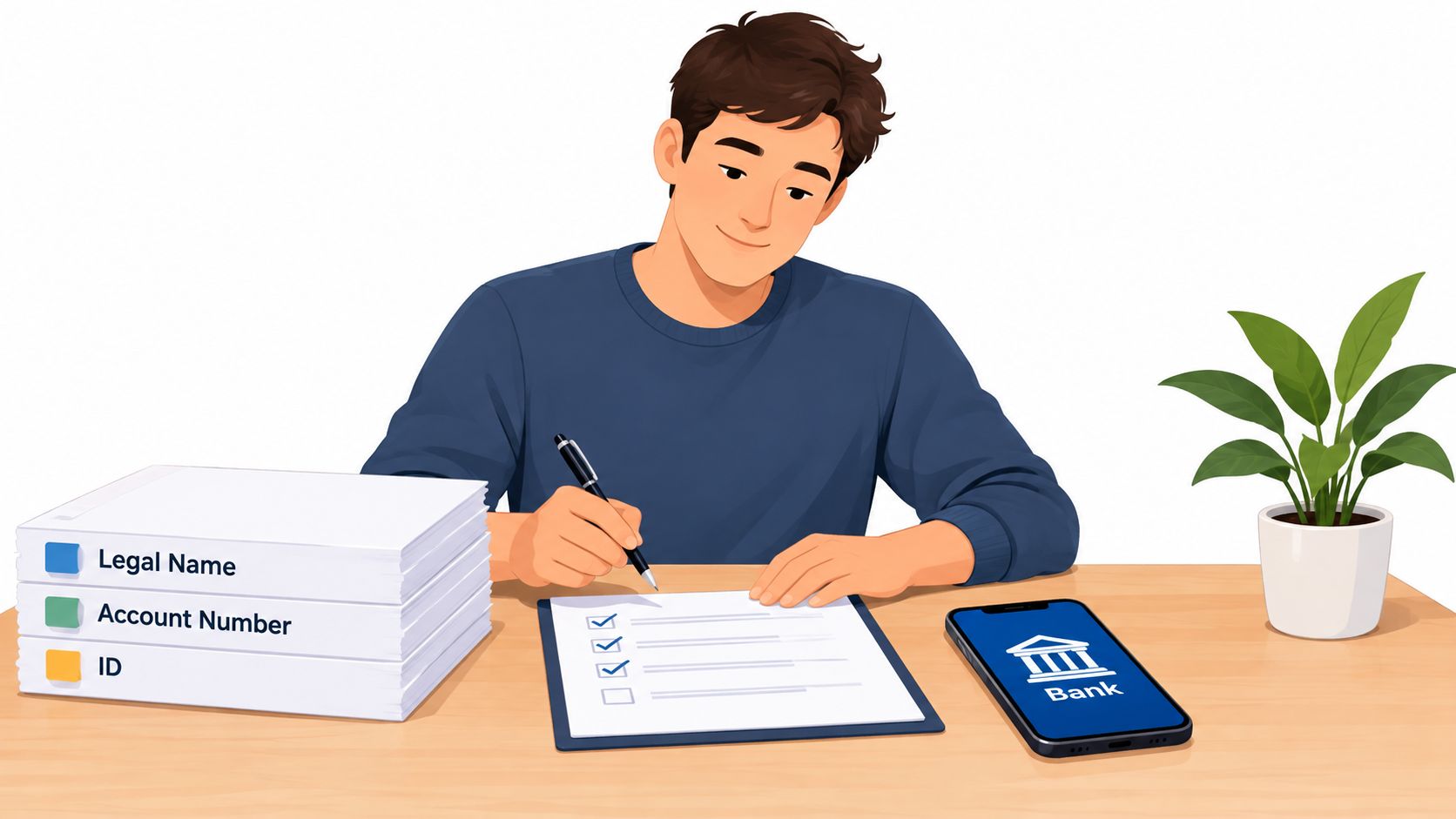
Prepare these details before submitting the request:
- Legal account name: Use the name recorded by the bank, including the registered business name.
- Account identifier: Provide the account number or an approved reference through a secure channel.
- Recipient details: State the recipient's legal name, address, and any required reference.
- Required fields: Specify the balance date, currency, account status, relationship date, and any other requested assertion.
- Authority documents: Have identification, authorization forms, and any third-party release ready.
Choose the channel carefully
Each institution sets its own process. A bank may accept a request through online banking or secure messaging, while another may require a branch visit, identification, written authorization, or a processing fee. Use a phone call to clarify the procedure, then obtain the final confirmation through a bank-controlled channel or as an official document.
Certification letters commonly cost about $10 to $50, with estimated processing of roughly 2 to 5 business days. Fees and timing vary by institution and jurisdiction, so confirm both before setting a deadline.
Ask how the bank will deliver the letter and whether it can send it directly to the requesting organization. Direct delivery gives the recipient a stronger chain of custody than an applicant forwarding an editable file. If consent is required before account information can be released, provide a written authorization naming the recipient and limiting disclosure to the fields requested.
The request should also identify the controlling date. A balance confirmed today may not answer a question about a transaction date, audit period, or closing date. Record the date and purpose in the instruction sent to the bank.
Sample Request Text You Can Adapt
The following examples work because they state the assertion, recipient, fields, delivery method, and deadline. Replace the bracketed details with the information relevant to the account and the receiving organization.
Balance confirmation request
Dear [Bank or Relationship Manager],
Please issue a bank confirmation letter for [legal account-holder name], account ending [last digits], addressed to [recipient's legal name and address]. The recipient requires confirmation that the account was held by [legal account-holder name] and that the balance was [amount and currency] as of [specified date]. Please include the account type, account status, account-opening or relationship date if available, the bank's independent contact details, and the name and authentication of an authorized representative.
Please deliver the letter through [secure message, direct email to the named recipient, branch collection, or another approved channel] by [deadline]. We authorize the bank to release these stated details to [recipient]. Our signature and identification documents are available through the bank's required process.
This wording separates the balance assertion from the general account relationship. It also tells the bank which date controls the balance. Without that date, the recipient may not know whether the figure relates to the application, closing, audit period, or another event.
Relationship confirmation request
Dear [Bank or Relationship Manager],
Please issue a bank confirmation letter for [legal account-holder name], account ending [last digits], addressed to [recipient's legal name and address]. The letter should confirm that [legal account-holder name] holds the account, identify the account type and status, state the account-opening or relationship date if available, and include the bank's official contact details and authorized authentication. This request is for [supplier onboarding, immigration application, rental application, or other purpose].
Please send the confirmation through [secure bank channel or direct delivery] by [deadline]. We authorize disclosure of these limited account details to [recipient] and will provide any required ID copy, authorization form, or signature.
A relationship letter shouldn't be presented as proof of funds unless it states the balance or availability assertion. Defining the requested fact at the outset prevents a second request and limits unnecessary disclosure.
How Recipients Should Validate the Letter
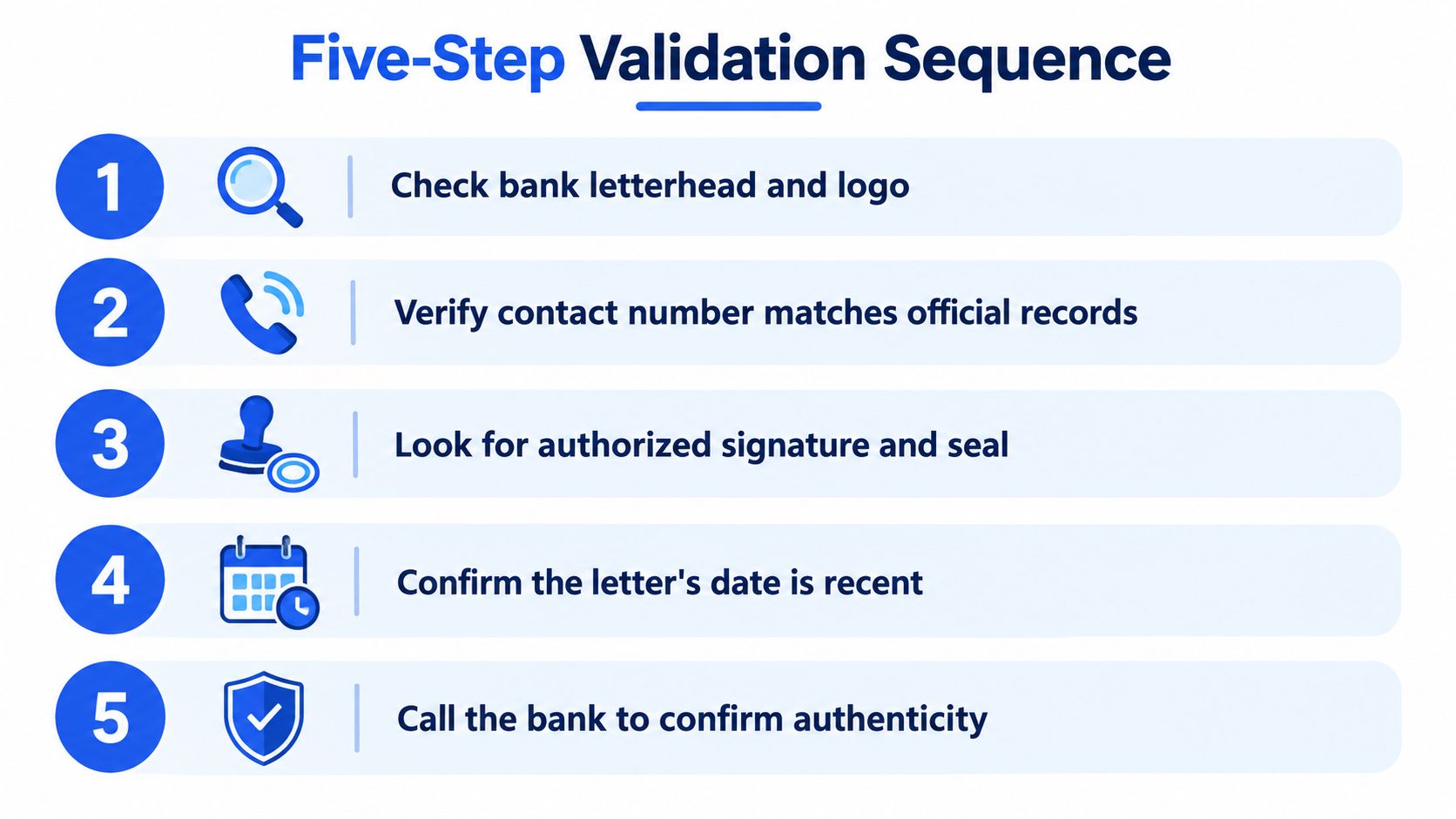
Recipients should treat a bank letter confirming account as a controlled verification artifact, not as a balance printout. The validation sequence should test both what the document says and whether the bank stands behind it.
The five checks
Inspect the source. Require official bank stationery or an authenticated electronic record. Look for the institution's name, address, identifying reference, issue date, and authorized signature or digital authentication.
Match the account. Compare the legal account-holder name and account number, including masked digits where applicable, with the records held by the requesting organization. A small naming difference may reflect a trading name, joint ownership, or an entirely different account, so don't resolve it by assumption.
Read the assertion. Confirm whether the letter states account existence, ownership, status, balance, currency, available funds, relationship date, or another defined fact. Check the issue date and any balance date. The UK government financial-requirement guidance notes that bank evidence should contain information comparable to a bank record and may need escalation when it lacks headed paper, an official signature, or verifiable contact information.
Verify contact details independently. Use the bank's published website, secure directory, or known relationship channel. Don't rely solely on a phone number or email address printed in an applicant-supplied PDF.
Obtain direct confirmation for high-risk decisions. For audits, lending, immigration, and compliance matters, obtain written confirmation directly from an authorized bank representative. An oral response alone isn't sufficient audit evidence, and an ordinary forwarded email may not establish the sender's identity or authority.
Escalation triggers
Set the document aside for follow-up if it is unsigned, contains a stale balance, uses unexplained abbreviations, has mismatched names, provides an unverifiable phone number, or arrives only as a PDF supplied by the applicant. A confirmation that looks professional can still verify the wrong account or report information that has since changed.
A recipient handling sensitive financial evidence should also limit the data requested and avoid exposing unnecessary account numbers or transaction details. The guidance on bank statements as proof of income is useful when the confirmation must be considered alongside broader financial records.
Reconciling the Stated Balance to the Underlying Statement
A balance in the letter is an assertion. The underlying statement provides the movement needed to test whether that assertion ties to the account record. We don't stop at matching the closing figure, particularly when the letter and statement have different dates or when transactions were extracted from a PDF.
The core check is:
Opening balance + credits − debits = closing balance
The finance team should match deposits and other credits, withdrawals and payments, interest, and bank fees against the accounting record. Differences may result from an omitted transaction, duplicate entry, timing item, fee, foreign-exchange conversion, pending transaction, or extraction error. A stated closing balance that doesn't tie to the transaction movement is a red flag, not a rounding issue.
Reconciliation Check on a Stated Balance
| Component | Source | Value |
|---|---|---|
| Opening balance | Bank statement at the start of the selected period | [enter statement value] |
| Credits | Deposits, receipts, interest, and other credits | [enter reconciled total] |
| Debits | Payments, withdrawals, fees, and other debits | [enter reconciled total] |
| Calculated closing balance | Opening balance + credits − debits | [calculate] |
| Confirmed closing balance | Bank letter or statement at the relevant date | [enter stated value] |
| Difference | Calculated closing balance − confirmed closing balance | [investigate if not zero] |
If the source statement is a PDF, a spreadsheet conversion can make the testing process faster, but the converted table is a working copy, not the authoritative record. Preserve the original bank letter, original statement, relevant metadata, and evidence of validation under the organization's retention policy. IRS electronic-record guidance explains the importance of retaining electronic records and validation documentation for the applicable retention period, including the records and metadata associated with digitized material.
For older or closed accounts, the retrieval problem may come before the arithmetic. Teams can use this practical guide on obtaining bank statements from a closed account, then document how the statement was obtained and how its dates relate to the confirmation.
Best Practices for a Defensible Confirmation Process
A defensible process begins before the request reaches the bank. Define the exact assertion, identify the recipient, restrict the fields to what the decision requires, and select a bank-controlled route for the request and response. “Confirm the account” isn't a sufficient control objective if the underlying question concerns ownership, a historical balance, withdrawal restrictions, or facility exposure.
Controls that withstand review
Preserve the original electronic response, request date, metadata, reference number, and authentication evidence. Don't rely on a forwarded email, a screenshot, or an editable document when the response supports a material decision. Electronic confirmation guidance also emphasizes respondent authority, independence from the account holder's preparation process, and the need to evaluate whether the response is relevant and reliable.
Reconcile any confirmed balance to the statement and ledger. Investigate timing differences, foreign-exchange conversion, pending transactions, restrictions, and unexplained differences rather than forcing the numbers to agree. If the response is ambiguous, inconsistent, suspicious, or clearly incorrect, document the exception and perform a second procedure, such as direct contact with the bank or review of independently obtained statements.
Authenticity and privacy belong in the same workflow. Fraud risk makes the verification path more important than letterhead alone. England and Wales recorded an estimated 4.2 million fraud incidents in the year ending March 2025, up 31% year over year, while bank and credit-account fraud rose about 30% to approximately 2.4 million incidents, according to the Bank of China guidance and related fraud-control context. The recipient should confirm through the institution's published contact channel, limit disclosed fields, and treat uploaded statements as sensitive temporary data.
A checklist for this week
- Define the assertion: State whether the request concerns existence, ownership, balance, currency, availability, or another fact.
- Control the channel: Request and receive the response through a bank-controlled or authenticated route.
- Preserve originals: Retain the original letter, statement, metadata, and validation evidence.
- Reconcile balances: Test opening balance + credits − debits = closing balance.
- Record exceptions: Document mismatches and the second procedure used to resolve them.
- Protect personal data: Mask unnecessary account details and delete temporary working files according to policy.
This approach turns a bank letter from a rubber stamp into evidence that another reviewer can understand, reproduce, and challenge.
autobankstatement converts digital, scanned via OCR, and password-protected PDF bank statements into CSV or Excel/XLSX files, with bulk upload support for files up to 25 MB. Try the free guest preview before payment, or use a registered account with 24-hour download access, with uploads automatically deleted within 24 hours. Visit autobankstatement to prepare statement data for the reconciliation checks described above.
Convert your next statement in minutes
Upload a bank statement PDF — digital, scanned, or password-protected — preview the extracted table, and download clean CSV or Excel.