
What Is a Verification of Mortgage Explained
Learn what is a verification of mortgage, why underwriters require it, and how finance teams reconcile VOM data with bank statements for loan processing.
A Verification of Mortgage, or VOM, is a lender- or servicer-issued document that confirms a borrower's existing housing obligation and payment history, especially when a standard credit report lacks sufficient detail. It validates an existing mortgage account, not the borrower's income, assets, or approval for a new loan.
The popular advice that “the credit report is enough” breaks down in real processing work. A trade line may confirm that a mortgage exists, but it might not give the underwriter a complete, source-confirmed record of payments, delinquencies, balances, or recent servicing changes. When a file contains missing months, an account that automated underwriting didn't evaluate, or a housing payment that needs direct confirmation, the VOM becomes an important control document.
For accountants, bookkeepers, and finance teams, the practical question isn't only what is a verification of mortgage. It's whether the document agrees with the borrower's transaction-level records and whether the file preserves reliable evidence for underwriting. A clean reconciliation can clear a condition quickly. A missing payment history or unexplained balance difference can send the file back for an addendum.
Table of Contents
- Defining the Verification of Mortgage and Its Purpose
- Key Components Included in the Document
- When Lenders Require Mortgage Verification
- Reconciling Verification Data with Bank Statements
- Common Misconceptions About Mortgage Verification
- Next Steps for Finance and Processing Teams
Defining the Verification of Mortgage and Its Purpose
A VOM confirms the history of an existing mortgage through information supplied by the lender or mortgage servicer. It typically identifies the account, original loan amount, current balance, payment amount, loan status, and payment performance. The borrower usually authorizes the release, but the requesting lender should receive the verification from the authorized source rather than treating a borrower-created document as equivalent evidence. Mortgage servicing guidance on verification of mortgage describes the document's role when a standard credit report doesn't provide enough detail.
That distinction matters because a VOM answers a narrow question: How has this existing housing debt been maintained? It doesn't answer whether the applicant earns enough, has sufficient assets, owns the property free and clear, or qualifies for a new mortgage. Those questions require separate documentation and analysis.
Practical rule: Treat the VOM as evidence about one liability, not as a summary of the entire borrower profile.
The document becomes especially relevant during a refinance, a purchase of another property, or an application where the underwriter needs a more complete housing-payment record. It can also help when an existing mortgage is absent from the credit report, wasn't evaluated by an automated underwriting system, or contains details that require confirmation from the servicer.
The same evidence discipline applies when finance teams review bank records for income or cash-flow support. A bank statement used as proof of income can show deposits and account activity, but it doesn't replace the servicer's official account verification. Each document has a defined purpose, and combining them without understanding those boundaries creates avoidable conditions.
The right mental model is layered underwriting. Lenders independently verify employment, income, assets, debts, credit history, and property information. The VOM strengthens the debt and payment-history portion of that file, particularly when the credit report leaves an evidentiary gap.
Key Components Included in the Document
A VOM is only useful when the receiving team can identify the account, understand its current position, and evaluate the payment record. Missing fields often create more work than a missing document because the processor must determine whether to request a corrected form, a supplement, or additional supporting evidence.
Account and property identifiers
Start with the fields that tie the verification to the correct obligation:
- Borrower identity: The name should match the loan application and other underwriting records.
- Property information: The property address should correspond with the housing debt being evaluated.
- Loan account: The account identifier should be traceable to the servicer's records.
- Original loan amount: This establishes the initial obligation reported by the servicer.
- Current unpaid balance: The balance should be compared with the latest mortgage statement, while allowing for posting dates and servicing activity.
- Payment amount: Record the required payment and determine whether the amount includes escrow or other components.
- Loan status: Look for current, delinquent, paid, modified, deferred, or otherwise qualified status.
- Payment history: Confirm the reporting period, due dates, payments received, and delinquency information.
The payment-history field deserves the closest review. HUD guidance says FHA manual underwriters evaluate housing payment history before installment and revolving debt, and an acceptable pattern generally involves on-time housing and installment payments during the prior 12 months, with no more than two 30-day late payments during the prior 24 months. HUD's FHA credit-history policy also makes clear that the underwriter must consider the broader pattern and the reason for any delinquency.
What makes the history usable
A processor shouldn't accept a form merely because it has a balance and payment amount. The document should show enough history for the applicable program, identify the source, and allow comparison with the credit report and borrower-provided statements.
HUD's guidance specifically flags a VOM that lacks payment history when the credit report also lacks it. That's why a form showing only “account current” may fail the actual underwriting purpose. We need to know whether payments were made as agreed, whether months are missing, and whether recent forbearance, modification, deferment, or late activity changes the risk analysis.
For conventional files, the VOM remains supporting evidence within the broader application package. Fannie Mae's application package guidance distinguishes supporting documentation from the signed and dated Uniform Residential Loan Application, Form 1003, and other required records. A VOM doesn't replace those items.
For teams that organize account records, a statement of accounts explanation can help clarify how balances and transaction histories should be classified, but the servicer's verification remains the authoritative mortgage-specific source.
When Lenders Require Mortgage Verification
A VOM isn't automatically required in every mortgage file. The request usually appears when the lender needs direct evidence of an existing housing obligation or when the available credit data doesn't provide enough detail for the applicable underwriting method.
FHA files provide a clear operational trigger. FHA lenders must verify and document the borrower's previous 12 months of housing history. Acceptable evidence can include a VOM obtained directly from the mortgage servicer, a credit-report supplement, the note with bank statements, or canceled checks. HUD's guidance on rent and mortgage verification explains why the VOM is often selected when the credit report doesn't establish the required history.
The request commonly arises in these situations:
- Refinancing an existing mortgage: The lender needs to confirm the current obligation, payment status, and performance before evaluating the replacement loan.
- Buying another property: The existing mortgage becomes a recurring debt that affects affordability and must be documented accurately.
- Incomplete credit reporting: A mortgage may be absent, recently transferred, reported with limited detail, or excluded from automated evaluation.
- Manual underwriting: The underwriter may need source-confirmed housing history to assess payment behavior rather than relying on a score or summary trade line.
- File discrepancies: The application, credit report, mortgage statement, and bank activity may show different balances or payment amounts.
The broader evidence framework checks both ability to pay and observed performance. FHA guidance focuses on housing history because recurring payment behavior provides direct context for credit risk. Conventional files follow their own program rules, but the same processing principle applies: document the liability, verify the source, and resolve conflicts before the underwriter relies on the record.
Employment and income evidence follows its own timing requirements. FHA guidance requires verification of employment history for the previous 2 years, while Fannie Mae generally requires verbal employment verification no more than 10 business days before or on the note date when qualifying income depends on employment or self-employment. Fannie Mae's verbal employment verification guidance shows how underwriting uses separate, current evidence for separate risk categories. A VOM fits into that layered process. It doesn't replace employment or asset verification.
Reconciling Verification Data with Bank Statements
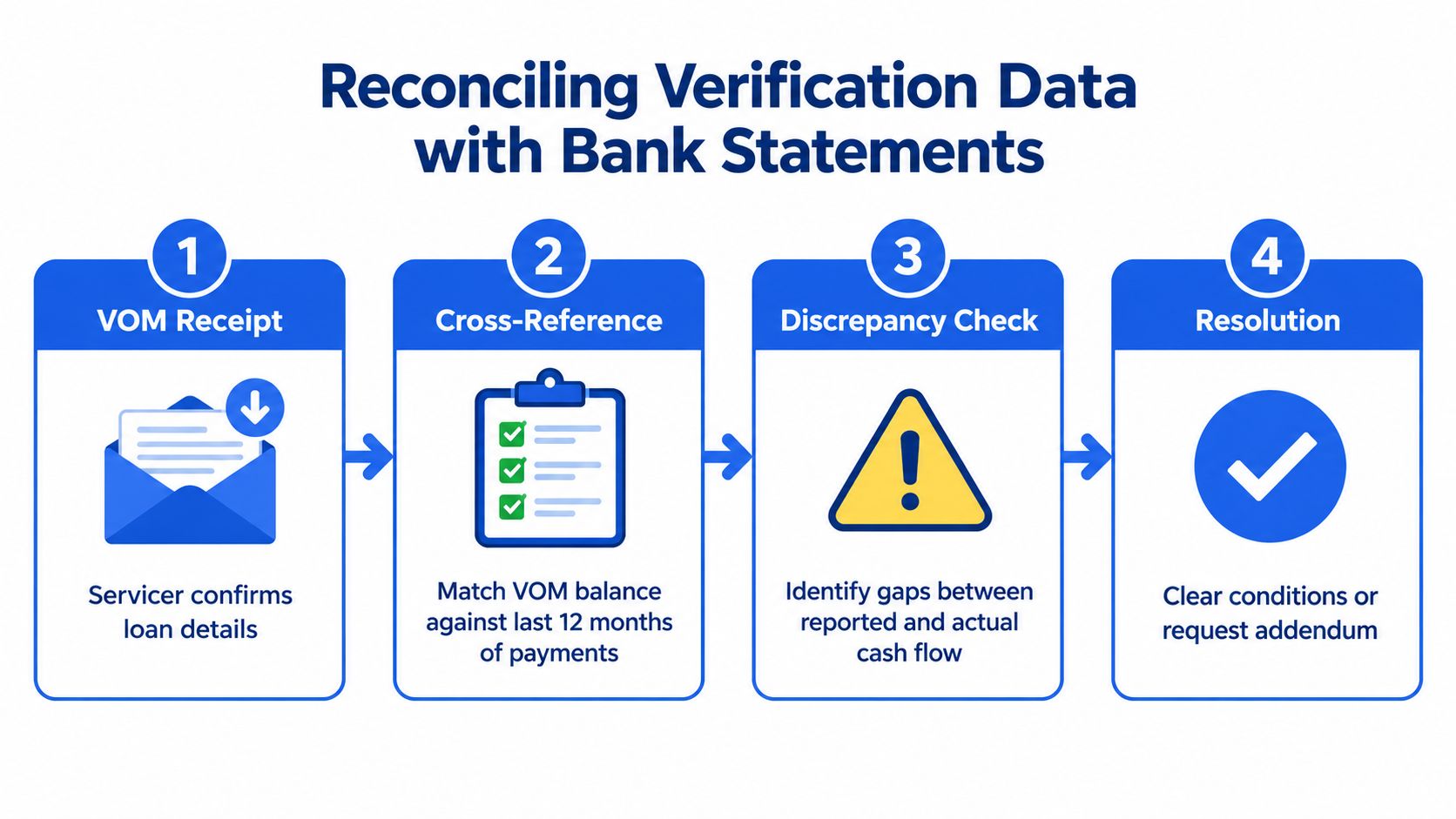
The VOM is the servicer's official account record. The bank statement shows what actually moved through the borrower's account. We need both when the file contains a condition, a mismatch, or a payment history that requires transaction-level support.
A useful reconciliation compares the VOM's reported payment and dates with mortgage debits in the relevant bank statements. The records may differ for legitimate reasons, including payment timing, escrow adjustments, fees, recently posted payments, or a servicing transfer. They may also differ because the borrower paid from another account, used an online bill-pay service, or provided an incomplete statement period.
The workflow should separate reported obligation from observed cash flow:
| Review point | VOM evidence | Bank-statement evidence |
|---|---|---|
| Required payment | Payment amount and terms | Mortgage debit or related payment transaction |
| Account status | Current, delinquent, modified, or deferred | Payment activity and posting dates |
| Balance | Current unpaid balance | Account activity that may explain changes |
| History | Servicer-reported payment ledger | Transaction-level debits and reversals |
| Exceptions | Missing months or unexplained status | Gaps, duplicate payments, returned items, or alternate payors |
Manual transcription from PDF statements is where many teams lose time. It's easy to mistype a date, omit a debit, confuse a credit with a payment reversal, or overlook a page. For a controlled review, structured extraction lets us filter mortgage-related transactions, inspect the surrounding account activity, and preserve the source file for follow-up.
When a team uses an extraction tool, the output still requires validation. We should verify:
opening balance + credits − debits = closing balance
That equation is a control check, not a substitute for judgment. A statement can balance mathematically while still containing a misclassified mortgage debit or an unexplained transfer.
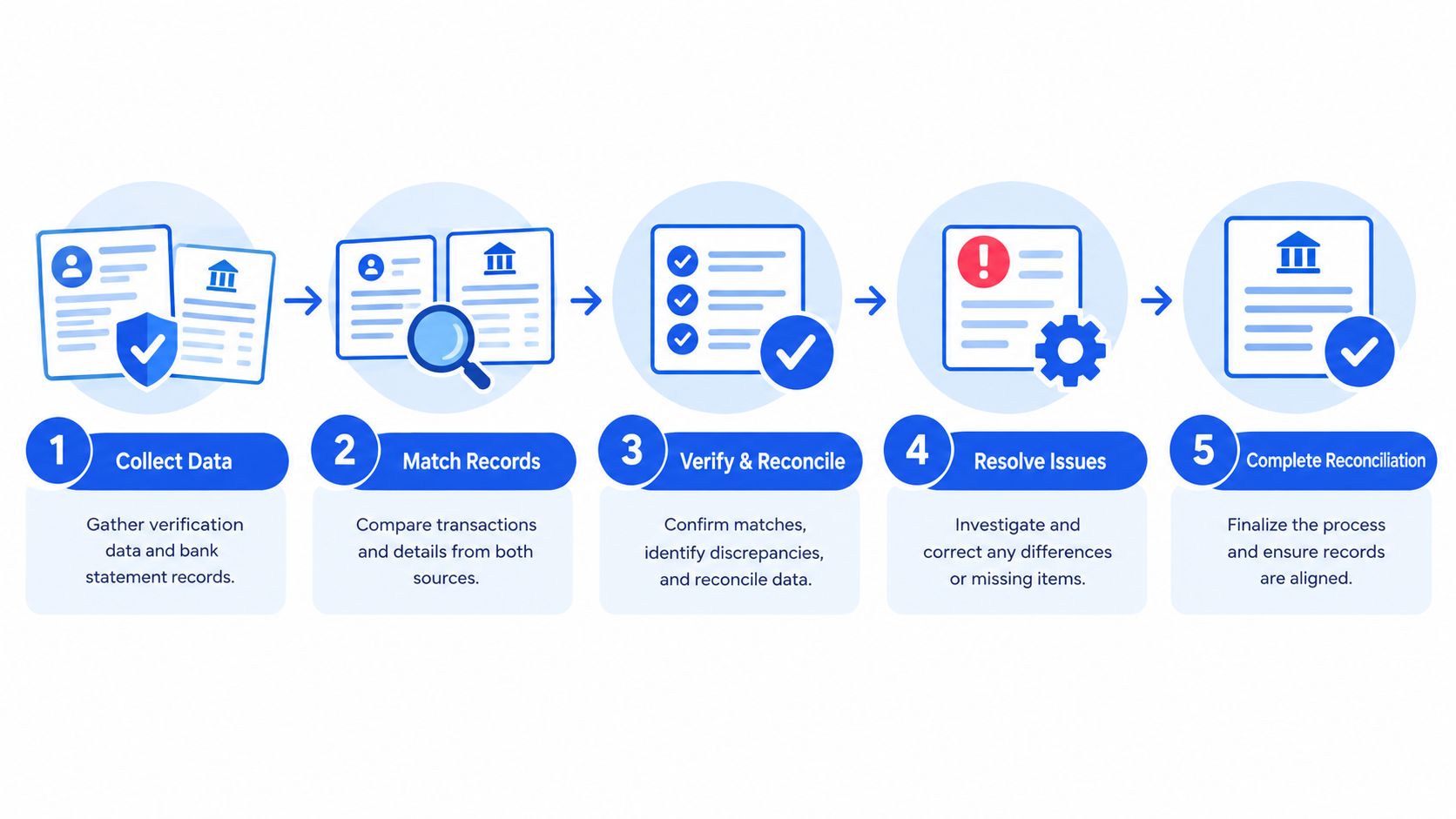
The practical sequence is straightforward:
- Collect: Obtain the VOM, latest mortgage statement, and relevant bank statements.
- Extract: Convert statement transactions into reviewable rows when manual entry would introduce avoidable risk.
- Match: Compare payment dates, amounts, account references, and periods.
- Investigate: Document timing differences, escrow changes, missed payments, reversals, and missing months.
- Resolve: Request a corrected VOM, servicer letter, payment confirmation, or borrower explanation when the records don't align.
Teams that need a repeatable control can use a documented bank statement reconciliation process that records the source period, reviewer, exceptions, and resolution. The goal isn't to force every number into identical columns. The goal is to explain every material difference before the file reaches underwriting.
Common Misconceptions About Mortgage Verification
The most damaging misconception is that a VOM is a form of approval. It isn't. A servicer can confirm that an account exists and report its payment performance, while the new lender can still decline the application or impose conditions after reviewing income, assets, credit, debt ratios, collateral, and other obligations.
A VOM also isn't a payoff statement. A payoff statement is designed to state what must be paid to satisfy the loan under specified terms and timing. A VOM documents the account and its history for underwriting. Those documents may contain related balance information, but they serve different decisions.
Nor does a VOM prove ownership of the property. It identifies the mortgage obligation associated with the borrower and property. Title evidence, public records, and other property documentation address ownership and collateral questions.
The four categories still apply
Freddie Mac describes four core underwriting components: capacity, capital, collateral, and credit. Freddie Mac's explanation of the four Cs places mortgage payment history primarily within credit, while the recurring payment also helps document an existing liability and housing expense.
That classification prevents teams from overusing the document:
- Capacity: Employment, income, and debt obligations determine the borrower's ability to repay.
- Capital: Account statements and verification-of-deposit records support funds for the down payment, closing costs, prepaid items, financing costs, and reserves.
- Collateral: Property value and condition require separate evidence.
- Credit: The VOM contributes direct information about mortgage payment performance.
A borrower-generated bank statement isn't a replacement for a servicer-issued verification when the lender requires direct-source confirmation. Fannie Mae's employment verification form illustrates the control principle. The applicant authorizes the release, the lender completes the request, and the verification returns directly from the employer. Mortgage verification follows the same basic concern with source integrity.
A VOM can confirm a debt without proving that the borrower can afford another one.
The same caution applies to variable income, self-employment, and multiple employers. Mortgage verification is becoming more multi-source and permission-based, but automated confirmation can't resolve every exception. Preserve official servicer records, payment confirmations, statements, and explanations instead of treating a “verified” label as a qualification decision.
Next Steps for Finance and Processing Teams
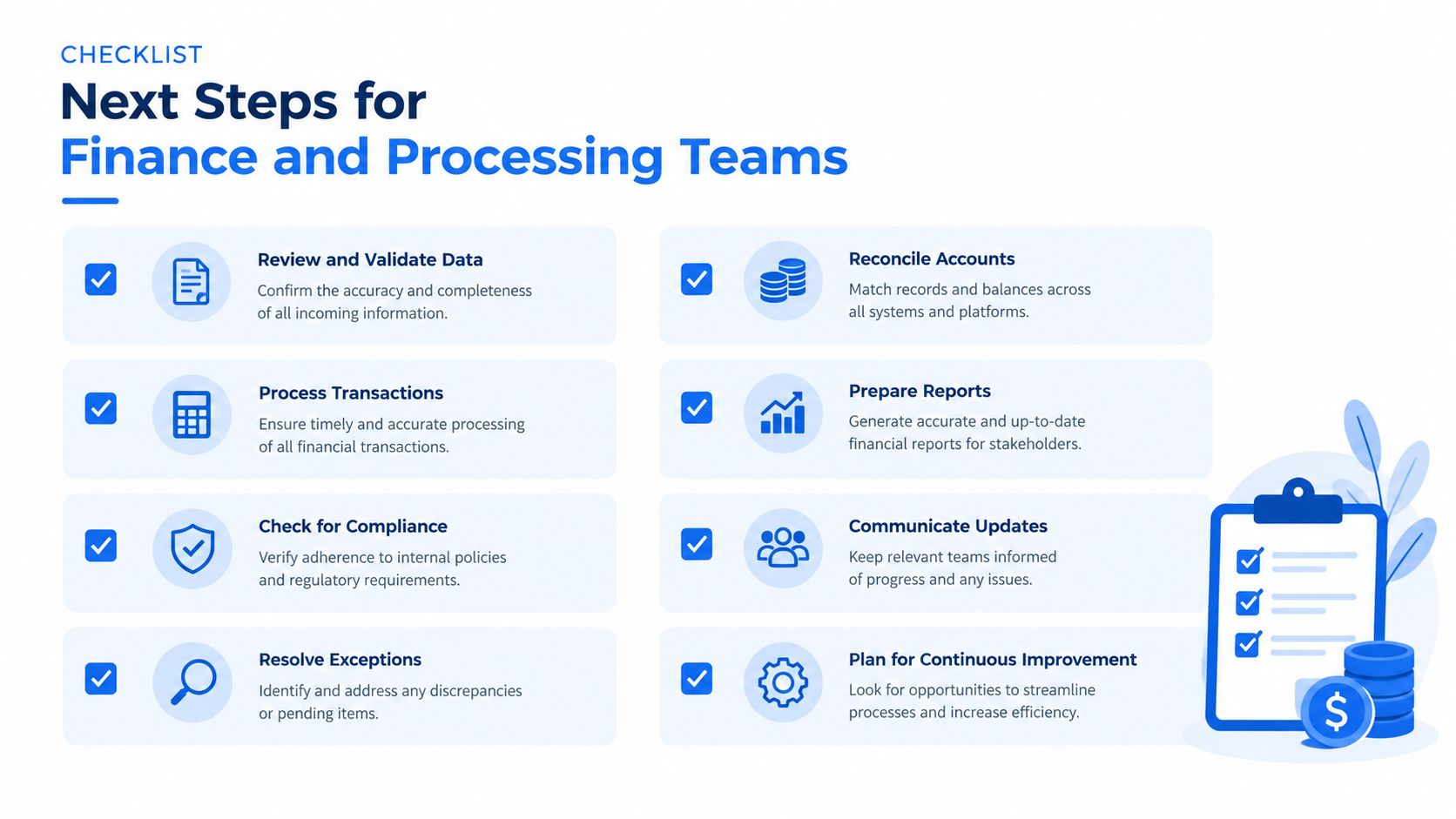
When a VOM arrives, we should process it like a controlled evidence item, not an attachment to skim and file. The following checklist keeps the review focused:
- Confirm the borrower and property. Match the name and property address to the application and supporting records.
- Log the account identifier. Record the loan number or other traceable reference without relying on an informal file name.
- Identify the issuing source. Confirm that the lender or servicer supplied the verification and note the delivery method.
- Review the issue date. Compare it with the lender's applicable freshness and re-verification requirements.
- Check the required fields. Look for original amount, current balance, payment amount, status, reporting period, and payment history.
- Compare the latest statement. Investigate balance or payment differences caused by timing, escrow, fees, modifications, or servicing changes.
- Reconcile transaction evidence. Match mortgage debits against bank statements and verify opening balance + credits − debits = closing balance when using transaction data.
- Preserve the relied-upon version. Store the exact VOM, reconciled statements, exception notes, and resolution documents used for the underwriting decision.
Timing deserves special attention because mortgage information can change between application, underwriting, and closing. Freddie Mac's pre-funding documentation checklist illustrates the broader control principle through employment re-verification close to the note date. The exact mortgage-document age rule depends on the lender and program, so we should confirm the applicable requirement rather than assume an old VOM remains sufficient.
A clean file makes the underwriter's job easier. It also gives the processing team a defensible trail showing what was received, what was compared, which discrepancies were found, and how each one was resolved.
For teams reconciling mortgage evidence, autobankstatement converts digital, scanned via OCR, and password-protected PDF bank statements into CSV or Excel/XLSX, with bulk uploads and files up to 25 MB. Use the free guest preview before payment, or choose a plan with 24-hour download access and automatic deletion of uploads within 24 hours, so we can move from statement PDFs to reviewable transaction data without manual copy-paste.
Convert your next statement in minutes
Upload a bank statement PDF — digital, scanned, or password-protected — preview the extracted table, and download clean CSV or Excel.