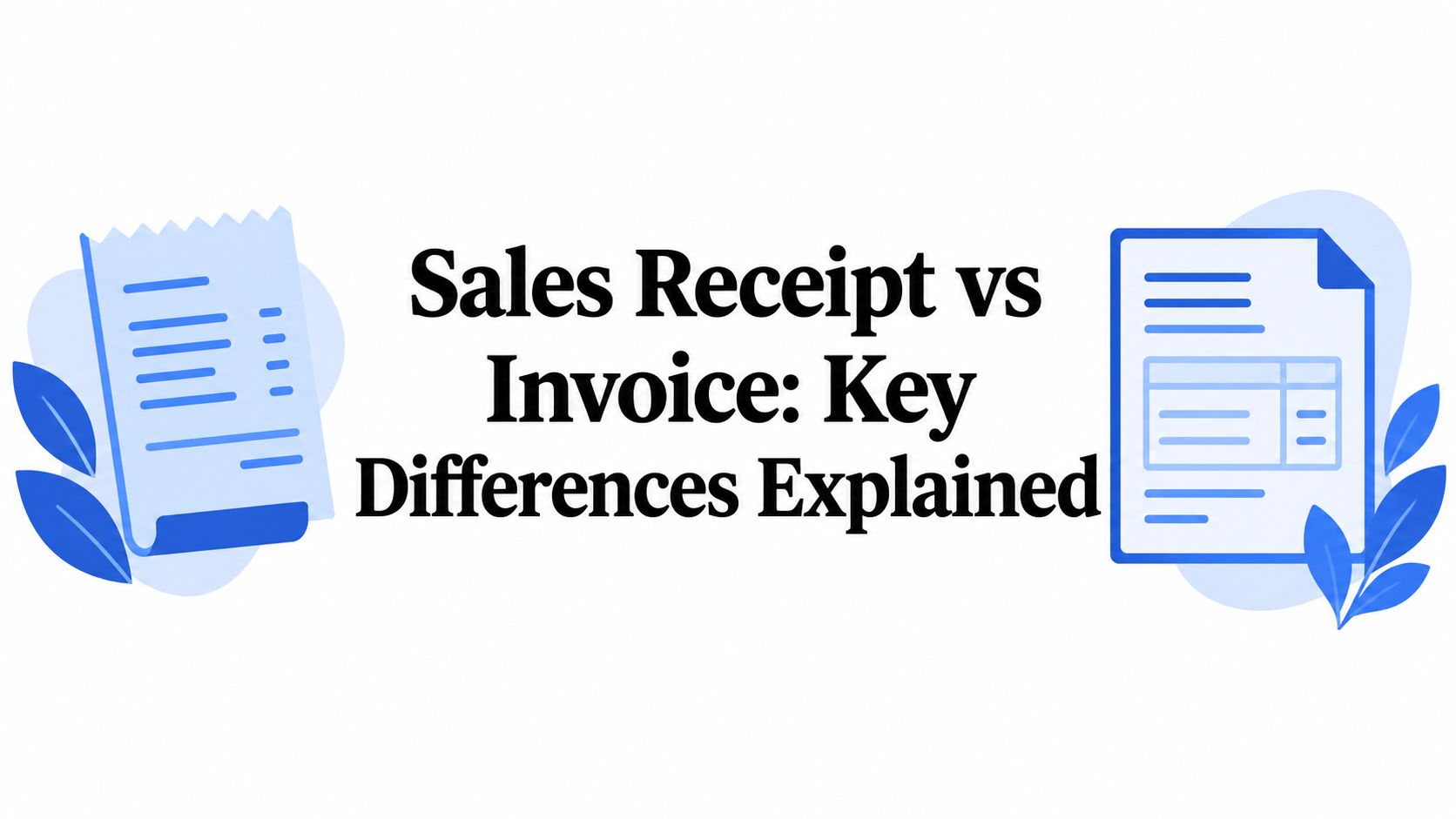
Sales Receipt vs Invoice: Key Differences Explained
Sales receipt vs invoice: learn the key differences, see real examples, and know when to use each document for your business.
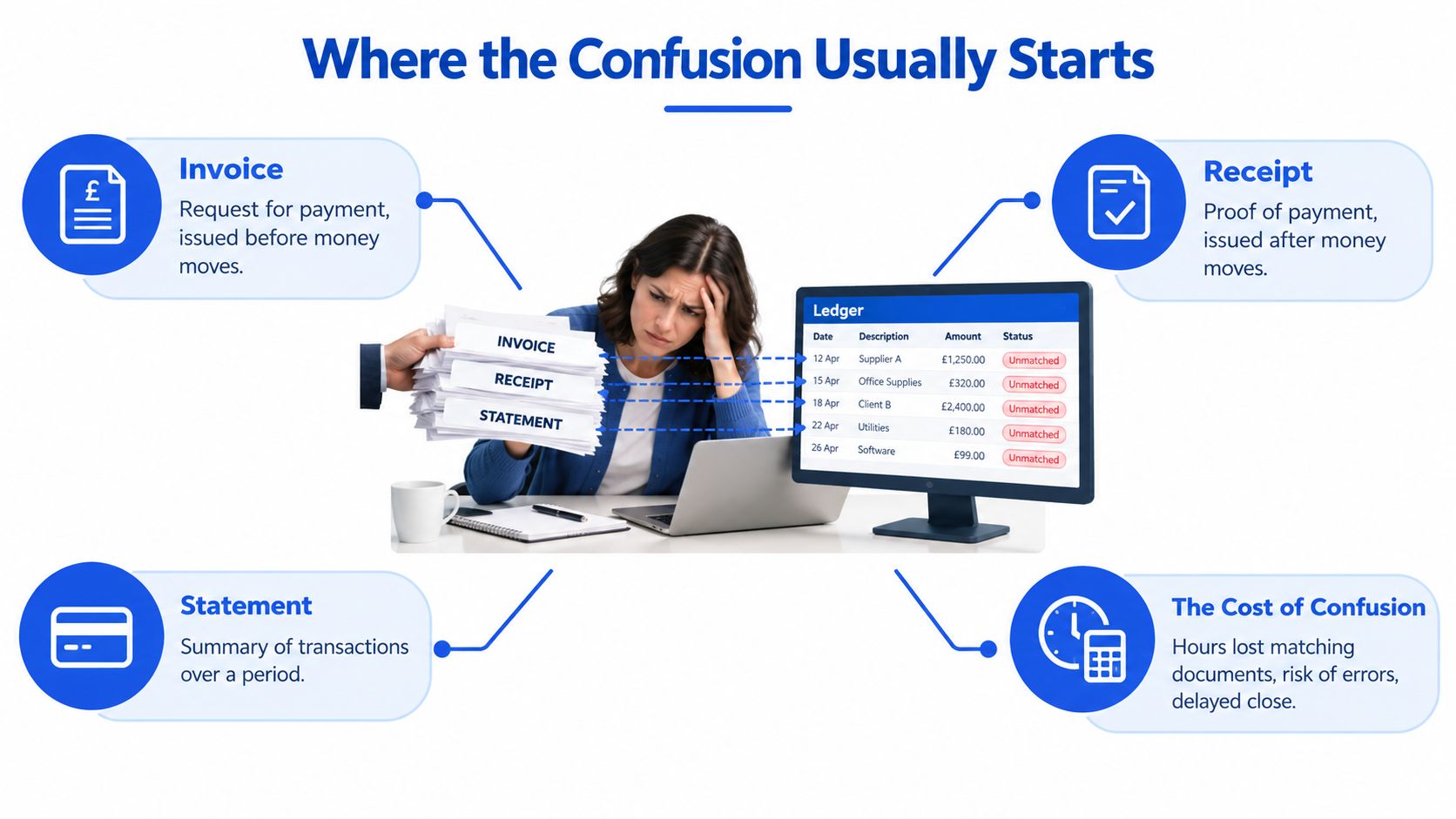
Month-end close has a way of turning simple paperwork into a mess. A bookkeeper opens a folder and sees three PDFs, one marked invoice, one marked receipt, one marked statement, then spends an hour trying to decide which file belongs to the open receivable, which one proves payment, and which one only shows that money moved.
That stall costs more than time. It delays the close, weakens the audit trail, and creates avoidable questions about tax treatment and settlement. The clean way to think about sales receipt vs invoice is not as a vocabulary test, but as an evidence map, each document proves a different part of the transaction, and the bank statement sits between them as payment corroboration, not as a substitute for the source record.
Table of Contents
- Where the Confusion Usually Starts
- What a Sales Receipt Actually Proves
- Side-by-Side at a Glance
- When Each Document Is the Right Choice
- The Legal and Tax Weight Behind the Labels
- How Invoices, Receipts, and Bank Statement Rows Line Up
- Why a Bank Statement Does Not Replace the Source Documents
- A Practical Document Choice Checklist for Month-End
Where the Confusion Usually Starts
The confusion usually starts at the exact moment a ledger row refuses to line up with the paperwork. A client sends a PDF invoice, the bank feed shows a card deposit, and someone files a receipt that looks close enough to the sale but doesn't clearly match the itemized charge. Then the bookkeeper has to decide whether the invoice is still open, whether the receipt settles it, or whether the bank line is only partial evidence.
Start with what an invoice proves
An invoice is the document that says what was sold, to whom, on what terms, and for what amount. It normally identifies the supplier and customer, itemizes the goods or services, sets the payment terms and due date, and carries tax treatment. In other words, it is a written claim for payment, not proof that payment happened.
That distinction matters in accounts receivable. Posting an invoice creates an open receivable because the sale has been recorded, but cash has not yet been settled. If we treat the invoice as cash evidence, we blur the line between obligation and collection, and the bank statement won't fix that by itself.
An invoice tells us what the customer owes. It does not, on its own, tell us that the money arrived.
A useful analogy is a signed promise, not a paid bill. The promise can be valid, detailed, and ready for collection, but it still needs settlement evidence before the receivable closes. That is why invoice matching is a bookkeeping control, not a label-reading exercise.
What the bookkeeper needs to know at close
By the time month-end lands, the question is simple: which document proves the obligation, which proves the settlement, and which only supports the movement of cash? Once we separate those roles, the reconciliation gets much easier. We stop asking whether a file is “the right one” and start asking what part of the evidence chain it completes.
For teams that receive converted bank PDFs, that chain matters even more. A clean statement row can support timing and amount, but it still has to sit beside the underlying invoice or receipt if we want a defensible close.
What a Sales Receipt Actually Proves
A sales receipt is the document that closes the transaction. It confirms that payment happened, and it usually identifies the seller, the buyer, the date, the item or service, the amount paid, and the payment method.
That makes the receipt the settlement record, not the request. An invoice asks for money. A receipt says the money arrived and the deal has moved out of pending status. For a cash sale at a counter, the receipt often does most of the work because the transaction is finished immediately. For deferred payment, it usually sits after the invoice in the file stack.
This date-of-receipt guide is useful when a team needs to decide which date controls filing or matching.
Why a receipt is stronger on payment than on terms
A receipt can be excellent proof that money changed hands, but it is weaker evidence of the commercial terms behind the sale. If the document doesn't clearly tie back to the underlying invoice, order, or service record, it may show payment without fully proving what was purchased or whether the amount was partial, refunded, or adjusted later.
That matters in disputes and reimbursements. A customer can use a receipt for returns or warranty claims, and a finance team can use it to support expense coding, but neither use case works well if the receipt can't be connected to the source transaction. The document has to tell a complete enough story for the control we're trying to satisfy.
Practical rule: if the receipt can't be linked to the underlying sale, it proves payment but only loosely explains the deal.
Receipt language also matters. A document that says “paid” without identifying the transaction, amount, and method is much less useful than one that shows the actual sale details. That's why a receipt is best treated as settlement evidence, not as a generic “proof of purchase” label.
Side-by-Side at a Glance
The quickest way to separate the two is to place them in the transaction lifecycle and ask what each one controls. The table below keeps the distinction practical.
| Criterion | Sales Receipt | Invoice |
|---|---|---|
| Moment in the transaction lifecycle | After payment, when the sale is settled | Before or during payment, when the amount is due |
| Primary purpose | Confirms payment | Requests payment and sets out the obligation |
| Legal weight | Evidence that cash was received | Commercial and tax document that can define what is owed |
| Tax significance | Supports settlement evidence | Often carries the tax details needed for compliance |
| What it proves on its own | That payment occurred | That a charge exists and is due |
| What it cannot prove well | The full commercial terms of the sale | That cash was actually collected |
| Typical role in bookkeeping | Closes the receivable or supports the cash sale | Opens or maintains the receivable |
For a more detailed framing of invoice structure, this invoice overview is a helpful companion. The key point stays the same, though. We use the invoice to establish the obligation, and we use the receipt to confirm settlement.
A bank row doesn't belong in either column. It sits beside them as a corroborating record, useful for timing and amount, but not enough by itself to explain the sale.
When Each Document Is the Right Choice
The choice usually follows the credit structure of the sale. B2B transactions and most deferred-payment customer sales need an invoice because the buyer owes money after the goods or services are provided. Point-of-sale and small cash transactions usually only need a receipt because payment and delivery happen together.
Standard cases that are easy to classify
If we issue work on account, send goods before payment, or bill a client later, the invoice is the right starting document. If we take payment at the counter, at delivery, or through an immediate card capture, the receipt may be all we need for the ordinary sale record. The deciding factor is whether the transaction creates a credit obligation or settles right away.
Gray areas that trip people up
Deposits are the first place teams get sloppy. A deposit receipt can prove that money arrived, but it may not settle the full amount owed if the invoice still has the balance open. Partial payments work the same way, the receipt or bank line may close part of the receivable while leaving the remainder outstanding.
Refunds and chargebacks need extra care because one receipt rarely tells the whole story. A bank statement may show the reversed cash movement, but it does not always explain the original sale or the business reason for the reversal. Foreign-currency card charges can also create gaps between the amount on the invoice and the amount on the statement, so the team needs both documents to understand the difference.
Recurring card charges and marketplace sales can be just as messy. A single payment line can cover several invoices, or a marketplace settlement can bundle multiple customer orders into one payout. In those cases, the label on the document matters less than whether it supports the later warranty, tax, or dispute review.
The Legal and Tax Weight Behind the Labels
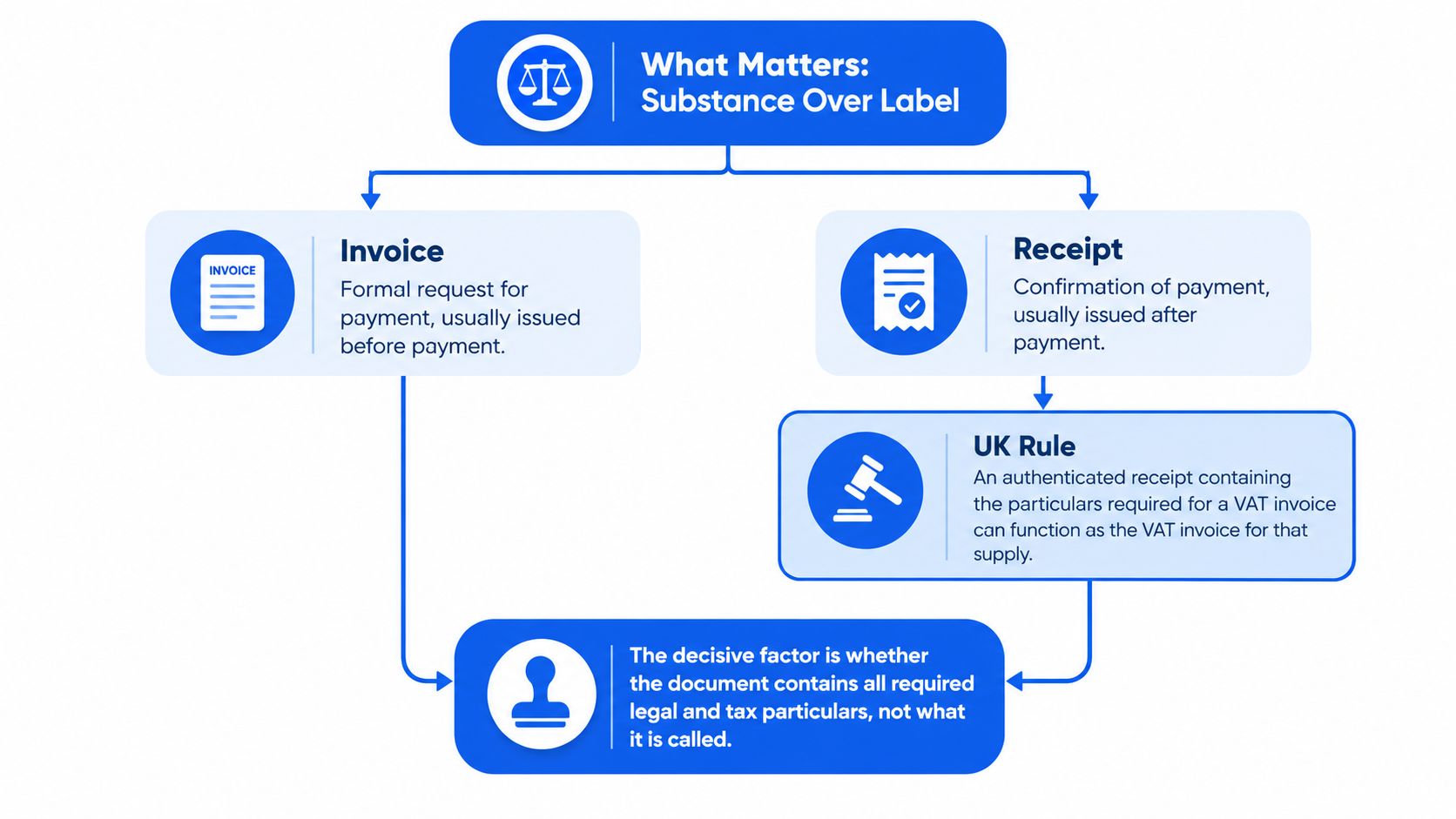
Labels matter less than the evidence inside the document. That's the point groups miss when they treat invoice and receipt as interchangeable names. Tax authorities look for the particulars that let them test the transaction, not just the heading on the PDF.
In the United States, the IRS treats invoices, sales slips, paid bills, receipts, deposit slips, and canceled checks as supporting documents, but the record still has to substantiate gross receipts and business expenses. For expense evidence, the record should identify the payee, amount, proof of payment, date incurred, and description of what was purchased, which is why a bank line alone is not enough for a clean file. The rule is practical, not theoretical, a document has to support the claim we're making about the transaction. IRS recordkeeping guidance
In the UK, HMRC says a business claiming input VAT must hold proper evidence, such as a compliant tax invoice or an approved less-detailed invoice for supplies of £250 or less. UK rules also allow an authenticated receipt with the required particulars to function as the VAT invoice for that supply, if another invoice isn't issued or intended to be treated as one. That means a receipt can sometimes do invoice work, but only when it contains the required tax details. HMRC VAT fraud manual
The EU is stricter in structure. A full VAT invoice generally needs the issue date, a unique sequential invoice number, the supplier's and customer's full names and addresses, the customer's VAT ID when relevant, the description and quantity of the goods or services, the unit price excluding tax, the payment or transaction date when different from the invoice date, the VAT rate, the VAT amount, and a VAT breakdown by rate or exemption. That list shows why an invoice is a tax document, not just a payment request. EU VAT invoicing rules
UK timing rules add another layer. The tax point decides which VAT period the transaction belongs to, and that can shift with invoice date, supply date, or early payment. So the label on the paperwork affects not only what we record, but when we record it for VAT. UK VAT recordkeeping guidance
Bottom line: if the document can't carry the required tax particulars, the label won't save it.
How Invoices, Receipts, and Bank Statement Rows Line Up
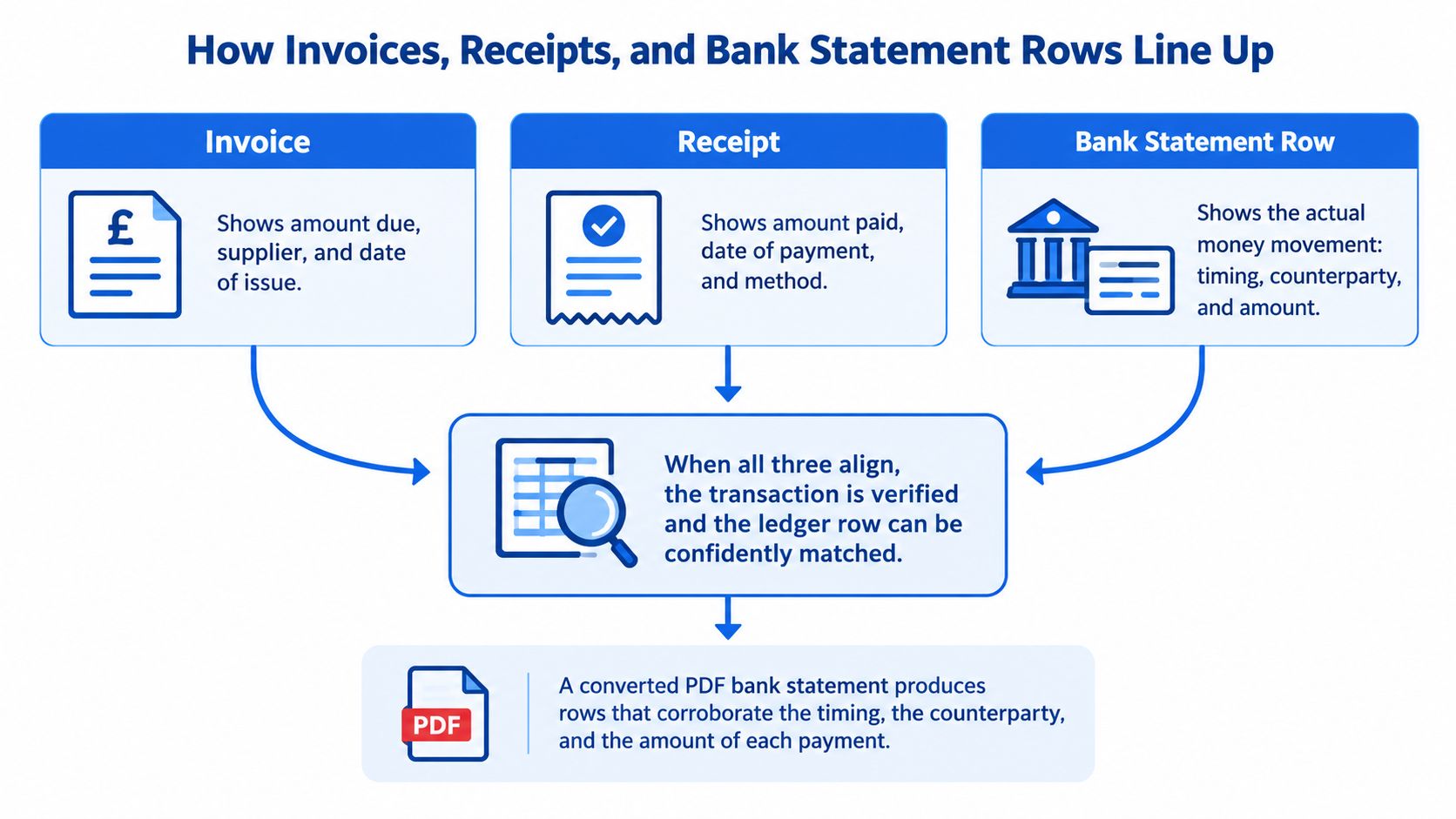
A converted PDF bank statement gives us a row-by-row view of money movement. It can corroborate the payment date, the counterparty, and the amount, but it usually can't independently establish the goods or services bought, the tax rate, the business purpose, or whether the amount was partly refunded. That's why the bank row belongs in the evidence chain, not at the center of it. Bank statement reconciliation guide
The clean match sequence
A practical match usually runs like this. The invoice creates the open receivable. The bank row confirms that money moved. The receipt or paid invoice closes the loop when the payment is received and filed against the original sale.
If the bank row appears first, such as with an advance payment or deposit, we still need the source documents to explain what that money was for. If the receipt appears without the invoice, we may know payment happened but still lack the commercial terms that support the ledger coding. If the invoice exists without payment evidence, the receivable stays open until settlement is clear.
What to verify before trusting the statement
Every converted statement should pass the simplest accuracy check first, opening balance plus credits minus debits equals closing balance. If that doesn't hold, the row data isn't ready for reconciliation yet. After that, match each payment line to the invoice or receipt that explains it.
Bank data can point us to the payment. It can't, by itself, replace the source document that created the obligation.
Structured extraction helps because the row output gives us a reviewable list instead of a stack of PDFs. For teams that process statements in bulk, autobankstatement converts PDF bank statements, including digital, scanned via OCR, and password-protected files, into CSV or Excel/XLSX, with files up to 25 MB, bulk upload, a free guest preview before payment, 24-hour download access for registered users, and auto-deletion within 24 hours.
Why a Bank Statement Does Not Replace the Source Documents
A clean bank statement can settle a dispute quickly, but only for the cash movement. The file still needs the source papers that explain why the payment existed in the first place.
The practical split changes by reader. A lender may accept statements alone for a cash-flow review because the question is whether funds moved in and out of the account. An accountant cannot stop there. For expense support, VAT treatment, and the audit trail, the file has to show the invoice, receipt, or other source document behind the bank row.
That is why the file set works best as a three-layer record: authorization, obligation, settlement, with the statement as the tie-breaker when amounts or dates need to be matched. A purchase order or contract shows the authority for the spend. The invoice shows what was billed. The receipt or paid record shows what was settled.
The statement row still has limits. A refund can sit beside the original charge, a card reversal can appear after the sale, and one bank line can cover more than one commercial event. Foreign-currency entries can also leave the bank amount different from the supplier document, even when the payment is correct.
The bank statement answers “did money move?”. The source documents answer “what did it settle, and under what terms?”.
File the receipt against the bank row the same day it clears, and the month-end question disappears.
A Practical Document Choice Checklist for Month-End
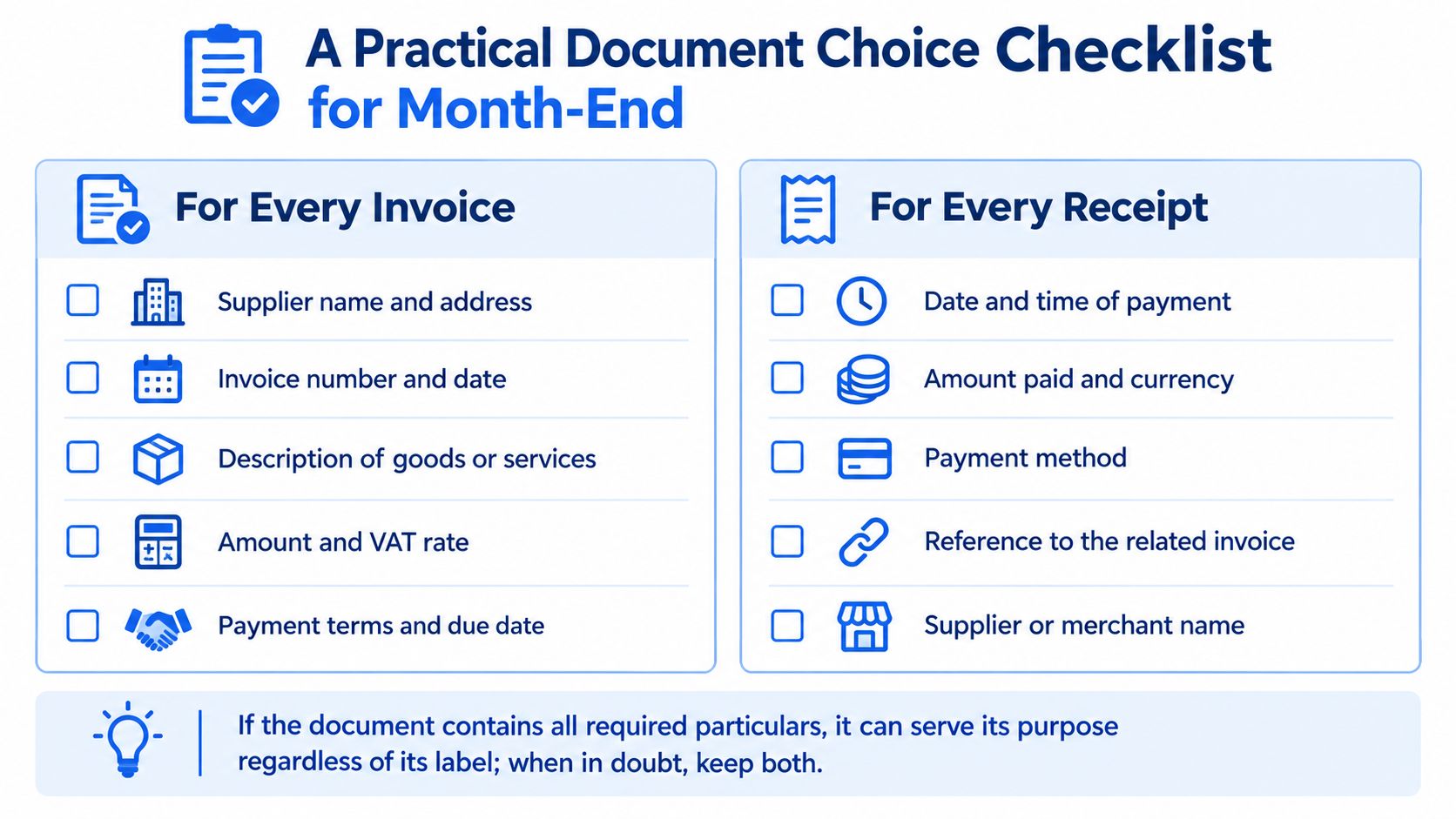
The fastest month-end close starts with the same three checks every time. First, decide whether the transaction creates a payment obligation or settles immediately. Second, confirm whether the tax record needs invoice-level detail or receipt-level settlement detail. Third, match the source document to the bank row before the ledger is finalized.
What to confirm on every invoice
- Supplier identity: Check the supplier name and address so the source is unmistakable.
- Document control: Confirm the invoice number and date, because those fields anchor the audit trail.
- Transaction detail: Make sure the description of goods or services is specific enough to support the ledger coding.
- Tax fields: Verify the amount and VAT rate where tax applies, since that's the part most likely to matter later.
- Payment terms: Keep the due date visible so the open receivable doesn't drift unnoticed.
What to confirm on every receipt
- Payment timing: Keep the date and time of payment visible, especially for same-day card and cash activity.
- Settlement amount: Verify the amount paid and currency so the bank row can be matched cleanly.
- Method used: Capture the payment method, because card, cash, and transfer each leave a different trail.
- Related transaction: Link the receipt to the related invoice or sale reference.
- Merchant details: Retain the supplier or merchant name, so the receipt doesn't become a dead-end file.
The three close checks that catch the most errors
- Statement math: Opening balance plus credits minus debits must equal closing balance.
- Invoice status: Every invoice should be matched to payment or flagged as open.
- Receipt filing: Every receipt should sit beside the bank transaction it clears.
When we apply those checks consistently, the document choice stops being a judgment call. It becomes a repeatable control that protects the close, the tax file, and the audit trail.
If your team wants to turn PDF bank statements into clean rows before matching invoices and receipts, autobankstatement can help with bulk uploads, OCR for scanned or locked files, and CSV or Excel/XLSX output. Visit autobankstatement to see how it fits into a month-end reconciliation workflow.
Convert your next statement in minutes
Upload a bank statement PDF — digital, scanned, or password-protected — preview the extracted table, and download clean CSV or Excel.