8 Common Abbreviations on Bank Statements Explained
Decode 8 common abbreviations on bank statements, from ACH and POS to NSF and EFT, with example lines and bookkeeping tips for clean reconciliation.
The close is open, the trial balance is almost tied, and one bank line still will not classify. It reads NSF, DD, or INT. The amount is real. The category in the import is a guess someone made because the description was short. Post that guess and the entry hits the wrong month, or it lands in income when the bank was charging a fee, pulling a debit, or crediting interest.
That is the usual failure with abbreviations on bank statements. The letters name a channel or an event. They don't name the legal payee, they don't set cutoff, and they don't tell us whether the line is income, expense, a balance-sheet movement, or a reversal. We treat each code as a classification decision. We keep the raw text, check the sign and the posting date, match a source document, and only then choose the account.
The eight codes that stall a reconciliation most often are ACH, ATM, POS, NSF, EFT, CHK, DD, and INT. Each one below uses a line we see, the field we match, the check that blocks a bad post, and the bookkeeping treatment that follows. One control sits under all of them. Opening balance plus credits minus debits must equal the closing balance. If that identity fails, we stop categorizing and find the omitted or duplicated line.
Table of Contents
- 1. ACH (Automated Clearing House)
- 2. ATM (Automated Teller Machine)
- 3. POS (Point of Sale)
- 4. NSF (Non-Sufficient Funds)
- 5. EFT (Electronic Funds Transfer)
- 6. CHK (Check)
- 7. DD (Direct Deposit or Direct Debit)
- 8. INT (Interest)
- How Each Statement Abbreviation Is Typically Recorded and Matched
- Turn Every Code Into a Verified Entry
1. ACH (Automated Clearing House)
ACH marks a batched electronic transfer between banks. Payroll, vendor payments, utilities, and subscriptions are the lines we see most. The originator name is the matching field. We tie that name and the amount to an invoice or a payroll register. These items often settle in one or two business days, so the posting date can fall after the date we started the payment.
ACH CREDIT PAYROLL on the 15th is a bi-weekly deposit. We match it to the register and park the initiation date beside the bank date, so a Friday file that posts Monday stays in the correct period. ACH DEBIT ADOBE is a recurring operating charge. A vendor rule on that originator string keeps the next debit out of uncategorized.
Banks print ACH abbreviations in their own wording, so we keep the raw description and a normalized type side by side. The bank's text stays on the record as evidence. The normalized type drives the vendor rules and the reports.
A credit raises the balance and a debit lowers it. When the sign on a familiar originator flips, we treat the line as a possible reversal and pull the source document before posting.
The batch moves money between institutions. The merchant detail lives in the originator name, and the code only tells us the channel.

- Date pair: The initiation date controls cutoff. The posting date controls the bank rec.
- Vendor rule: Map a stable ACH debit string to one expense account.
- Balance identity: Opening balance plus credits minus debits equals the closing balance before those ACH lines are cleared.
Cutoff rule: Don't let the bank date silently move a Friday payroll into the next month.
2. ATM (Automated Teller Machine)
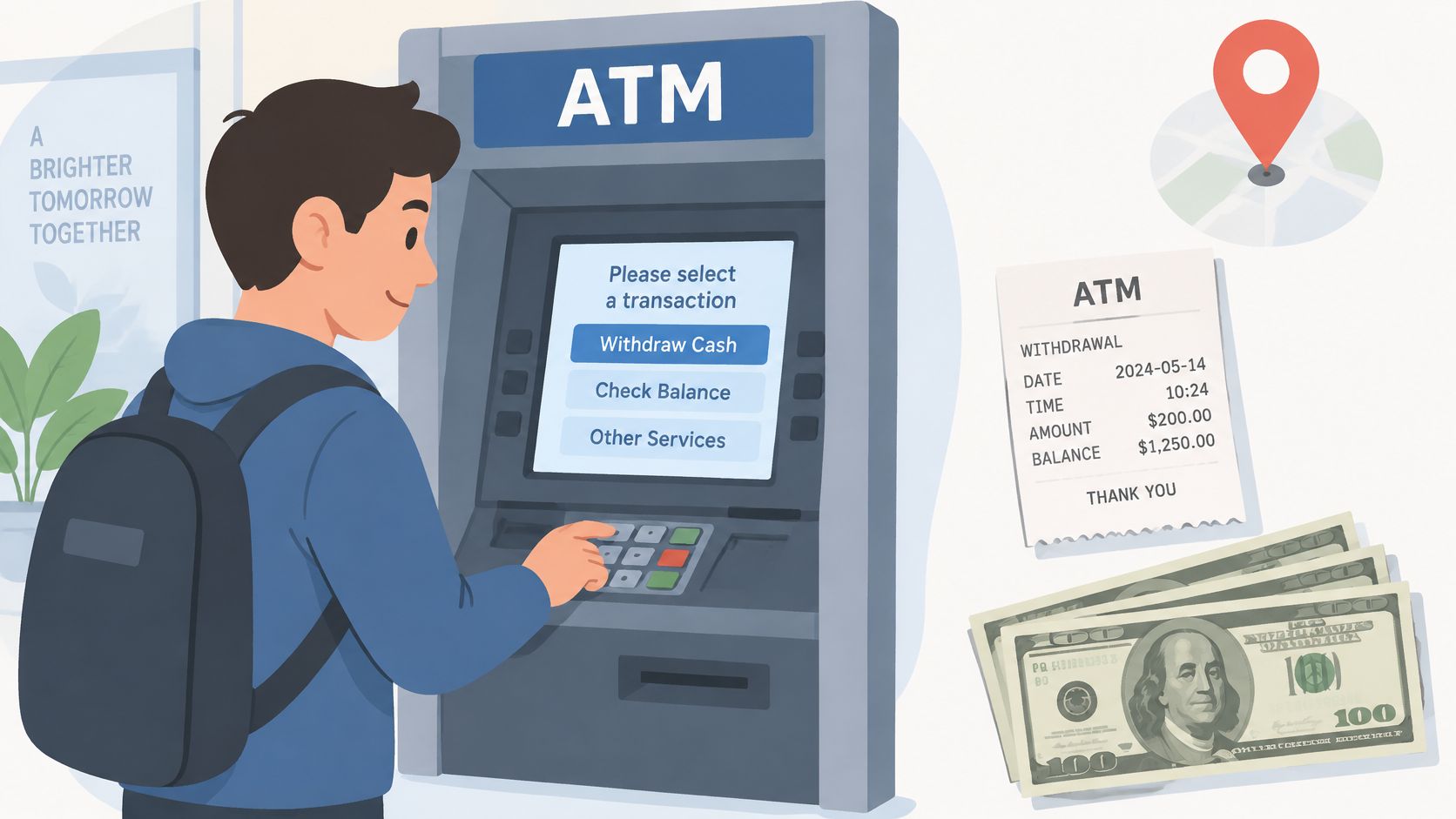
ATM WITHDRAWAL with a city and state is not travel and not supplies. It is cash leaving the bank until a log says who spent it. We credit the bank and debit petty cash, then we match the cash log. Location and any terminal ID tell us whether the draw happened at the shop or on the road.
An ATM FEE on the next line is a different account. It is bank charges, not more cash. Fold the fee into the withdrawal and the drawer count will not tie, while bank charges stay too low. An ATM deposit flips the sign. We increase cash on hand only for bills the log shows going in, and we still watch for a fee on its own line. A machine transfer between our own accounts stays off profit and loss.
The receipt is the support, not a courtesy copy.
- Demand the log: A business withdrawal needs a cash log or receipt before it leaves clearing.
- Split the fee: Withdrawal amount to cash, fee amount to bank charges.
- Retotal after export: Withdrawal and fee totals on the statement should match the spreadsheet, not just the row count.
Split the fee from the cash, or the drawer will never agree with the books.
3. POS (Point of Sale)
POS is a card purchase at a terminal or online, and it is where day-to-day expenses hide. The merchant name is often cut short. A processor prefix such as SQ or PAYPAL may replace the shop we remember. The same vendor can wear three descriptions in one quarter. We map those strings to one vendor, then we match a receipt before we pick the account.
POS PURCHASE OFFICE SUPPLY becomes office expense only when the receipt agrees on date and amount. POS REFUND is not a sale. It reduces the original expense. Coding that credit to income overstates revenue and leaves the expense account too high.
Visa and Tink report that 45% of UK adults want more detail about individual payments, including the logo, location, and retailer name, and that 41% of banks overuse the generic transaction type "other." A bare POS PURCHASE is that gap on the rec. When only a prefix survives, our note on proof of purchase abbreviations keeps POP from being confused with the card code.
Pending card items are why the identity still matters. Opening balance plus credits minus debits should equal the closing balance. A small gap is often a pending POS item that is not a posted expense yet.

A refund reduces cost. It is not revenue.
4. NSF (Non-Sufficient Funds)
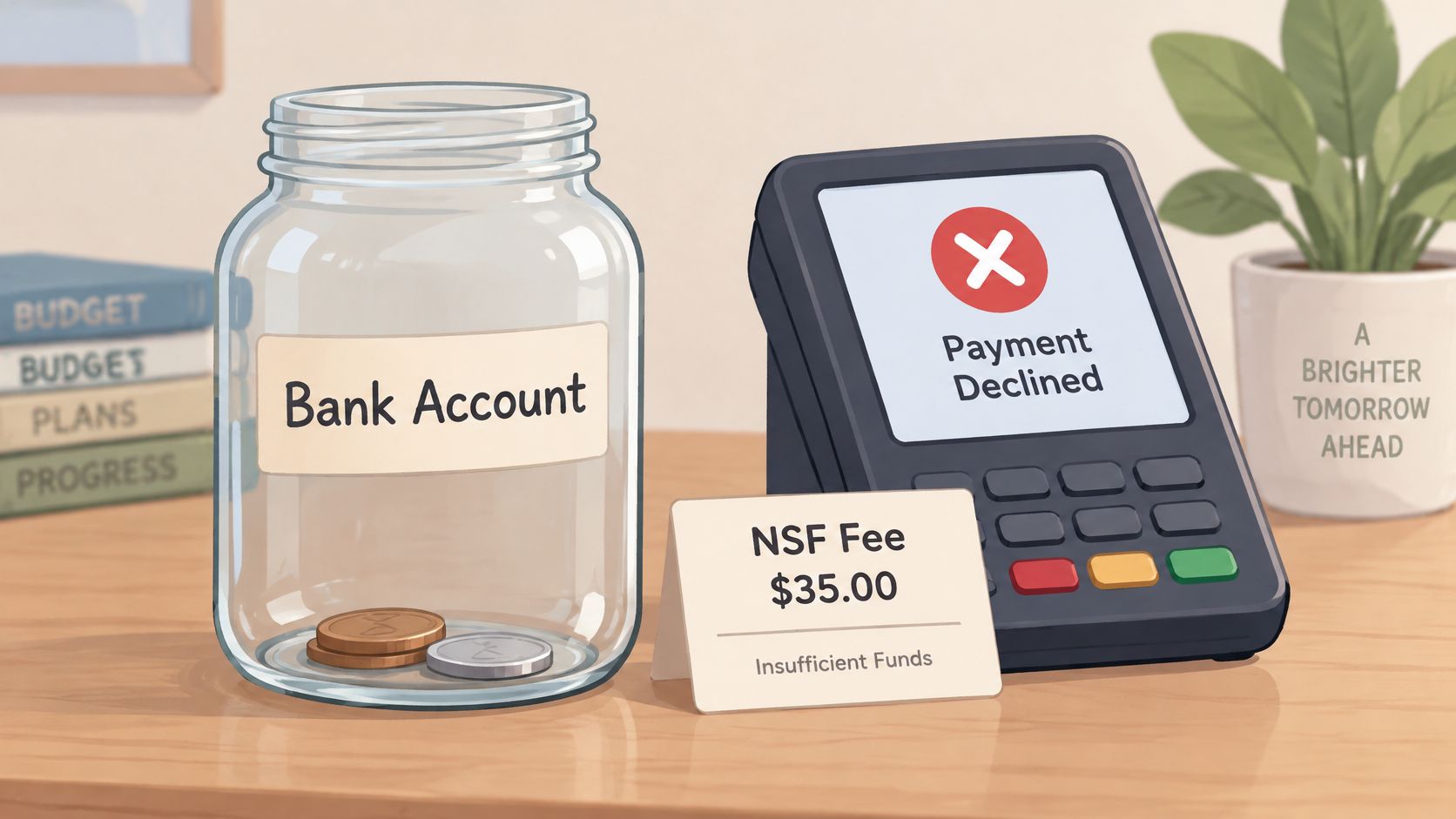
NSF means the bank returned an item because the available balance was not enough. On the statement it can appear as a returned ACH debit, a returned check, or a fee, and often as the return plus the fee in the same run. The original bill is still unpaid, so the vendor balance has to come back before anything else gets coded.
NSF FEE after a returned ACH debit goes to bank charges. The returned check gets reversed so the vendor balance is restored, and when a replacement payment clears, that payment is its own line. Reversing and re-entering is slower than editing the old entry. It is also the version a reviewer can follow, because the trail shows the return, the fee, and the second payment as three separate events.
Unfamiliar statement descriptions are a common reason consumers question a transaction, so an odd NSF narrative is a reason to trace the item rather than stamp fraud on it. Repeated fees are still a cash-flow warning we count each month, and lending reviewers look for them. Our guide on how to read a bank statement is the pass we make before those lines get coded.
The declined terminal is the event. The fee line is only the bank's price for it.
- Reverse, then rebook: Restore the vendor balance, then post the payment that clears.
- Count the month: NSF frequency is a strain signal, separate from the fee account.
- Leave it visible: Applicant files should show NSF lines, not bury them.
5. EFT (Electronic Funds Transfer)
EFT is the wide label. Any electronic movement that isn't a check and isn't cash can wear it, including ACH, bill pay, a near-wire, or a transfer between our own accounts. The code doesn't classify the entry. The words after EFT do.
EFT TO SAVINGS isn't income and isn't expense. We keep it off profit and loss and we confirm the other account shows the matching credit so the pair nets to zero. EFT TAX PAYMENT reduces a tax liability. It isn't an operating expense if that tax was already accrued. An EFT we don't recognize gets a prompt look. Consumer rules give account holders specific protections on unauthorized electronic transfers, and banks publish the reporting window for a reason. We note that deadline when we escalate. We still don't stamp fraud on a line we merely don't remember.
A Huntington ISO 20022 implementation shows why the short code is a weak match key. Messages can carry a UETR, message ID, instruction ID, end-to-end ID, and transaction ID, while unstructured remittance text in that web-payment setup is capped at 140 characters. A PDF often gives us none of those IDs. We copy whatever reference survived into its own column, and we lower confidence when the label is cut off.
- Stop the double count: Internal transfers stay off income and expense when both accounts are imported.
- Net the pair: Linked accounts should net to zero before the period is final.
- Keep the reference: An end-to-end ID beats a guessed category.
6. CHK (Check)
CHK, CHECK, or CK means a paper check paid from the account. Sometimes only the number prints. That number is the matching field, not the word CHK. CHECK 1047 clears against register item 1047 and nothing else. An outstanding check from last month that posts now matches the original register line. We don't book a second expense.
Checks still show up for rent, vendors, and taxes even as the rail shrinks. In 2024, Federal Reserve Banks handled 2.98 billion checks, a 5.4% decrease from 2023. The register stays part of the close.
A prior-month check that clears this period is a timing item. If we recorded the expense when we wrote the check, this month only clears it.
- Mark them as they clear: Update the register when the statement arrives. Don't wait for year-end.
- List what is still out: Outstanding checks explain most timing gaps.
- Foot the page: Opening balance plus credits minus debits equals the closing balance, with cleared checks inside that math.
The check number is the key. The word CHK is only the label.
7. DD (Direct Deposit or Direct Debit)
DD punishes a rushed sign check. It can mean direct deposit, money in, or direct debit, money out. Direction is the first field we read. A credit isn't an expense. A debit isn't a receipt.
DD PAYROLL as a credit is a payroll deposit matched to the register. For owners and for lenders, that credit is often part of the income file, so we keep the raw line when statements serve as proof of income. DD INSURANCE as a debit is insurance expense on a schedule. The payee pulls the money under an earlier authorization, and the debit continues until someone cancels it. We review those pulls quarterly and drop any the business no longer uses.
ISO 20022 bank transaction code guidance treats the harmonized code as a cash-management aid, while the abbreviation on the statement can still be defined by the issuer. Our file keeps the raw description and a normalized type. Reading the letters DD as "deposit" without the sign is how a premium gets booked as revenue.
- Sign first: A credit DD and a debit DD are different journals.
- Template the repeats: A schedule flags a missing or duplicated debit.
- Cancel what ended: Quarterly, remove authorizations that no longer belong.
8. INT (Interest)
INT is income or expense, and the sign chooses. INT CREDIT on a deposit account is interest income for the period the bank names. It isn't sales, and it shouldn't sit in miscellaneous receipts where tax prep misses it. INT CHARGE on a line of credit or an overdraft is interest expense. Whether that cost is deductible depends on the debt. We follow IRS guidance on interest income and on deductible interest instead of inventing a tax code during the bank rec.
The posting often covers a month or a quarter that doesn't match our close. When the earning period straddles two statements, we accrue the piece that belongs in the open period and we true it up when the bank posts. Taking the whole credit in the month it appears can be acceptable on a pure cash basis. On accrual, it smears the period.
- Separate the accounts: Interest income in its own income account, interest expense in its own expense account.
- Accrue the overlap: A line that spans two statements shouldn't all hit one close.
- Include every INT line: Opening balance plus credits minus debits equals the closing balance only when those lines are in the totals.
Interest isn't "other." A credit is income. A debit is the cost of borrowing.
How Each Statement Abbreviation Is Typically Recorded and Matched
| Item | Typical Posting or Settlement | Usual Direction on the Statement | Primary Matching Field | Typical Bookkeeping Treatment |
|---|---|---|---|---|
| ACH (Automated Clearing House) | Usually settles in 1–2 business days; posting may lag initiation | Credit or debit | Originator name, company ID, or reference number | Categorize as a receipt or payment; track initiation date for cutoff |
| ATM (Automated Teller Machine) | Posts with the cash withdrawal or deposit; fees may appear separately | Usually debit for withdrawals and fees; credit for deposits | Location, city/state, or terminal ID | Record withdrawals to cash or petty cash; categorize fees as bank charges |
| POS (Point of Sale) | Usually posts 1–3 business days after authorization | Usually debit; refunds may be credits | Merchant name, receipt, or processor prefix | Categorize the purchase by expense; treat refunds as reductions of the original expense |
| NSF (Non-Sufficient Funds) | Appears when a payment is returned or declined; a fee may post separately | Usually debit for fees; returned items may reverse the original direction | Returned item or payment reference | Record fees as bank charges and reverse returned items; re-enter payment when cleared |
| EFT (Electronic Funds Transfer) | Varies by transfer type | Credit or debit | Counterparty or purpose in the transaction description | Classify by purpose; exclude internal transfers from income and expense totals |
| CHK (Check) | Posts when presented and paid, potentially weeks after being written | Usually debit | Check number | Match to the check register and clear outstanding checks during reconciliation |
| DD (Direct Deposit or Direct Debit) | Often posts on a predictable recurring schedule | Credit for deposits; debit for direct debits | Payer or payee name and transaction direction | Record deposits as receipts and debits by purpose, such as insurance or utilities |
| INT (Interest) | Often posts monthly or quarterly | Credit for interest earned; debit for interest charged | Interest description and accrual period, if shown | Record credits as interest income and charges as interest expense; accrue across periods when needed |
Turn Every Code Into a Verified Entry
Reading the abbreviation is half the close. The other half is the proof around it. We confirm the direction of the amount, we match the code to a register, receipt, invoice, or payroll file, and we verify that opening balance plus credits minus debits equals the closing balance. A tidy category on a statement that doesn't foot is still a broken rec.
The bad posts rhyme. ACH and checks need a second date or a check number so cutoff and clearing stay honest. ATM fees have to leave the cash account. POS refunds must not become sales. NSF returns have to reopen the vendor. EFT and DD have to be tested for sign, and for movement between our own accounts, before they touch profit and loss. INT has to leave miscellaneous. None of that survives if we overwrite the bank's text with a guessed merchant and throw away the original line.
For U.S. banks, a statement or equivalent record has to show each transaction in or relating to a deposit account. That is why the abbreviation is never the whole record. The Federal Reserve's recordkeeping rule is the reason we keep the date, the amount, and the narrative with the code. FFIEC BSA guidance includes account statements among records banks generally retain for at least five years. Our copies often need to live longer for tax, a contract, or a dispute. We keep the original PDF, the spreadsheet, and a short note on any code we normalized. An export with no source file is hard to defend when someone asks what DD meant on that line.
Covered records also have to stay retrievable within a reasonable time, which is the practical test in the Federal Reserve retention rule. A folder of renamed exports fails that test even when the numbers look fine today.
Retyping invites small, helpful rewrites of the bank's own text. Converting the PDF to CSV or Excel keeps each description and amount intact for the checks above. autobankstatement handles digital, scanned, and password-protected statements, including bulk files up to 25 MB, with a free guest preview before payment. Registered downloads stay available for 24 hours, and the original upload is deleted within 10 seconds after the conversion is complete. The spreadsheet gives us one place to run the balance identity and each code decision without copying rows by hand; the ledger entry still has to stand on its own.
Decode the rail, name the business event, post the account that event is, and leave a trail from the bank's letters to the ledger.
If month-end is still a stack of PDFs, autobankstatement turns those bank statements into CSV or Excel rows so we can reconcile ACH, POS, NSF, and the rest without retyping each line. A guest preview is available before payment, and the original descriptions stay intact for the balance check and the code-by-code review. Open a statement at autobankstatement.
Convert your next statement in minutes
Upload a bank statement PDF — digital, scanned, or password-protected — preview the extracted table, and download clean CSV or Excel.