Business Loans with Bank Statements: A Practical Guide
Learn how to qualify for business loans with bank statements. Covers loan types, eligibility, statement prep, lender tips, and how to avoid costly mistakes.
You've assembled the loan package: tax returns are filed, the profit-and-loss statement is current, and the bank statements are downloaded. Then the lender asks which deposits are transfers, why cash fell in one month, and whether the revenue on the statements matches the revenue in your books. At that point, sending another folder of PDFs won't help. The useful work is turning those statements into a clear, reconciled cash-flow record the underwriter can verify.
That distinction matters for business loans with bank statements. Statements can show what moved through the business, but gross deposits aren't the same as recurring revenue, and a clean document package can't fix weak repayment capacity. Our recommendation is straightforward: normalize the transactions, explain the exceptions, calculate debt-service coverage, and only then choose which lender to approach.
Table of Contents
- What Bank-Statement Lending Actually Looks Like
- Loan Products That Use Bank-Statement Underwriting
- Eligibility Factors Lenders Read Off Your Statements
- Preparing and Normalizing Your Statements Before Submission
- Which Transactions Lenders Will Strip Out
- Traditional Bank and SBA Paths Versus Online Statement Lenders
- Submission Checklist and the Most Common Denial Reasons
What Bank-Statement Lending Actually Looks Like
A finance team can spend hours gathering statements and still send a package that creates more questions than it answers. The underwriter sees a stack of PDFs, but no clear way to distinguish customer receipts from transfers, loan proceeds, refunds, or owner contributions. The problem isn't a lack of paperwork. It's that the cash-flow evidence hasn't been prepared for review.
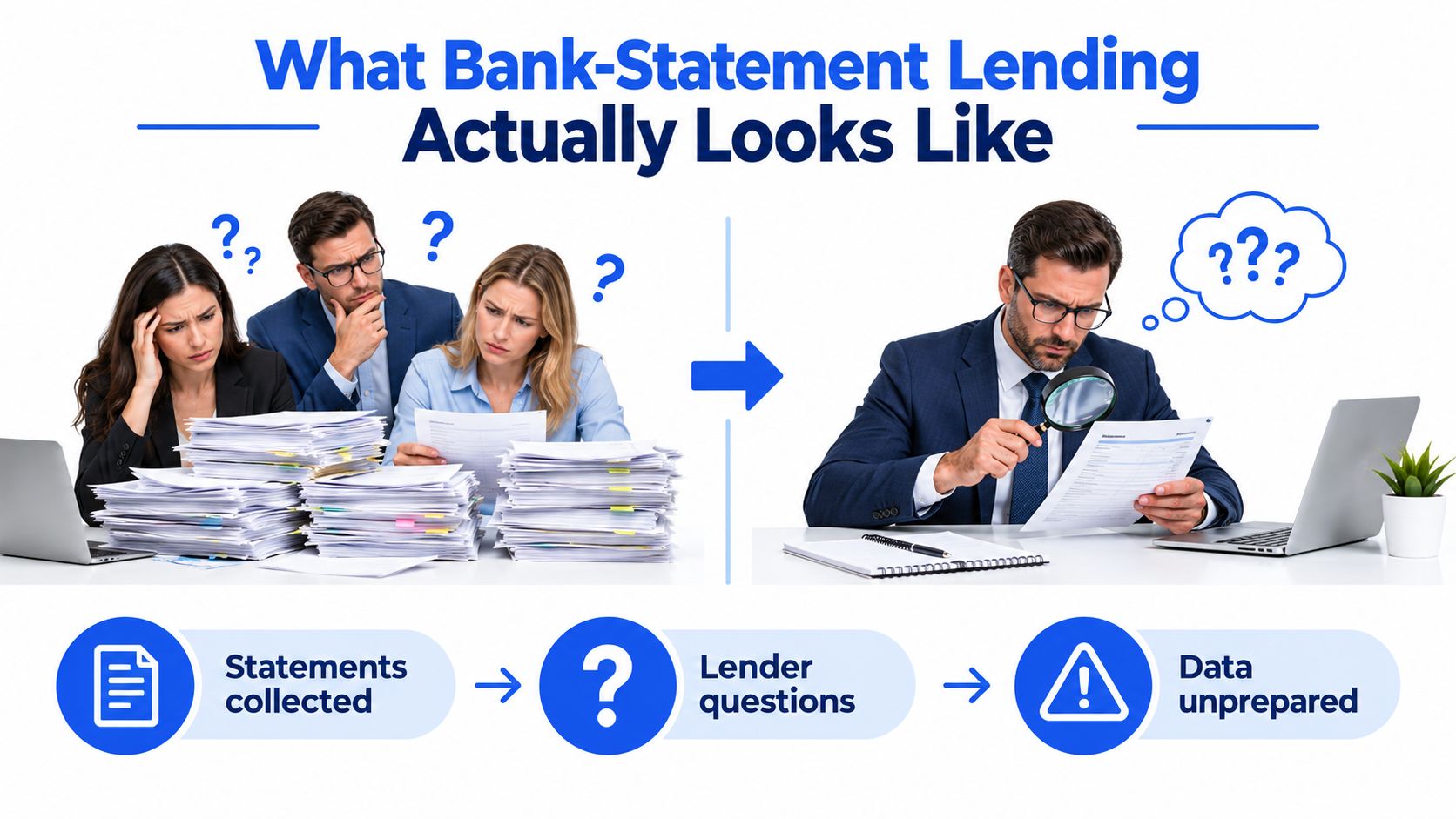
Bank statements matter because they show real account activity: deposits, recurring payments, available balances, fees, and existing debt payments. They give a lender a way to test reported revenue against cash movement, alongside credit information, tax returns, and financial statements. They don't replace those other documents, and they don't prove that every deposit is operating income.
Why this review matters
Smaller financing requests make cash-flow details particularly relevant. In the Federal Reserve's 2023 Small Business Credit Survey findings, 37% of small employer firms reported applying for a loan, line of credit, or merchant cash advance in the preceding year. Among applicants, 50% sought $100,000 or less, and 30% sought $50,000 or less. Those figures describe substantial demand for relatively modest financing, where recurring deposits, operating expenses, and existing obligations can meaningfully shape repayment analysis.
The same survey found that approval wasn't assured. Small banks approved 75% of applicants for at least some financing, compared with 66% at large banks. Approval varied with credit quality, too. Organized cash-flow evidence helps a lender assess the business more clearly, but it doesn't guarantee a positive decision.
The finance team's job
The practical aim isn't to make statements look better. It's to make the actual cash-flow story easy to check: match each statement to the right account and period, classify unusual transactions, reconcile the balances, and connect the totals to the business's reported financials.
Our standard: Don't ask an underwriter to infer what a deposit means. Label it, document it, and reconcile it before submission.
Loan Products That Use Bank-Statement Underwriting
Bank statements appear in several types of business financing, but lenders don't all use them the same way. Some treat statements as one part of a broad underwriting file. Others rely heavily on account activity to assess revenue and payment capacity. Match the product to your business's financial profile, not to an advertisement promising easy approval.
How the main options differ
| Lender type | Statements required | Typical use of statement data |
|---|---|---|
| SBA 7(a) or SBA Express lender | Requirements vary by lender. SBA-oriented applications often request several months of statements alongside extensive financial records. | Cross-check deposits, balances, and payments against tax returns, financial statements, ownership details, and liabilities. |
| Conventional bank term loan | Lender-specific, often with other financial documents. | Assess recurring cash flow and whether the requested payment fits alongside existing debt. |
| Bank or community-bank line of credit | Lender-specific; may require ongoing financial reporting. | Review operating inflows, balance patterns, and seasonal working-capital needs. |
| Revenue-based financing | Varies by provider and offer. | Focus on revenue deposited into the account and the payment structure tied to receipts. |
| Online short-term or “bank-statement” lender | Varies; some products emphasize statement activity. | Assess deposit volume and account behavior, sometimes with less emphasis on a full traditional package. |
For SBA-oriented financing, don't mistake statement underwriting for statement-only underwriting. A bank checklist describes requirements such as business and personal tax returns, a current profit-and-loss statement, a balance sheet, a debt schedule, and personal financial information for qualifying owners. Requirements differ, so confirm the specific lender's checklist before applying. The SBA loan document preparation guidance is a useful reminder to assemble the wider financial package, not just bank PDFs.
A conventional term loan or line of credit may be a better fit when your books are consistent and your statements support the results in your financials. Community banks can be worth approaching when the business has a clear local operating history and you can explain its cash cycle directly. The Federal Reserve's lending survey defines a small-business loan using a firm revenue threshold and draws on a panel of 398 domestically chartered commercial banks, offering a broad view of lending conditions rather than a single lender's experience (Kansas City Fed Small Business Lending Survey).
Don't confuse speed with fit
Revenue-based financing and online short-term products can be more focused on deposits, but a lighter application doesn't necessarily mean a lower-cost or safer loan. Compare the full payment burden and terms before accepting an offer. If a lender uses statements mainly to size frequent withdrawals, make sure the remaining cash still covers payroll, taxes, vendors, and existing debt.
Eligibility Factors Lenders Read Off Your Statements
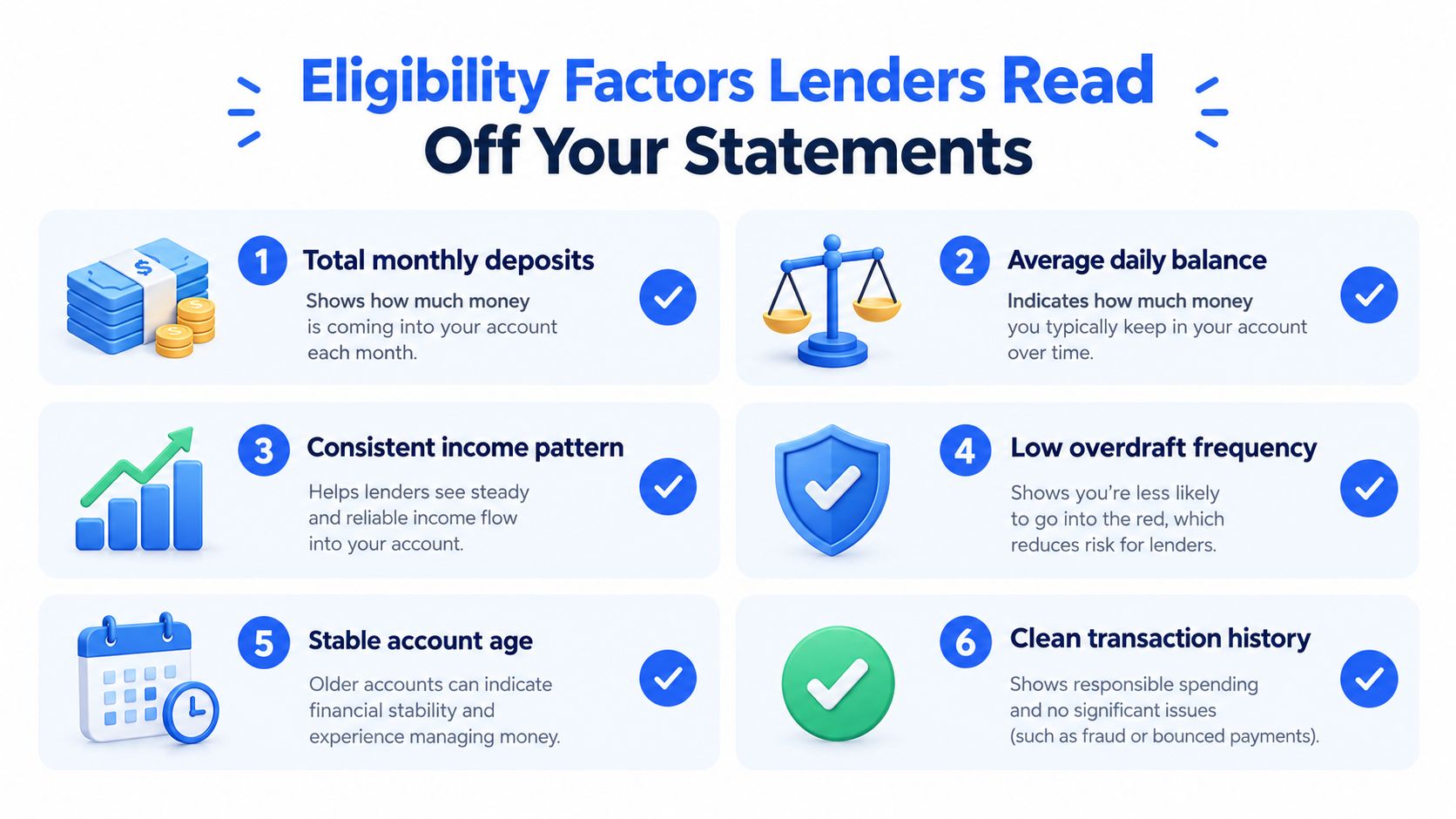
An underwriter isn't judging a statement by its page count. They're looking for patterns that indicate whether the business can support another payment without disrupting operations. The useful question is not “How much came in?” but “How much reliable cash remains after normal expenses and existing debt?”
Six signals worth reviewing
- Total monthly deposits: Separate recurring customer receipts from transfers, loan proceeds, owner contributions, and one-time inflows. A high deposit total can overstate the revenue available to repay debt.
- Average balance: Low balances at statement close or frequent cash depletion can make a business look less able to absorb a new payment. Review the pattern across the period, not just a single favorable day.
- Income consistency: Compare deposits month by month. Seasonal businesses may have strong annual revenue but weaker months that matter when payments are due.
- Overdraft and NSF activity: Repeated overdrafts or nonsufficient-funds charges can signal timing pressure or inadequate cash reserves.
- Recurring debt payments: Identify existing loans and advances, including obligations paid from another account. A lender needs the full debt picture to estimate capacity.
- Payroll and tax payments: Consistent payroll and tax activity can help demonstrate normal operations. Gaps or irregular payments may need an explanation.
For a wider discussion of what statements can demonstrate, see our guide to using bank statements as proof of income.
Use DSCR to test the request
The debt-service-coverage ratio (DSCR) compares available cash flow with scheduled debt payments. Calculate it as available cash flow divided by proposed debt service. A commonly cited benchmark is at least 1.25, meaning $1.25 of available cash flow for each $1.00 of scheduled debt service, but lender and product standards vary (SBA loan financing guidance).
Use normalized cash flow, not total deposits. Then test the proposed payment against a weaker revenue month and the business's normal expense cycle. If the loan only works when every month is strong, the request is too aggressive.
Preparing and Normalizing Your Statements Before Submission
A lender reviewing a polished spreadsheet can still deny the request if the figures do not match the original statements. Build a transaction file from complete, official records, then reconcile it to the business's accounting records before calculating cash flow.
Build a complete source file
Start with the statement period the lender requests. Requirements vary by lender and product. Check that every month and page is included, and confirm that each account belongs to the business or has a clear explanation.
If you need structured transaction rows, Autobankstatement converts digital, scanned via OCR, and password-protected PDF statements into CSV or Excel/XLSX. That gives you clean rows to classify instead of relying on manual copy-paste. Uploaded files are deleted within 24 hours (Autobankstatement).
Normalize the rows before calculating
Classify transactions consistently. Mark transfers between business-owned accounts, loan proceeds, owner contributions, refunds, and chargebacks separately from customer revenue. Label payroll, taxes, vendor payments, fees, and scheduled debt payments so the lender can distinguish operating activity from other cash movement.
Then compare deposit-derived revenue with the current profit-and-loss statement and tax returns. Lenders use statements to check reported figures, not to replace them. Use this guide to prepare business bank statements for a loan application.
A tidy spreadsheet is not a reconciled spreadsheet. Check every total against the source statement.
For each statement period, confirm that opening balance plus credits minus debits equals closing balance. Investigate any mismatch before submission. Common causes include missing pages, duplicate or misread transactions, reversed signs, and activity posted across statement cutoffs. Submit the transaction table only after its totals tie to the official document.
Which Transactions Lenders Will Strip Out
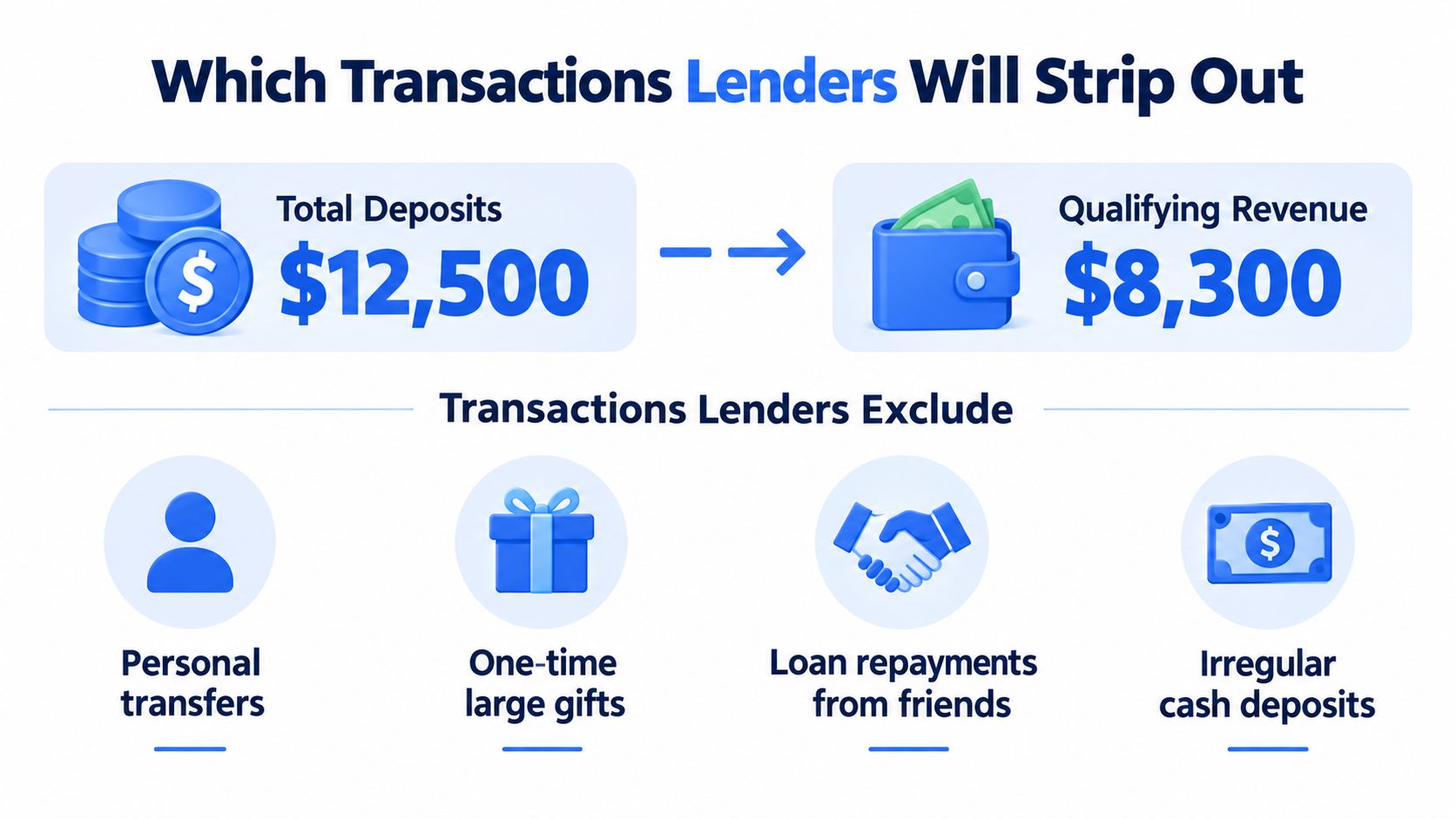
Large deposits can make a statement look impressive and still contribute little to qualifying revenue. Lenders need to know whether money came from ordinary business activity and whether it's likely to recur. That's why “total deposits” is a starting point, not a revenue figure.
Flag deposits that need an explanation
Transfers between the owner's accounts shouldn't be counted twice as revenue. Loan proceeds and owner contributions add cash, but they don't represent customer sales. Refunds and tax refunds may appear as credits without reflecting ongoing operating income. A one-time insurance recovery or a large customer payment that won't recur should be identified rather than folded into a normal monthly run rate.
For every unusual deposit, add a short note that answers three questions: what was it, where did it come from, and why should it or shouldn't it count as recurring business revenue? Keep supporting records available, such as the transfer from the other account or documentation explaining a refund. The goal is to make classification verifiable, not persuasive by tone.
Show the lender what remains
Prepare a simple bridge from gross statement credits to normalized operating revenue. Subtract transfers, financing proceeds, owner funds, refunds, and other nonrecurring items, then reconcile the remaining business receipts to the accounting records. This is more credible than presenting the largest possible deposit total and hoping the reviewer accepts it.
Learn how to inspect transaction descriptions and statement sections with our guide to reading a bank statement. The same discipline applies here: explain a deposit before it becomes an underwriting question. Unexplained activity can undermine confidence in otherwise strong financials, especially when the business's reported revenue and statement activity don't align.
Traditional Bank and SBA Paths Versus Online Statement Lenders
Traditional lenders and online statement lenders may request similar documents, but they use them differently. A bank or SBA lender usually looks across statements, tax records, financial statements, debt, and ownership information. An online product may put more weight on account deposits and speed. Neither approach is automatically better for every business, but fast approval isn't a substitute for affordable repayment.
Compare the whole offer
| Decision point | Traditional bank or SBA path | Online statement lender |
|---|---|---|
| Documentation | Usually broader, with financial statements and tax or ownership records alongside bank statements. | May place greater weight on statement activity, but requirements vary by provider. |
| Funding pace | May involve more review and document follow-up. | May be marketed around faster decisions; verify the actual timeline and conditions. |
| Guarantees and liens | Review the written terms for guarantees, collateral, and filings. | Do the same. Don't assume a lighter application means fewer obligations. |
| Prepayment | Check whether early repayment changes the total cost. | Confirm how early payment is treated and whether fees or pricing change. |
| Total cost and repayment pressure | Compare the annualized cost and scheduled payments with cash flow. | Check APR or estimated annualized cost, factor rates, and daily or weekly withdrawals. |
The cost concern is real. In the Federal Reserve's 2025 Small Business Credit Survey report, high interest rates were the most common challenge among financing applicants. Online-lender borrowers were more likely to report higher-than-expected costs and unfavorable repayment terms. The survey also found that only 52% of applicants were fully approved, below the 58% recorded in 2018 and 62% in 2019. Cleaner documents can clarify your application, but they don't guarantee a good offer or eliminate structural problems such as thin operating history, high existing debt, or low cash reserves.
Make the choice on repayment economics
Use a conventional bank or SBA path when your records reconcile and your business can support a full review. Treat an online statement product as a fallback, not a shortcut: compare the cost, payment frequency, personal guarantee, lien terms, prepayment treatment, and default triggers before signing. Then stress-test the payment against a weak month, not just your best recent period.
Submission Checklist and the Most Common Denial Reasons
A complete package doesn't have to be complicated. It has to be consistent. Before sending the application, make sure the documents tell the same story about revenue, expenses, debt, and available cash.
Run these checks first
- Confirm continuity: Check that every requested statement period and page is present, and identify the account owner.
- Verify the balance equation: For every statement, confirm opening balance + credits − debits = closing balance.
- Annotate unusual deposits: Explain transfers, loan proceeds, owner contributions, refunds, and one-time receipts.
- Reconcile reported revenue: Compare normalized deposits with the profit-and-loss statement and tax returns.
- Calculate DSCR: Divide available cash flow by proposed debt service, using the lender's stated method where available.
- Stress-test repayment: Recalculate against a weaker revenue month and account for existing obligations.
Borrower financials were identified as the most common denial reason by about 71% of respondents in a 2025 Kansas City Fed small-business lending survey. Credit history and collateral were also frequently cited. That should shape your preparation: resolve inconsistencies before underwriting rather than waiting for the lender to request explanations.
Clean statements improve the lender's view of the evidence, but they can't create revenue, erase debt, or supply cash reserves the business doesn't have. If the payment only works under optimistic assumptions, reduce the request or reconsider the product. Run the balance check and DSCR calculation before you apply.
Autobankstatement converts digital, scanned, and password-protected PDF bank statements into CSV or Excel/XLSX, with bulk uploads for files up to 25 MB. Try the free guest preview at autobankstatement to prepare statement data for reconciliation before you submit your loan package.
Convert your next statement in minutes
Upload a bank statement PDF — digital, scanned, or password-protected — preview the extracted table, and download clean CSV or Excel.