
8 Expense Account Examples for Better Bookkeeping
Explore 8 expense account examples with transaction categories, chart-of-accounts tips, and reconciliation tactics for SMEs, bookkeepers, and finance teams.
The most popular advice on expense account examples is to copy a standard list into the chart of accounts and start coding transactions. That approach works until one payment could be travel, a client cost, a project cost, a prepaid asset, or a capital purchase. A useful expense account makes transactions easier to classify, review, budget, and reconcile. An overly broad one hides differences that matter to management reporting, tax work, approvals, and month-end close.
This guide is for accountants, bookkeepers, finance teams, and small business owners who need categories tied to real bank activity. We'll examine eight difficult patterns: travel and meals, office purchases, professional fees, facilities, vehicles, marketing, insurance, and software subscriptions. The examples focus on what belongs in each account, what should be separated, and how statement data supports review without replacing accounting judgment.
A bank statement proves that money moved. It doesn't, by itself, prove the business purpose, tax treatment, capitalization decision, project allocation, or policy compliance. After converting a statement into CSV or XLSX, verify opening balance + credits − debits = closing balance before relying on the extracted rows for bookkeeping or tax work, as explained in this bank reconciliation guidance.
Table of Contents
- 1. Travel and Meals Expenses
- 2. Office Supplies and Equipment
- 3. Professional Services and Consulting Fees
- 4. Utilities and Facility Maintenance
- 5. Vehicle and Transportation Expenses
- 6. Marketing and Advertising Expenses
- 7. Insurance Premiums and Claims
- 8. Subscriptions and Software Licenses
- 8-Category Expense Account Comparison
- Turn Examples Into a Working Chart of Accounts
1. Travel and Meals Expenses
Travel and meals become difficult when one trip creates a chain of transactions across airlines, hotels, restaurants, taxis, and client venues. A single parent account called “Travel” may be adequate for a small operation, but it can conceal the difference between airfare, lodging, employee meals, client entertainment, and reimbursable project costs.
For a consulting firm, airfare and lodging might belong to a client project and later be billed back. For a sales team, the same type of charge may be a selling expense. We should therefore separate airfare, lodging, ground transportation, employee meals, and client meals when management reporting or tax treatment requires that distinction. Client meals shouldn't be mixed with employee travel meals just because both appear at restaurants.
A credit card statement can reveal the merchant and amount, but not who attended dinner, which customer was involved, or whether the expense complied with policy. Receipts, attendee details, approval records, and project codes still matter. A practical guide to reading bank statements helps teams understand what the extracted transaction evidence can and can't establish.
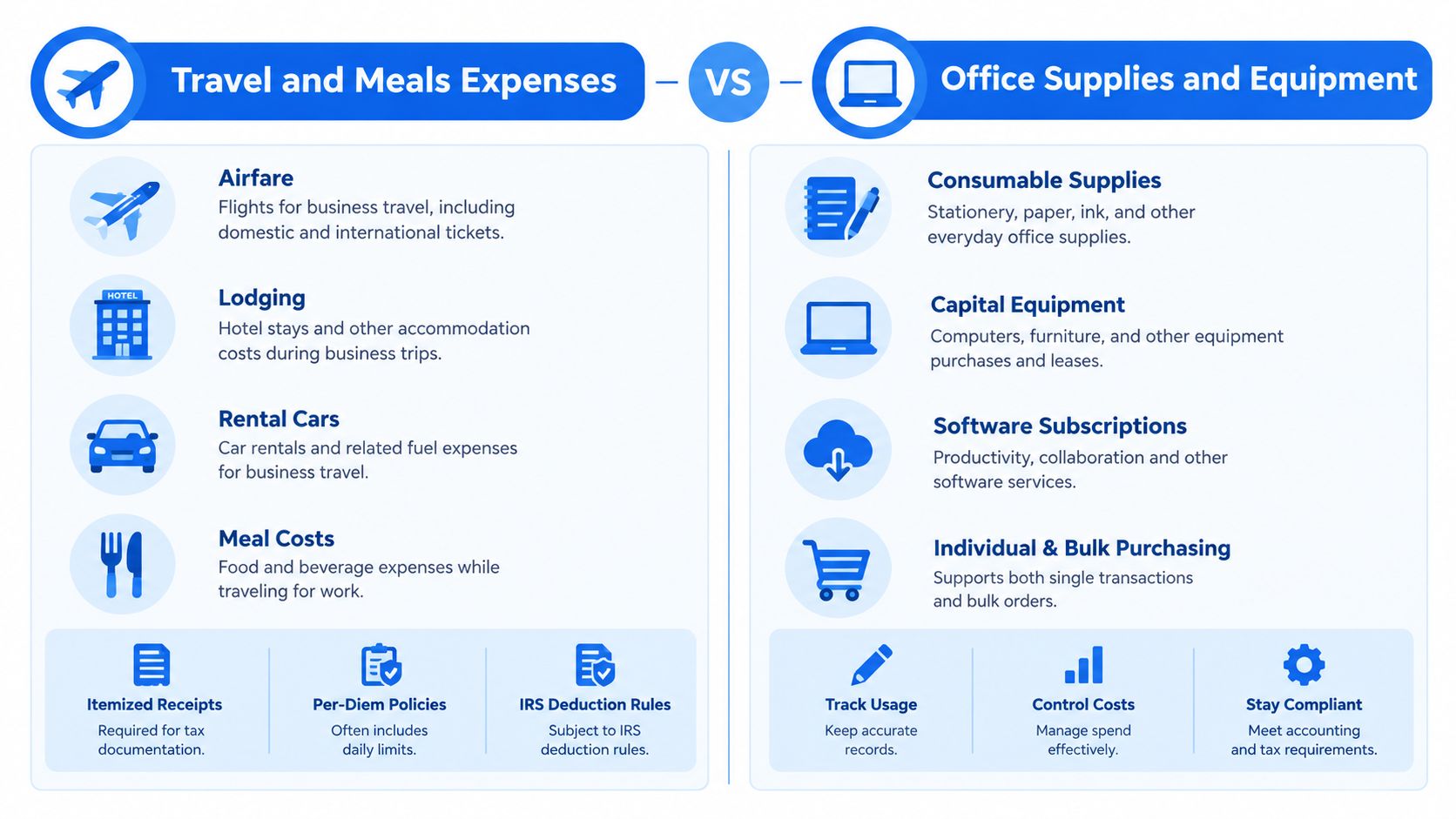
Practical rule: Code the payment from the statement, then validate the business purpose from the receipt, expense report, traveler, customer, and project record.
Before travel occurs, define approval thresholds, permitted vendors, per-diem rules, and receipt requirements. During close, filter converted transaction rows for airline, hotel, restaurant, and transport vendors, then investigate duplicates, missing receipts, unusual merchants, and charges without a project or employee reference.
2. Office Supplies and Equipment
Office spending looks simple until consumables and durable purchases land in the same feed. Paper, toner, pens, and postage are normally consumed through operations. A laptop, server, desk, or production device may provide value over multiple periods and may need to be recorded as a fixed asset under the business's capitalization policy.
We shouldn't solve this by creating dozens of vendor-specific accounts. A cleaner structure separates office supplies, office equipment, computer equipment, and, where useful, repairs and maintenance. The vendor name doesn't decide the account. A single office retailer can sell printer paper, a monitor, furniture, and a capital purchase on the same receipt.
Set the capitalization boundary before coding
Every business needs a written capitalization policy, including its threshold, expected useful-life rules, and treatment of grouped purchases. The threshold should be applied consistently, not improvised during reconciliation. A purchase below the policy threshold may be expensed, while a qualifying durable asset should be recorded separately and depreciated according to the applicable accounting and tax rules.
Converted CSV or XLSX rows are useful for finding repeated vendors, unusual amounts, and recurring maintenance charges. They don't contain enough context to determine whether an item is a fixed asset, a repair, or an ordinary supply. Match the statement row to the invoice or receipt before posting.

A quarterly review can compare office-supply purchases with inventory or purchasing records. It can also identify subscriptions hidden in retailer or marketplace charges, which should move to a software or service account rather than remain buried in supplies.
3. Professional Services and Consulting Fees
Professional fees deserve more discipline than a generic “outside services” account. An accounting firm may pay tax counsel, audit support providers, legal advisers, valuation specialists, and temporary contractors. Those payments differ in purpose, documentation, project relevance, and sometimes tax reporting treatment.
A technology company paying a strategic adviser should match the bank transaction to an approved engagement, invoice, contract, and responsible department. The statement confirms the payment, but the invoice explains what was delivered. If the work relates to product development, implementation, litigation, or a customer project, a department or project tag may be more useful than creating a new general-ledger account for every type of consultant.
Separate recurring retainers from one-time work
Recurring monthly payments should be reviewed against active contracts and expected invoice schedules. One-time payments deserve a separate exception review because they may represent a new vendor, a final project milestone, a deposit, or an unauthorized payment. Legal settlements, loan-related fees, and costs connected with acquiring an asset may also require treatment outside ordinary professional services.
Teams can use a converted statement to sort vendor names, dates, amounts, and recurrence patterns before matching rows to invoices. The broader accounts payable and accounts receivable workflow is useful context, but extracted bank data shouldn't replace invoice approval or the ledger's supporting documentation.
A payment match answers “did cash leave?” It doesn't fully answer “what did we buy, for whom, and in which period?”
For close, investigate unmatched professional-fee rows, duplicate amounts, payments made outside approved terms, and invoices posted to the wrong department. Keep the engagement scope and business purpose in a central tracker so a reviewer can understand the classification without searching through email.
4. Utilities and Facility Maintenance
Utilities and facility costs are recurring by nature, but they aren't all the same cost. Electricity, water, gas, internet, phone service, janitorial work, repairs, security, and building maintenance may all appear alongside one another in the bank feed. A broad facilities account makes occupancy easy to total, yet it can hide billing anomalies and make location reporting unreliable.
For a business with multiple stores or offices, assign a location to every relevant transaction. A monthly electricity payment belongs to the correct site, while a central internet contract may need allocation across locations. Repairs should generally be separated from ordinary utilities, especially when a major project, lease improvement, or asset-related cost is involved.
Use recurrence as a review signal
Convert the relevant statements into a spreadsheet and sort by vendor, date, location, and amount. Recurring charges should align with approved invoices or contracts. A missing payment may indicate a timing issue, while an unexpected duplicate may signal a billing error. A sudden change deserves investigation, but the bank row alone won't explain whether usage increased, rates changed, or a new service was added.
A location-level utility schedule can include vendor, service address, billing period, invoice reference, payment date, and general-ledger account. That schedule supports budgeting and lease cost recovery without forcing the chart of accounts to carry every reporting dimension.
One-time facility costs need a different path. Require approval and supporting invoices for major repairs, construction work, security installations, or landlord-related charges. Posting every unusual facilities payment to ordinary maintenance may understate project costs or misclassify an asset.
5. Vehicle and Transportation Expenses
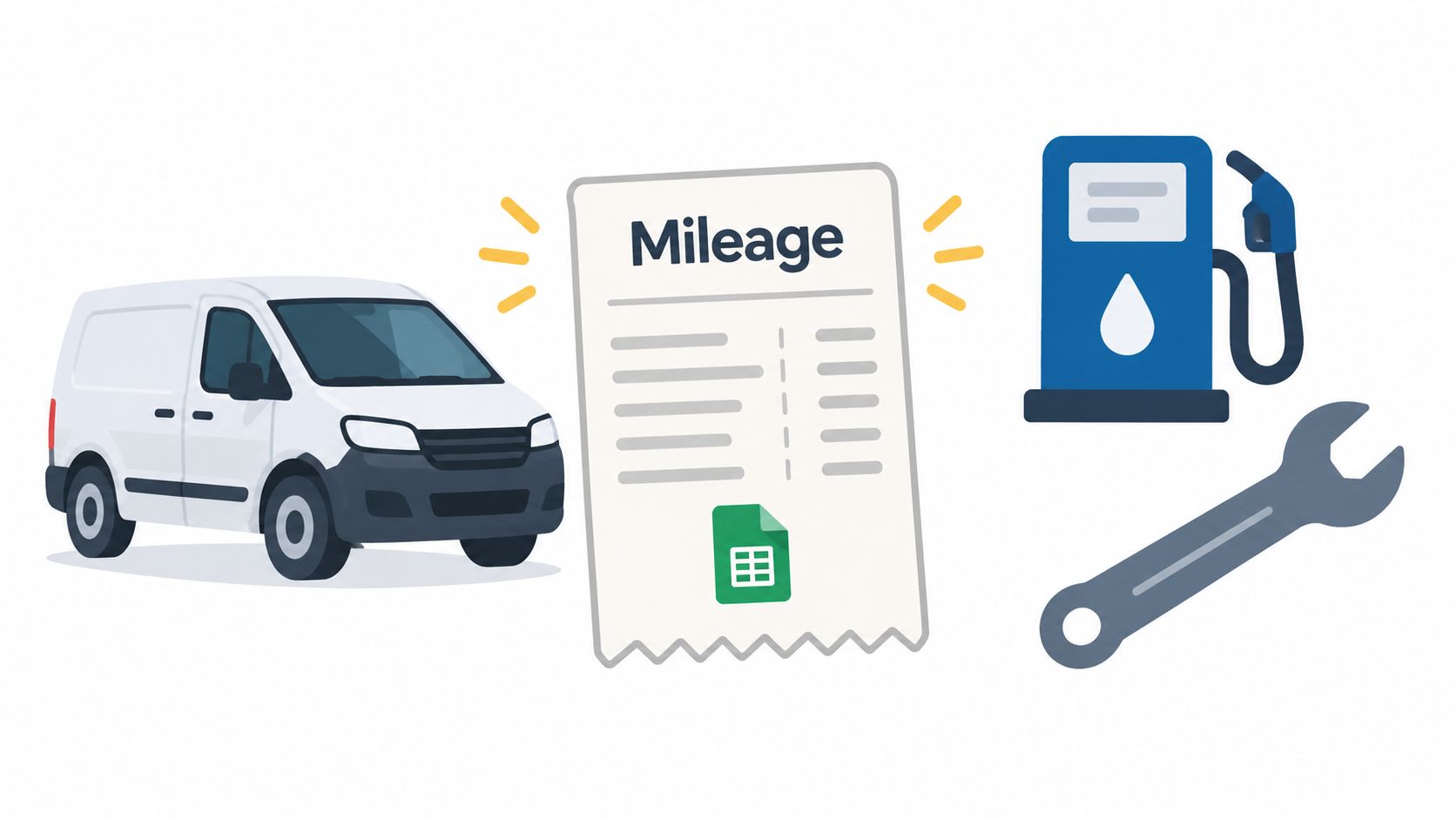
Vehicle costs combine operating consumption, asset ownership, employee reimbursement, and compliance evidence. Fuel, tolls, parking, insurance, registration, repairs, and maintenance may all be legitimate transportation costs, but they don't support the same decisions. A delivery business needs fleet economics. A sales team may need mileage reimbursement. A field-service company may need costs by vehicle, driver, or work order.
We should usually separate fuel, repairs and maintenance, tolls and parking, vehicle insurance, and mileage reimbursement. Company-vehicle fuel shouldn't be mixed with an employee's personal-car reimbursement. The payment source matters too. A fuel-card charge may require a vehicle or driver reference, while a mileage claim requires a trip log and business-purpose evidence.
Reconcile by vehicle, not only by vendor
A converted statement can bring fuel vendors, toll operators, service shops, and parking providers into one sortable table. Match those rows to a fleet or mileage record, then investigate purchases outside assigned routes, unusual fuel frequency, missing vehicle identifiers, and maintenance payments without work orders.
- Fuel: Match the merchant, date, vehicle, driver, and location where available.
- Maintenance: Tie repairs to a work order and vehicle history.
- Mileage: Match reimbursement to trip purpose, route, and approved mileage documentation.
- Tolls and parking: Allocate to a trip, client, project, or location when reporting requires it.
Bank data helps identify the cash event. It can't prove that personal mileage was business-related or that fuel was used by the company vehicle. Keep those supporting records separate and review them together.
6. Marketing and Advertising Expenses
Marketing transactions often span advertising platforms, agencies, designers, printers, event organizers, sponsorships, software, and client entertainment. A single “marketing” account is easy to use but weak for budget control. It won't show whether spending went to paid search, social campaigns, trade shows, content production, brand work, or an agency retainer.
A practical structure separates digital advertising, events and trade shows, creative and design services, printing and promotional materials, sponsorships, and marketing software where the volume justifies it. Campaign, channel, region, and cost-center tags should provide additional detail instead of creating a new account for every campaign.
Match cash activity to the campaign plan
A B2B software company might reconcile charges from Google Ads, LinkedIn, HubSpot, and a design agency against campaign budgets. The statement can show recurring charges and vendor patterns, while the marketing platform or invoice provides campaign, audience, and service-period detail. An e-commerce retailer can use the same process to isolate paid media from fulfilment or marketplace fees.
Convert the statement to CSV or XLSX, then add columns for campaign ID, channel, owner, service period, and approval status. Sort by vendor to find recurring commitments and by amount to prioritize review. Don't infer campaign performance from the bank transaction. Financial reconciliation confirms spend, while marketing reporting evaluates results.
Client entertainment also needs care. A restaurant payment may be a marketing event, a sales meal, employee travel, or a non-business charge. Require attendees, customer or campaign reference, and policy approval before assigning the account.
7. Insurance Premiums and Claims
Insurance payments can look repetitive, but coverage type and coverage period are critical. General liability, property, workers' compensation, cyber liability, directors and officers coverage, and employee health insurance shouldn't automatically share one account if management needs to monitor risk or renewal costs.
A construction company may have separate carriers for workers' compensation, general liability, equipment, and property. Each payment should be matched to a policy schedule, invoice, and coverage period. A prepaid premium may initially belong on the balance sheet and then be recognized over the coverage period, rather than expensed entirely on the payment date. That timing decision requires the applicable accounting policy and supporting documentation.
Build a policy-to-payment control
Maintain a policy inventory with carrier, coverage type, policy period, payment schedule, renewal date, responsible owner, and general-ledger account. Convert statement data and sort by carrier to identify expected payments, missing premiums, duplicate debits, and unfamiliar vendors. Compare each payment with the approved policy terms, not merely the prior month's amount.
Claims require separate tracking from premiums. A claim payment, deductible, reimbursement, or recovery may not belong in the same account as ordinary insurance expense. Keep claim numbers, correspondence, settlement details, and recovery expectations with the claim file so the accounting treatment remains traceable.
Employee health insurance can also involve payroll deductions, employer contributions, and remittances. Those flows should be reconciled to payroll records and carrier invoices rather than coded solely from the bank description.
8. Subscriptions and Software Licenses
Software subscriptions create a recurring-charge problem that broad expense lists rarely solve. A business may pay for accounting, payroll, security, collaboration, customer relationship management, design, hosting, and industry-specific tools. The bank statement may show a vendor name, but it won't show the department owner, active users, contract term, renewal date, or whether the service is prepaid.
Separate software subscriptions, hosting and infrastructure, security services, and software implementation or consulting when those distinctions improve decisions. Don't split every application into its own general-ledger account. Use a subscription register for vendor, owner, department, contract term, renewal date, payment frequency, and license count.
Review recurring charges against actual use
A technology company can convert monthly statements, sort by vendor, and compare recurring charges with its active-license list. New vendors may indicate a trial that became paid, an employee purchase, or an unapproved tool. A missing expected charge may reflect a billing change or a payment issue. Those are useful review signals, not automatic classification answers.
A finance team should also examine whether an annual payment is a prepaid expense, whether implementation work belongs outside ordinary subscription expense, and whether shared software needs departmental allocation. The invoice and contract establish the service period. The bank row establishes the payment.
For a repeatable process, use this bank reconciliation workflow to compare statement balances and transaction rows, then document exceptions before posting. Retain evidence for renewals, approvals, cancellations, and allocation decisions.
8-Category Expense Account Comparison
| Expense Category | 🔄 Implementation Complexity | ⚡ Resource Requirements | ⭐📊 Expected Outcomes | 💡 Ideal Use Cases | 📊 Key Advantages |
|---|---|---|---|---|---|
| Travel and Meals Expenses | Moderate–High, itemized receipts, per‑diem rules, multi‑currency | Medium, receipt collection, card feeds; benefits from automation | Accurate reimbursements, tax compliance, monthly reconciled travel ledger | Frequent business travel (sales, consulting) | Clear audit trail; streamlined reconciliation via bulk statement conversion |
| Office Supplies and Equipment | Low–Moderate, many small transactions, capitalization thresholds | Low, basic bookkeeping; automation reduces manual entry for volume | Controlled supplies spend, accurate asset schedules and depreciation | High-frequency low-value purchases, multi-location offices | Easy categorization; supports budgeting and vendor management |
| Professional Services and Consulting Fees | Moderate, invoice matching, project/cost‑center allocation | Medium, invoice access, approval workflows, project tracking | Accurate cost allocation, audit support, project profitability insight | Firms using outside advisors or project-based billing | Strong invoice‑payment linkage; enables client billing and allocation |
| Utilities and Facility Maintenance | Low–Moderate, recurring vendors, location allocations, seasonal variance | Low, predictable recurring payments; automation for anomaly detection | Forecastable facility costs, anomaly detection, occupancy cost visibility | Multi-location retail, property managers, facilities teams | Predictable trends; quick capture of recurring charges for budgeting |
| Vehicle and Transportation Expenses | Moderate–High, high-frequency fuel/maintenance, mileage substantiation | Medium, fleet/fuel card systems, maintenance logs, reconciliation | Fleet cost analysis, driver accountability, tax deduction support | Field service, delivery fleets, mobile sales teams | Enables fuel efficiency tracking; supports reimbursements and anomaly checks |
| Marketing and Advertising Expenses | High, many vendors, numerous small digital charges, ROI linking needed | Medium, campaign tracking, attribution data, cross-team coordination | Spending visibility, campaign ROI analysis, budget vs actual | Marketing-driven businesses, digital ad-heavy companies | Enables campaign-level allocation; rapid vendor identification after conversion |
| Insurance Premiums and Claims | Moderate, match premiums to policies, handle claims and timing differences | Low–Medium, policy docs, renewal schedules, carrier reconciliations | Compliance, premium tracking, renewal and cost-optimization visibility | Any business with multiple insurance policies | Centralized policy tracking; supports regulatory reporting and audits |
| Subscriptions and Software Licenses | Moderate, recurring charges, seat/license reconciliation, trial monitoring | Medium, IT/vendor inventories, owner assignment, license audits | License optimization, reduced duplicate spend, subscription visibility | SaaS-heavy organizations, companies with many cloud tools | Detects unused/duplicate subscriptions; aids renewal negotiations and cost control |
Turn Examples Into a Working Chart of Accounts
A strong chart of accounts starts with purpose, not a long list of names. Define what each account is meant to show, list representative transactions, identify items that need separate treatment, assign documentation requirements, and test the design against real statement data. If the account can't support a decision, it may be too broad. If nobody can code it consistently, it may be too detailed.
Use this implementation sequence:
- Define the account purpose: State the business question the account answers, such as total occupancy cost, campaign spend, or fleet maintenance.
- List representative transactions: Include ordinary, recurring, unusual, reimbursed, prepaid, and project-related payments.
- Separate boundary cases: Decide how to handle capital purchases, COGS, non-operating costs, prepaid items, personal-use portions, and client-reimbursable expenses.
- Assign evidence requirements: Specify when a receipt, invoice, contract, attendee list, mileage record, policy schedule, project code, or approval is required.
- Test against statement rows: Use actual vendor descriptions and transaction patterns, then revise names or subaccounts that create repeated ambiguity.
- Document allocation rules: Set the method for departments, locations, vehicles, campaigns, and customer projects before the first close.
Review converted CSV or XLSX rows by vendor, date, amount, recurrence, and business purpose, rather than coding solely from merchant names. A payment to an office retailer might be supplies, equipment, or a fixed asset. A restaurant charge might be travel, a client meal, a marketing event, or an unsupported personal expense. Classification remains a bookkeeping judgment supported by evidence.
Key takeaways
- Use specific accounts where decisions differ: Separate travel components, vehicle costs, software services, and insurance types when the distinction affects reporting or control.
- Set capitalization boundaries in advance: Don't decide asset versus expense inconsistently from one transaction to the next.
- Review recurring charges: Subscriptions, utilities, insurance, and professional retainers should be compared with contracts, invoices, and active services.
- Allocate meaningful dimensions: Use projects, locations, vehicles, departments, and campaigns when management needs that view.
- Match receipts and invoices: Bank rows confirm payment evidence, but supporting documents establish purpose, scope, timing, and approval.
- Protect the balance control: Verify opening balance + credits − debits = closing balance before using extracted data for reconciliation or reporting.
Autobankstatement supports the data-preparation step by converting digital, scanned statements through OCR, and password-protected PDF bank statements into CSV or Excel/XLSX files. It supports bulk uploads and files up to 25 MB, while the converted rows still need human review for account selection, allocation, tax treatment, and policy compliance. The service offers a free guest preview before payment, registered-user download access for 24 hours, and automatic upload deletion within 24 hours. Subscription options include Starter at $15 per month for 400 pages, Professional at $30 per month for 1,000 pages, and Business at $50 per month for 4,000 pages, with annual discounts and custom enterprise limits.
Use those outputs as a structured review layer, not as an accounting judgment engine. The most reliable process keeps the original statement, preserves opening and closing balances, matches rows to source documents, and records the reason for every material classification decision.
Use autobankstatement to convert digital, scanned, or password-protected PDF statements into review-ready CSV or Excel/XLSX tables for expense classification and reconciliation. Start with the free guest preview, verify the balance equation and supporting documents, then build a repeatable statement-review process around the accounts that matter most to your business.
Convert your next statement in minutes
Upload a bank statement PDF — digital, scanned, or password-protected — preview the extracted table, and download clean CSV or Excel.