
How Long Should You Keep Credit Card Statements in 2026?
How long should you keep credit card statements? Get the 60-day dispute window, IRS and VAT periods, and safe digital storage rules.
Routine personal credit card statements can generally come out after about one year once they're reconciled. A US billing-error notice has to reach the issuer within 60 days, tax-supporting statements stay at least three years after the return is filed, and UK VAT-related records run five years, or six when they form part of the VAT account. The purpose of each statement decides which of those periods applies.
The advice people repeat is tidier than the files we keep. Hold every statement for seven years, or shred the folder after tax season. Neither rule survives a card that mixes household spending, an open dispute, a deductible subscription, and equipment still on the books. A grocery charge and a server bought on the same account don't share a destruction date. Deleting by the document label, rather than by what the charge has to prove, is how evidence disappears before anyone asks for it.
Table of Contents
- Retention Periods at a Glance
- Why the 60-Day Dispute Window Sets the Floor
- Tax Records Follow the Tax Year, Not the Statement Date
- Worked Examples for Five Common Statements
- Verify a Converted Statement Before Deleting the PDF
- Digital Storage Without Creating a Breach Target
- Set One Retention Rule and Confirm Your Dates
Retention Periods at a Glance
There isn't one retention period for credit card statements. A short set of deadlines covers nearly every file a bookkeeper, finance team, or owner will see. Read the row that matches the purpose of the transactions, not the month printed on the PDF.
| Purpose | Minimum period | Basis |
|---|---|---|
| Routine personal statement, no dispute or tax link | About 1 year after reconciliation | FTC consumer guidance |
| Billing error dispute (US) | Written notice within 60 days of the first statement showing the error; keep until resolved | Fair Credit Billing Act, CFPB |
| Statement supporting a US tax return | 3 years after the return is filed | IRS record-keeping guidance |
| Bad debt or worthless securities claim | 7 years | IRS record-keeping guidance |
| Property or asset cost basis (US) | 3 years after disposal | IRS record-keeping guidance |
| UK VAT-related statement | 5 years; VAT account records 6 years | HMRC |
| Business records with no fixed rule | As long as needed under the tax code, usually until the return's limitation period ends | IRS Publication 583 |
How to read each row
Start with the shortest row only when nothing else on the statement does legal or tax work. Recent FTC consumer guidance treats ordinary credit-card bills like other household bills: about one year after reconciliation is enough when there's no dispute and no deduction. The moment a line supports income, an expense, a gift, loan activity, or an asset's cost, that line pulls the whole statement into a longer file.
US tax-record guidance commonly uses a three-year baseline for records that support a filed return. The same guidance stretches some files further. Records tied to a claim involving bad debt or worthless securities may need to be kept for seven years, as Investopedia's summary of tax-record periods notes. Property records don't expire with the purchase year. They run until three years after the asset is disposed of.
Business files are looser on paper and stricter in practice. IRS Publication 583 doesn't fix one number of years for every firm. It says businesses keep records for as long as they may be needed to administer the tax code, and it names credit-card charge slips and account statements as business records. We keep the statement with the invoice and the reconciliation, not the PDF alone.
A credit card statement often serves two purposes at once. When it does, the longest applicable requirement wins. Tag the purpose at reconciliation so a later purge doesn't guess.
Why the 60-Day Dispute Window Sets the Floor
For an ordinary personal card, the dispute window is the minimum, not a multi-year habit. Think of the statement the way you'd think of the date stamped on a parking ticket. That date, not the day you noticed the problem, tells you how long you have to contest it.
Under the US Fair Credit Billing Act framework, a written billing-error notice must reach the card issuer within 60 days after the first statement containing the alleged error was sent. The Consumer Financial Protection Bureau points out why the copy matters. The statement is what shows when that 60-day clock began. Covered problems include an uncredited payment, an incorrect charge, or another billing error.
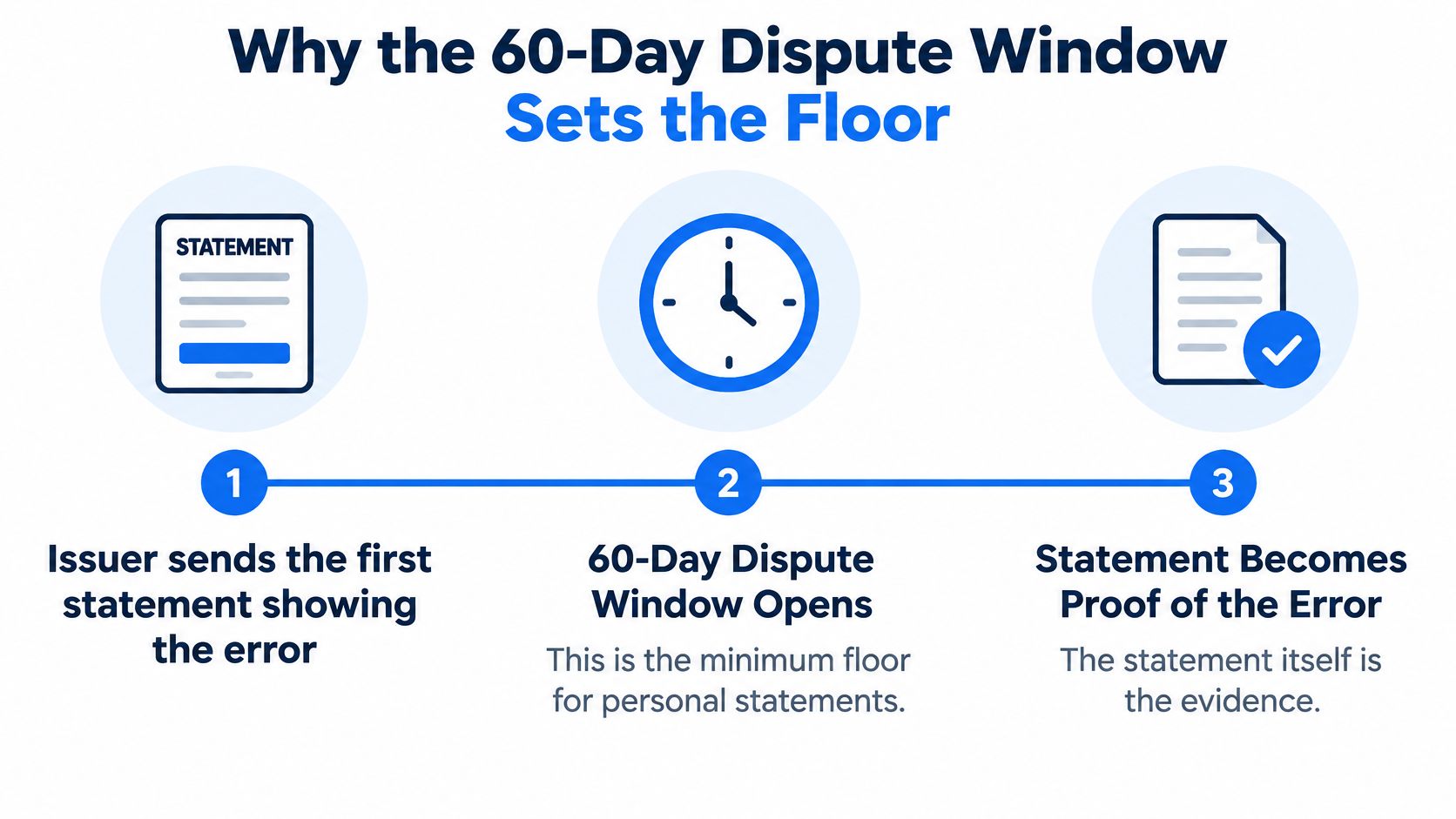
The dated sequence
The notice goes to the billing-error address printed on the statement. Regulation Z makes that address matter, because it can differ from the payment address. A letter sent to the wrong place can miss the window even if it was mailed on time.
After the issuer receives the notice, it generally must acknowledge it within 30 days unless it resolves the issue sooner. It must finish the investigation within two billing cycles, and that work is capped at 90 days. Those three dates, 60, 30, and 90, are why a "I'll deal with it next quarter" pile fails.
Keep one packet, not scattered emails:
- The statement: It anchors the day the clock started.
- The dispute letter: It shows what was challenged.
- Proof of delivery: It shows the notice arrived in time.
- The issuer's response and follow-up notes: They show whether the case is closed.
The 60-day figure is a US legal benchmark, not a worldwide rule. Cardholders elsewhere should check local consumer-credit rules and the cardholder agreement.
A warranty, return window, insurance claim, financing condition, or fraud concern can justify a longer hold. The practical floor is still simple. Keep each statement, receipt, and payment confirmation at least 60 to 90 days after the statement date, or until any dispute is fully closed, whichever is later.
Tax Records Follow the Tax Year, Not the Statement Date
A statement date is a billing event. A tax file follows the return that used the charge. That's why a December purchase can outlive the calendar year by several years, and why shredding "old" statements in January can strip a return you haven't even filed.
The statement and the receipt do different jobs. The statement links a payment to a tax-relevant transaction. The receipt or invoice shows what was purchased. The IRS treats credit card receipts and other proof-of-payment records as supporting documentation, and it states that tax records are normally kept for three years. We don't treat the statement alone as enough.
What three years actually means
Count from the filing date of the return that reported the item, not from the charge date. Say a firm buys software for $1,200 on a business card in 2026. The statement proves the card was charged. The invoice proves the business purpose. Both stay with the file for three years after the 2026 return is filed. If that return goes in during 2027, the destruction date sits in 2030, not in 2029.
Digital copies are acceptable when they stay readable, complete, and retrievable. The IRS applies the same retention expectations to electronic records as to paper. A photo that cuts off the last page, or a CSV nobody can tie back to a statement period, doesn't meet that bar.
Property is the extension people miss. When the transaction relates to property, records should generally be retained until at least three years after disposal. That covers equipment bought on a card, capitalized, and depreciated. The cost basis lives in the purchase evidence. Selling or scrapping the asset starts the shorter clock. It doesn't erase the earlier years.
Publication 583 puts credit-card charge slips and account statements in the business-record set. Keep them whenever they substantiate reported revenue, expenses, assets, liabilities, or credits. A freelancer's card and a company's card follow the same evidence logic. The return they support is what sets the date.
Attach a short reconciliation note to each tax-supporting statement: which expense or deduction it backs, and which return year it belongs to.
That note is what makes the file usable in an audit or a lender review. Without it, someone has to reconstruct purpose from memory.
Worked Examples for Five Common Statements
Generic advice rarely separates ordinary household records from tax-supporting evidence. FTC guidance says bank statements, credit-card bills, and utility bills can generally be kept for one year. Separate FTC tax-record guidance notes that tax-related receipts and canceled checks may warrant seven years, because the IRS can audit in some circumstances for that long. The five files below show how that split works on real paperwork.
| Statement | Why it matters | Keep until |
|---|---|---|
| Personal grocery charge, no dispute | Household record | About 1 year after reconciliation |
| Laptop purchase on a card with a 2-year warranty | Warranty claim evidence | End of the 2-year warranty, plus any claim |
| Disputed charge on a statement sent March 3, 2026 | Billing error | Written notice by May 2, 2026; then until the case closes |
| Business software subscription on a company card | Business expense deduction | 3 years after the return reporting it is filed |
| Equipment bought on a card, depreciated over time | Cost basis and depreciation | 3 years after the asset is disposed of |
A reconciled grocery charge with no dispute is the easy case. Once the month ties out, about one year is enough. The same card's laptop purchase is different. A two-year manufacturer warranty means the statement is claim evidence through the warranty, and through any claim that is still open when the warranty ends.
The March dispute is a calendar exercise. The issuer sent the statement on March 3, 2026. Written notice has to reach the issuer by May 2, 2026. After that, the packet stays until the case closes, even if a normal household year has already passed.
The software subscription supports a deduction, so it travels with the return that reports it. The depreciated equipment doesn't end when depreciation starts. Disposal is the event that starts the final three-year hold.
One rule the five files share
The document label doesn't decide retention. The transaction's evidentiary purpose does. A grocery statement is routine until a tax question, a warranty, or a legal matter turns that charge into proof. A card charge can still substantiate a business expense, a refund dispute, an insurance matter, a bankruptcy, or a proceeding long after the month feels old. That's the gap freelancers, small businesses, and accounting teams hit, because the statement is part of an audit trail, not merely a bill.
Tag purpose at reconciliation. Don't delete by age alone. Early deletion is the costliest mistake, since the statement is often the only proof of payment. Keeping only the issuer's online portal is fragile too. If the account closes or access changes, that copy can vanish. Export what you still need, and back it up.
Deleting quickly can be safer for privacy. Premature deletion weakens documentation. Purpose beats the label.
Verify a Converted Statement Before Deleting the PDF
A spreadsheet is easier to search than a PDF. That convenience means nothing if a row went missing during conversion, because the search fails and so does the evidence. A converted statement inherits the transaction's evidentiary purpose only when it reproduces the original line for line. Until the checks below pass, the PDF is the record and the spreadsheet is a draft. For the monthly routine of checking bank statements, this verification is the gate.
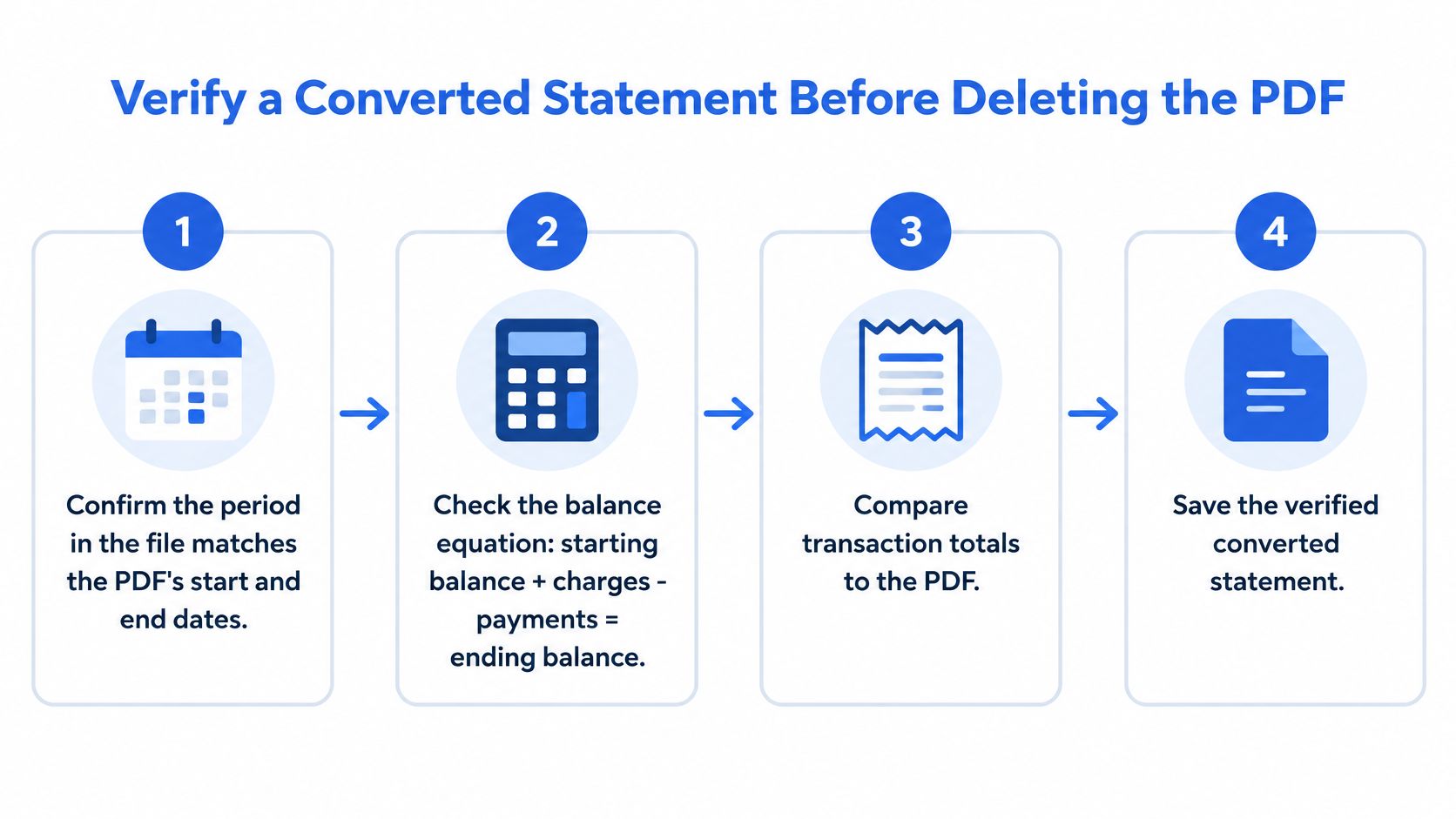
- Match the period. Confirm the file's start and end dates are the PDF's dates. A prior-month export filed under this month will balance and still be the wrong evidence.
- Run the balance equation. Opening balance plus credits minus debits must equal the closing balance. A mismatch means a missed row or a flipped sign.
- Compare counts and totals. Match the transaction count and the debit and credit totals to the statement summary, not only the ending balance.
- Spot-check at least five rows. Include the first line, the last line, and any large or foreign-currency charge. Those are where a parser usually slips.
- Check dates, signs, and running balances. On a scan, confirm the amounts read as printed. A 6 that became an 8 will not announce itself.
- Save the pair together. Keep the original PDF and the CSV or XLSX, named by statement end date, so a reviewer can open both.
- Then cut duplicates. Keep one authoritative copy in a controlled location, plus a backup. Delete extra PDFs only after the check passes.
A file that balances is usable evidence. When the numbers disagree, the review starts on the PDF, because the break is whatever the spreadsheet lost or relabeled. Keep both files for as long as the transaction's purpose requires, since a tax question or a dispute years from now will ask for the statement, and the converted copy earns its place only by matching it.
Issuers often deliver locked PDFs or image-only scans. Autobankstatement converts those too, taking the password at upload for that conversion only and reading scanned pages through OCR into CSV or Excel output. Files up to 25 MB can go up in bulk in one session, and a free guest preview shows the result before payment. Registered users get 24-hour download access, but the uploaded statement is deleted within seconds of processing finishing, so keep your own copy of the original PDF and save the converted file to your archive during that download window. The tool doesn't hold a retention archive for you.
Digital Storage Without Creating a Breach Target
More storage isn't safer. A shared drive full of ten years of card PDFs is a breach target with a folder name. Many articles still say "keep everything for seven years." FTC guidance is narrower. Protect financial records, review statements for unauthorized charges, and shred documents that contain personal or financial information when disposal is appropriate. The FTC also tells businesses not to retain sensitive information longer than necessary, because extra retention raises exposure to fraud or identity theft, and it recommends written retention and secure-disposal policies.
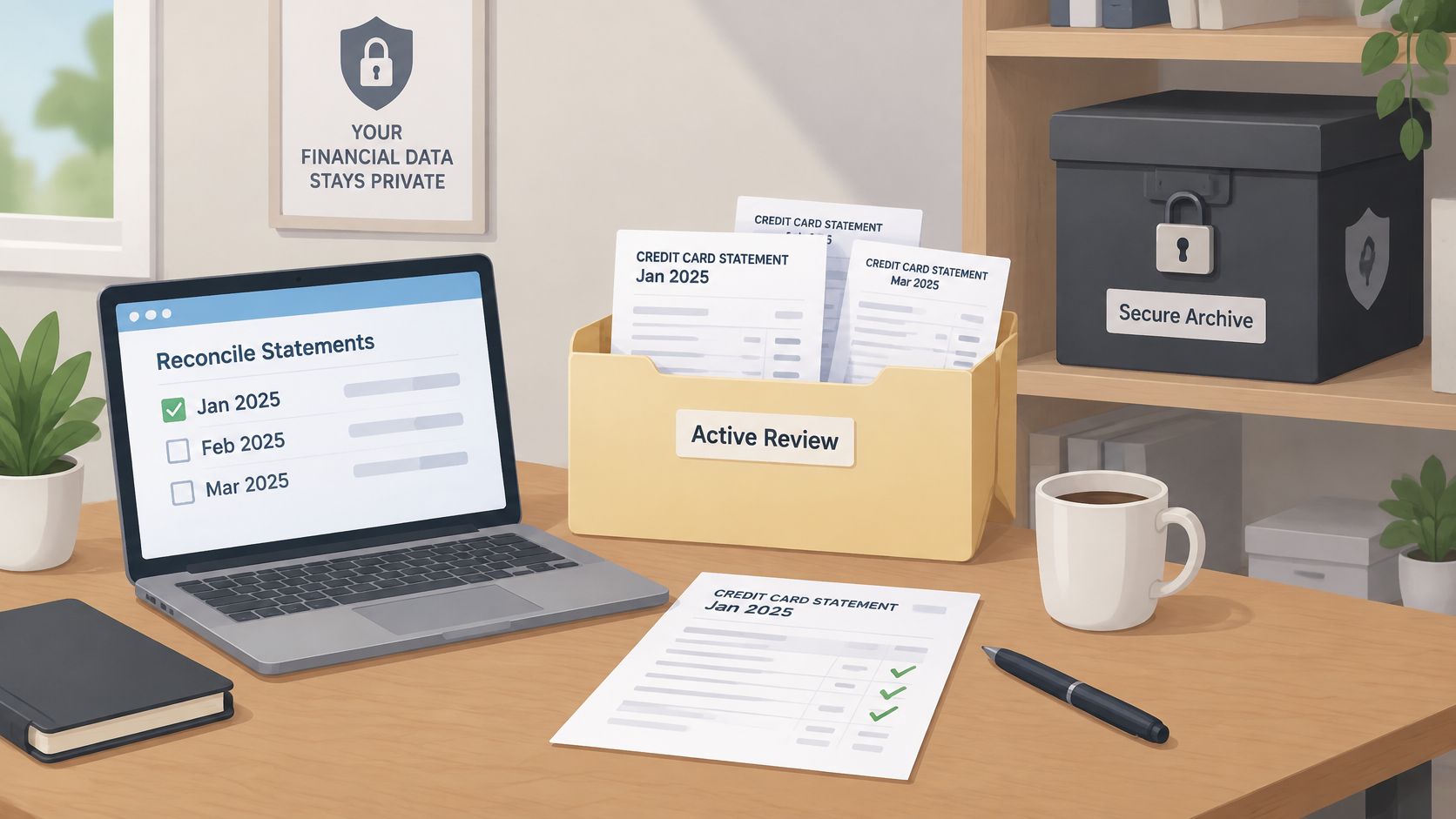
Active review versus the archive
Separate the working month from the archive. Download what reconciliation needs, convert it into one controlled record, and restrict who can open that record. Encrypt backups. Don't leave full account numbers in a shared folder "so the team can find them." Once the authoritative copy is verified, securely delete duplicate PDFs and the paper.
For households, an electronically accessible copy can justify shredding the paper. Shred paper that still shows personal details once disposal is appropriate. FTC material lists credit-card bills among documents often kept for one year when they aren't doing tax or dispute work. The test isn't the year count. It's whether the copy you kept is complete, searchable, recoverable, access-controlled, and gone when the need ends.
Three operational problems get skipped in consumer write-ups:
- Password-protected PDFs: Put the password in a password manager. Never put it in the file name.
- Scanned statements: They aren't searchable until OCR has run, and a bad scan should be rechecked against the paper before the paper is shredded.
- Monthly bulk archives: They grow into thousands of files. Name them by statement end date and purpose tag, or the January review becomes a scroll.
Don't upload sensitive statements to a service you haven't checked. Read the provider's data-handling terms first. An online portal copy you don't control is not an archive. If the account closes or the issuer changes access, that history can stop at whatever the portal still shows. Export the periods you still have a reason to keep.
A retained file should be complete, searchable, recoverable, and access-controlled, then securely disposed of when the business or legal need ends.
Set One Retention Rule and Confirm Your Dates
We use one retention rule per purpose, taken from the table above, rather than one number for every PDF. A statement stays for the longest period any of its purposes requires. Tag it at reconciliation so the purge later doesn't depend on memory.
HMRC's compliance handbook lists bank statements among records that may need five years for certain VAT-related purposes, while records that form part of the VAT account generally require six years. When one document serves more than one purpose, use the longer period. The same logic covers tax, accounting, litigation, lending, and internal-control holds. A personal-finance interval doesn't override them. US billing-error timing stays critical on its own track. If a dispute is open, keep the statement, the transaction detail, the dispute notice, and the issuer correspondence until the case is fully resolved, even when the normal tax period has already expired.
Before anything is deleted:
- Confirm the tax year each tax-supporting statement belongs to.
- Calendar every open dispute, counting 60 days from the statement date printed on the statement.
- Tag each file as routine, dispute, tax, or property.
- Set a review date each January.
- Confirm the period with a qualified accountant or the tax authority before deleting records for a regulated business, a lender's file, or an active audit.
VAT periods apply where HMRC governs the business. They aren't a default for a US-only filer. Apply the rule to the last full tax year, purge files that no longer serve a purpose, and note the purge date in the archive index so the decision can be shown later. Issuer portals aren't a substitute for that index. How long banks keep records is their policy, not your evidence file.
When a stack of card PDFs still has to be checked before anyone deletes the originals, autobankstatement converts those PDFs, including locked and scanned files, into CSV or Excel so the balance check and the row review can happen in a spreadsheet. Retention stays in your archive, not in the upload. Visit autobankstatement to preview a statement and keep the verified copy with the PDF.
Convert your next statement in minutes
Upload a bank statement PDF — digital, scanned, or password-protected — preview the extracted table, and download clean CSV or Excel.