
Account Number Short Form: Formats, Examples, and Privacy
Learn what account number short form means — abbreviations like Acct. No., masked formats such as ****1234, and best practices
We're closing the month, and the statements don't agree on something as simple as a heading. One PDF says Acct. No., another says A/C, and a shared worksheet shows only ****1234. Before we copy anything into the reconciliation file, we need to know whether we're shortening a label, concealing an identifier, or working with data that's already incomplete.
Table of Contents
- What Account Number Short Form Actually Means
- The Standard Abbreviated Labels and Where They Come From
- Masked and Truncated Formats You Will See on Statements
- Choosing the Right Format for Each Use Case
- A Reconciliation Walkthrough Using Shortened Account Numbers
- Account Number vs IBAN vs Sort Code and Other Identifiers
- Why Masking Is Not Automatically Safe
What Account Number Short Form Actually Means
The simplest answer is that account number short form usually means Acct. No., A/C No., or Account No. These are shortened labels, not shortened account identifiers. General English references recognize a/c and acct. as abbreviations for account, but the surrounding form determines what information belongs beside them, as reflected in the Cambridge Dictionary entry for account.
In statement processing, however, colleagues may use “short form” to mean a concealed number rather than an abbreviated heading. That ambiguity matters: changing a column name doesn't protect its contents, while concealing its contents may leave us without enough information to identify the account.
Separate the label from the value
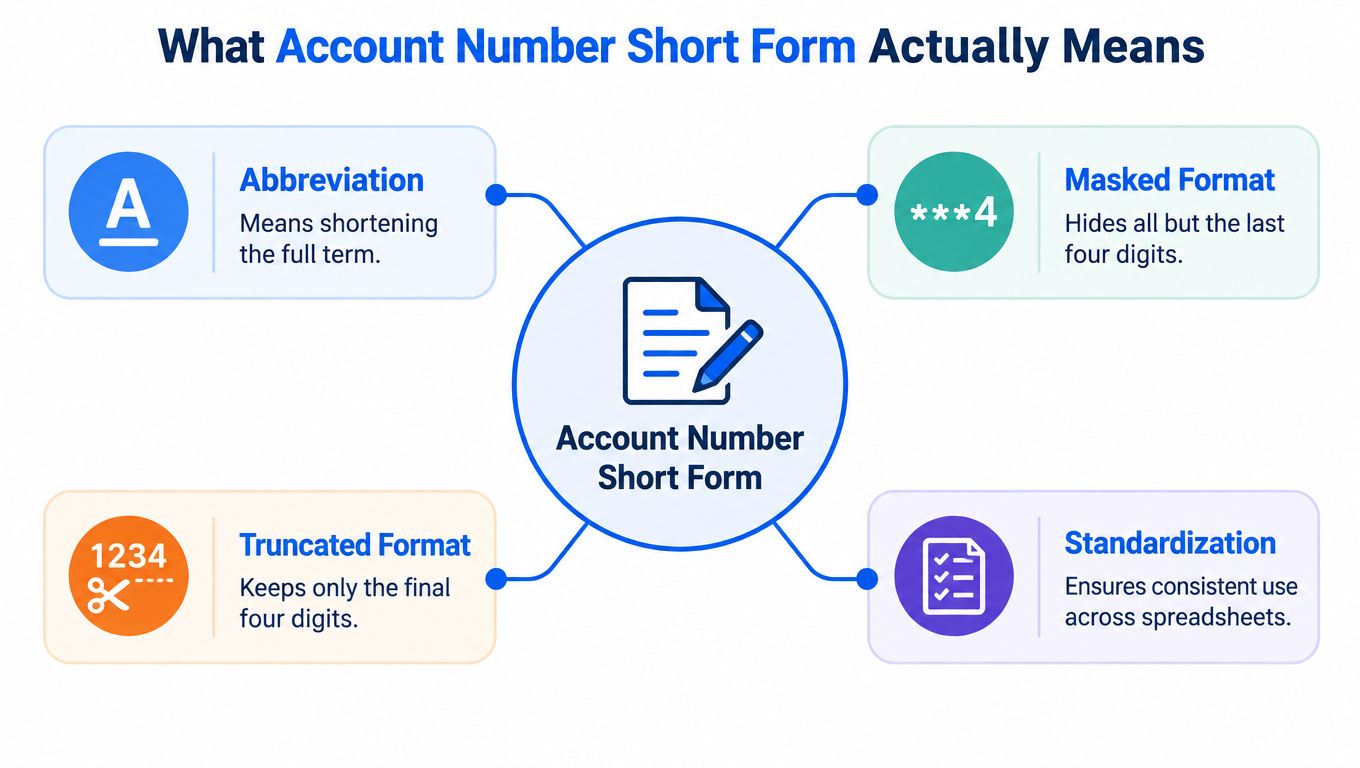
We can resolve the ambiguity by asking what changed:
- Abbreviation: We write
Acct. No.instead ofAccount Number. The value beside it may still be complete. - Masked display: We show a representation such as
****1234instead of exposing the complete value. - Truncated field: We retain only a selected portion of the identifier in that field.
- Standardized label: We map different source headings to a consistent spreadsheet column without changing their meaning.
Practical rule: Before approving a shortened account field, ask whether we changed the wording, the visible value, or the stored value.
We should also ask who will use the result. A colleague preparing an authorized payment needs different information from a reviewer checking whether a statement belongs in a reconciliation pack.
Our working rule is therefore broader than spelling: name the field accurately, preserve the information needed for the task, and expose no more than the recipient needs. That gives us a useful basis for handling domestic account numbers, international identifiers, shared previews, and spreadsheet records.
The Standard Abbreviated Labels and Where They Come From
Acct. No., A/C No., and Account No. express the same basic label when the document asks for an account number. Their differences are editorial: Acct. and A/C shorten account, while No. shortens number. None of these choices makes the value confidential.
Account numbering developed alongside mechanized banking and check processing. A commonly cited milestone places account-number arrangement systems around 1910, when numbering helped sort checks and route them to the correct account holders, according to this account-number reference. The useful distinction is between the identifying code and the words printed beside it.
Choose the label by meaning
| Label | Appropriate editorial use | What we should verify |
|---|---|---|
| Acct. No. | Compact spreadsheet or form heading | The value is the requested account number |
| A/C No. | Preserving a statement's existing terminology | The surrounding document confirms its meaning |
| Account No. | A clearer heading for mixed audiences | The number hasn't been substituted for another identifier |
| Account ID | A deliberately broader reference field | Its definition is documented rather than assumed |
We shouldn't “correct” every heading to Acct. No. merely because it looks familiar. If a source uses Account ID, we first establish whether that means the bank's account number, an internal reference, or another identifier. When the meaning remains uncertain, preserving the source label is better than creating false certainty.
A consistent heading is useful only when the values beneath it mean the same thing.
For a form that explicitly requests an account number, Acct. No. is a reasonable compact label. For an existing payment form, we follow its terminology rather than replacing a more specific field name.
International records require particular care. A domestic customer-account value may be a component of a larger international identifier, not its replacement. We should therefore standardize labels only after identifying the field, not use standardization as a reason to combine unlike identifiers.
Masked and Truncated Formats You Will See on Statements
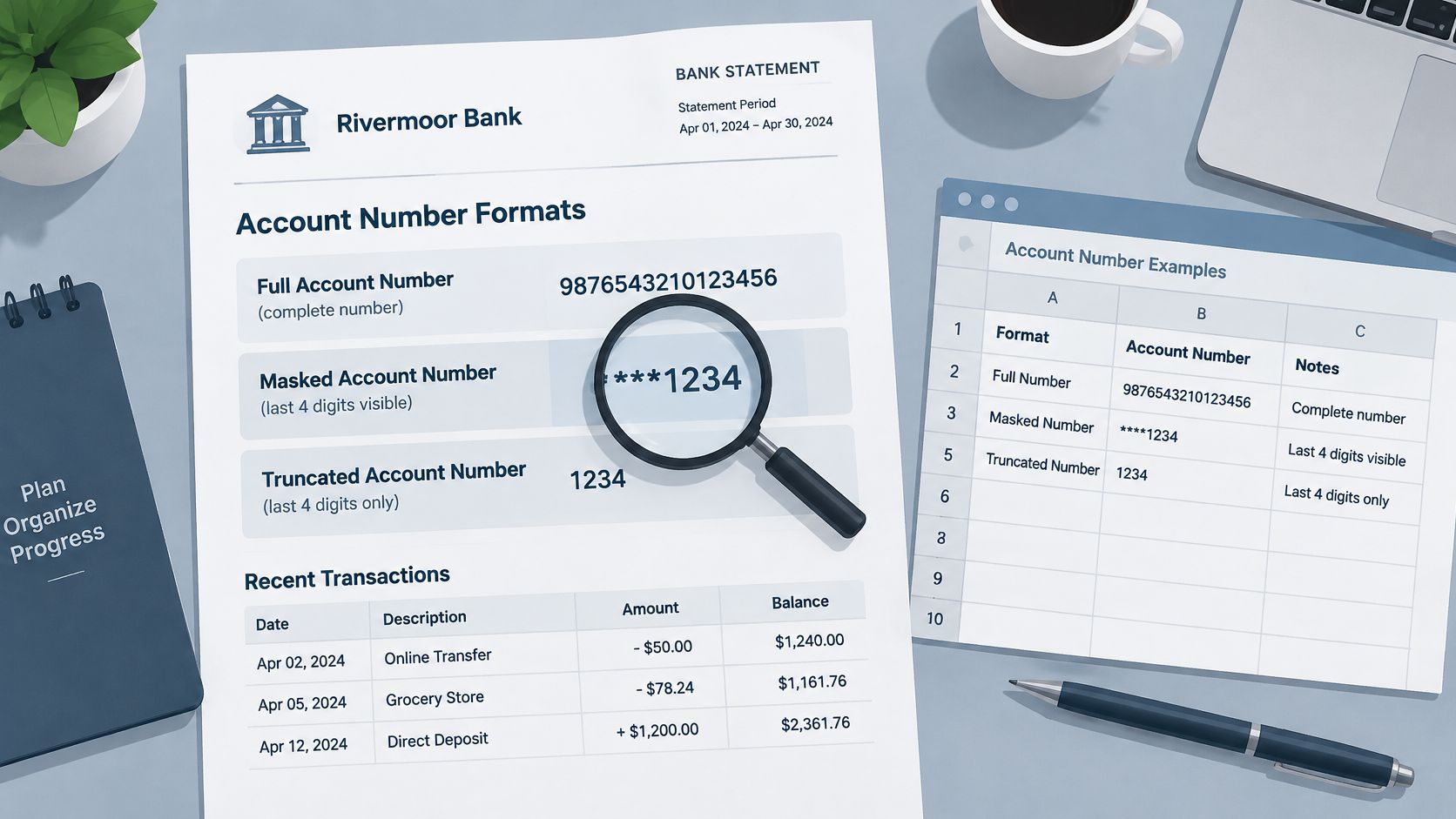
A statement showing Acct. No. ****1234 contains both an abbreviated label and a shortened display. The heading tells us what the field represents; the asterisks tell us that the displayed identifier isn't complete. Neither tells us, by itself, what the underlying system stores.
The important distinction comes from PCI Security Standards Council guidance on masking and truncation: masking conceals digits during display or printing, whereas truncation removes data from a stored representation so it can't be recovered from that field.
Understand what the field contains
For payment-card primary account numbers specifically, PCI display guidance generally permits the BIN and last four digits, unless a documented business justification allows more. Its storage protections are separate and can include truncation, encryption, tokenization, or one-way hashing. We shouldn't present those card-specific requirements as a universal display rule for bank deposit accounts.
For statement work, a useful field design is:
account_number_original: The value exactly as supplied by the statement, held in the restricted working record.account_number_masked: A deliberately concealed representation for an appropriate review surface.account_number_last4: A limited reference value for human comparison, not a replacement for the complete identifier.
If the source itself is masked, the “original” field contains that masked source value. We mustn't imply that extraction recovered the concealed digits.
A guide to reading a bank account statement can help us interpret the field in its document context. We should inspect the heading and surrounding details rather than treating every prominent numeric string as an account identifier.
Finally, a shortened reference isn't a unique matching key. Different customers or institutions can share the same ending, so we use it to support review, not to authorize an automatic match by itself.
Choosing the Right Format for Each Use Case
We choose an account-number format by asking what the recipient must do. A client confirming which account supplied a statement may need only a recognizable reference. An authorized colleague entering payment instructions may need the complete identifier through an approved channel.
The following is a recommended working policy, not a claim that every bank or software product handles fields this way.
Short form format by use case
| Use case | Label | Display format | Access control |
|---|---|---|---|
| Printed review statement | Acct. No. | Masked where the complete value isn't needed | Controlled printing, handling, and disposal |
| Restricted reconciliation workbook | Account number | Complete source value where justified | Access limited to authorized preparers |
| Client email | Account ending | Limited reference only | Confirm recipient and avoid unnecessary attachments |
| Shared reconciliation pack | Account reference | Masked or truncated reference | Recipient-specific sharing |
| Automated review preview | Acct. No. | Masked display linked to a restricted original | Separate preview access from full-value access |
A useful automated-preview design keeps a limited display separate from the restricted working record. That's a workflow recommendation, not a feature we should assume a particular converter provides. We need to inspect the actual preview and export before sharing either.
A reconciliation log can hold a limited reference while authorized preparers retain the necessary source record elsewhere. We shouldn't put a complete identifier into every working paper because it was available during extraction.
Check document permissions separately
PDF access introduces another decision. Adobe distinguishes an opening password from a permissions password that restricts actions such as copying, editing, or printing in its PDF security guidance. A statement may therefore be viewable while copying remains restricted.
We first confirm that we're authorized to process the document, then establish which restriction applies. Being able to open a PDF doesn't settle whether we should extract it, share it, or expose its account information in an unrestricted spreadsheet.
A Reconciliation Walkthrough Using Shortened Account Numbers
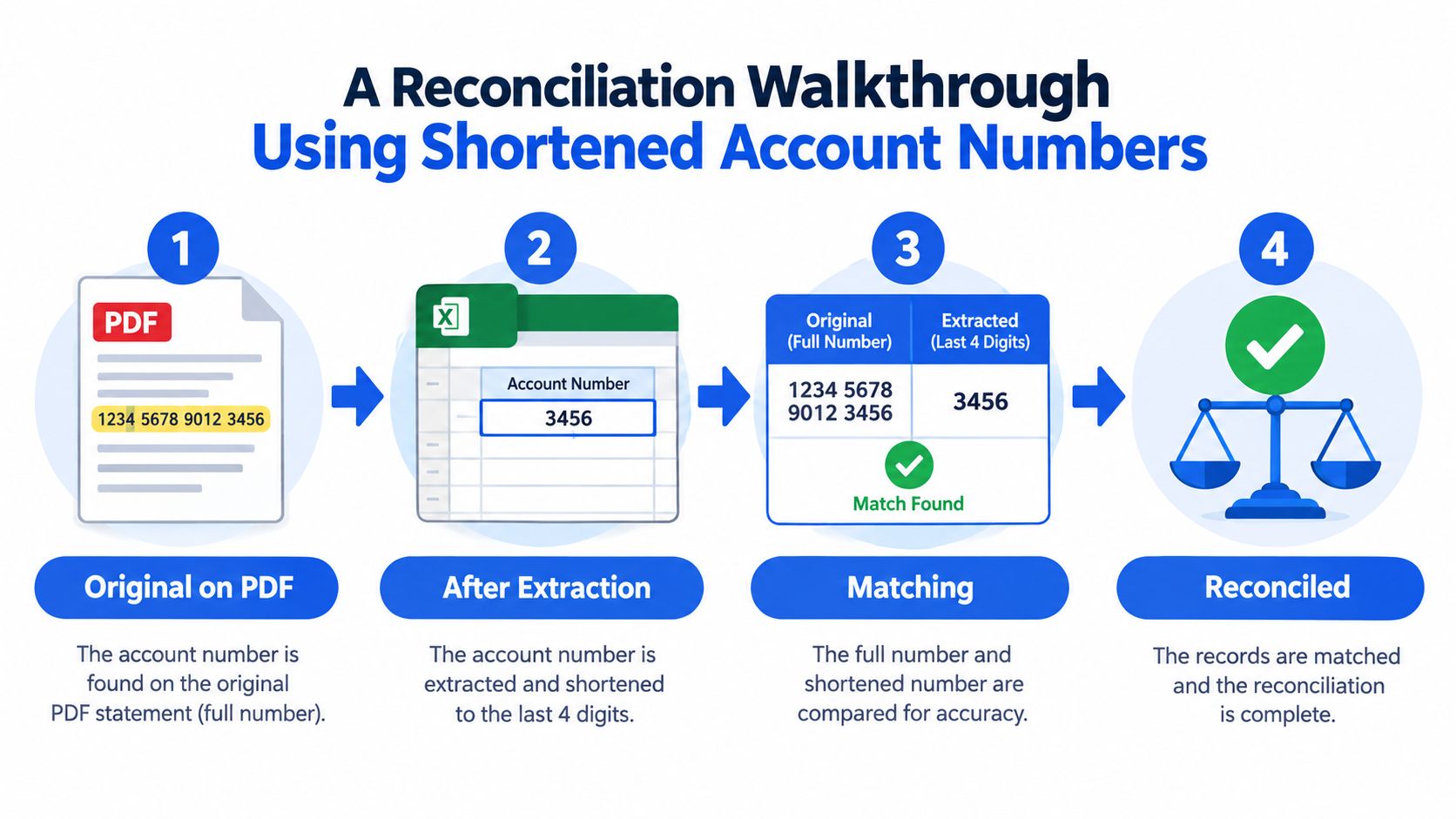
Suppose we receive a monthly PDF whose account field ends in 1234. This is an illustrative workflow, not a customer case study. We start with the statement itself, identify whether its account field is complete or already concealed, and retain that source representation without guessing.
In the restricted preparation workbook, we preserve the extracted original field. We then create the review representation and limited reference deliberately, rather than overwriting the original column. The shared reconciliation sheet receives only the fields its reviewers need.
Check identity before checking the arithmetic
- Confirm the account context: Compare the account holder, institution, statement period, and authorized account record.
- Inspect the extracted field: Check that the export preserved the source value and didn't confuse it with a nearby identifier.
- Prepare the review copy: Include the appropriate limited reference and exclude unnecessary full-value fields.
- Reconcile the balances: Verify opening balance + credits − debits = closing balance.
That equation checks the statement's balance movement. It doesn't establish that we selected the correct account, and a correct account reference doesn't establish that every transaction was extracted accurately. We need both checks.
For a broader explanation of the matching process, our bank statement reconciliation guide provides the accounting context around the preparation work.
Review scanned statements against the original
An image-only PDF requires optical character recognition, or OCR, to make its visible text searchable and extractable. Adobe explains that OCR adds a text layer and recommends comparing extracted statement information with the original scan in its PDF data-extraction guidance.
We review dates, descriptions, amounts, and balances against the PDF, paying particular attention to decimal points, minus signs, and column boundaries. If a balance check fails, we investigate the extraction and transaction classification rather than adjusting a figure to make the workbook agree.
Review checkpoint: A tidy spreadsheet is an output format, not evidence that the underlying statement has been reconciled.
Account Number vs IBAN vs Sort Code and Other Identifiers
An account number and an IBAN aren't interchangeable labels. IBAN means International Bank Account Number, standardized through ISO 13616. Its structure begins with a two-letter country code, followed by two check digits and a country-specific Basic Bank Account Number, or BBAN, as described in the European banking guidance on IBAN structure.
That structure permits an IBAN of up to 34 alphanumeric characters, including a BBAN of up to 30 characters, with a fixed national length. The same guidance provides examples of 27 characters for France, 22 for Germany, 16 for Belgium, 24 for Slovakia, and 23 for the UAE, where the customer-account portion occupies 16 characters.
Keep identifiers in their own fields
| Source field | Recommended handling |
|---|---|
| Domestic account number | Preserve as the domestic account field |
| IBAN | Retain the complete international identifier |
| Sort code, routing number, or branch code | Keep separately under its source-specific heading |
| BIC/SWIFT | Don't rename it “Acct. No.” |
| Card number | Don't merge it into the bank-account field |
| Account ID | Establish its meaning before mapping it |
IBAN check digits use ISO/IEC 7064 MOD97-10, supporting automated detection of many transcription and formatting errors under the ISO IBAN framework. Structural validation is useful, but we still need to confirm that the identifier belongs to the intended account.
For spreadsheet preparation, we recommend retaining the source representation alongside a canonical IBAN field without spaces. A separate human-readable version can follow the source grouping, without changing the underlying identifier.
When a form requests IBAN, we supply the IBAN rather than a locally labeled account component. When supporting documentation is needed, a bank letter confirming an account can be considered alongside the statement and the recipient's requirements.
The practical boundary is simple: normalize presentation without erasing meaning. A parser should flag an ambiguous field for review instead of placing every number into a catch-all account column.
Why Masking Is Not Automatically Safe
A concealed display reduces exposure, but it doesn't make the surrounding document harmless. A limited account reference can still appear beside an owner's name, institution, balances, and transaction history. We should assess what the recipient can learn from the whole record, not just the account-number cell.
Government identity-theft prevention guidance from South San Francisco identifies bank account numbers as information that can be used in identity theft and advises against unnecessary sharing. Our operational response should be data minimization, not confidence based solely on asterisks.
Apply controls to the actual task
- For written labels: Treat abbreviation as a presentation choice, never as protection for the value beside it.
- For review documents: Include only the information necessary for that review, including transaction details.
- For complete identifiers: Restrict access and use an approved encrypted transmission method rather than ordinary unencrypted sharing.
- For retained records: Keep documents only as long as operational needs and applicable obligations require.
Before sending a workbook, we should inspect the actual deliverable rather than just the visible worksheet. Our recommended check includes whether unnecessary source fields remain elsewhere in the file and whether the recipient needs the original statement at all.
We should also separate recognition from authorization. A reviewer recognizing an account's ending is not, by itself, sufficient grounds to approve a payment, change banking details, or combine account records.
Share enough to complete the accounting task, not everything available in the source document.
A sound account-number policy makes those decisions explicit: which fields we retain, which representation we share, who can access complete values, and when we remove working copies. That's how a spelling question becomes a dependable data-handling practice.
For teams preparing statements for these checks, autobankstatement converts digital, scanned via OCR, and password-protected PDF bank statements into CSV or Excel/XLSX, with bulk upload and a free guest preview before payment. Visit autobankstatement to preview a conversion, then review the exported identifiers and verify opening balance + credits − debits = closing balance before using the file for reconciliation.
Convert your next statement in minutes
Upload a bank statement PDF — digital, scanned, or password-protected — preview the extracted table, and download clean CSV or Excel.