Bank Statements for Mortgage Applications: A Practical Guide
Prepare bank statements for mortgage applications by checking periods, deposits, redactions, lender-ready exports, and common underwriting red flags.
You're preparing a mortgage application, the bank balance looks sufficient, and the financial documents are ready to send. Then the lender asks for another statement, evidence behind a transfer, or pages that seemed irrelevant. For accountants, bookkeepers, finance teams, and business owners, the challenge isn't just collecting files. It's making sure those files answer the underwriter's questions.
When we prepare bank statements for mortgage application review, we should treat them as financial evidence, not disposable attachments. The original documents establish the record. Our organization, explanations, and spreadsheet checks help someone else verify it without guessing.
Table of Contents
- Why Mortgage Statement Requests Fail
- Understanding Mortgage Statement Requirements
- Prepare a Complete Statement File
- Review Transactions Before Submission
- Explain Deposits With Evidence
- Organize Files and Protect Privacy
- Create Lender-Ready Spreadsheet Exports
- Run the Final Mortgage Document Check
Why Mortgage Statement Requests Fail
Consider a hypothetical application-day problem. A business owner supplies a current account screenshot and a polished spreadsheet showing available cash. The bookkeeper has checked the arithmetic, but the lender returns the packet because it doesn't establish the statement period or explain a recent credit.
Nobody necessarily calculated anything incorrectly. The problem is that a balance and a transaction summary answer different questions from a complete bank statement.

A Complete-Looking File Can Still Be Incomplete
We might see enough money and conclude that the applicant is ready. An underwriter still needs to connect the account holder, reporting period, transactions, and available funds. Missing pages or an unexplained credit can interrupt that connection even when the closing balance looks reassuring.
The practical questions are straightforward:
- Whose funds are these? The statement must connect the applicant to the account.
- What period does the evidence cover? A current screenshot doesn't establish the requested history.
- Where did relevant deposits originate? A credit description may need supporting documentation.
- What remains available? Money moving through an account isn't necessarily money available for the mortgage.
Assign Preparation Responsibilities Clearly
Our recommended division of work keeps interpretation separate from evidence collection. Applicants obtain bank-generated records and explain transactions they recognize. Bookkeepers match activity to supporting records, while accountants and finance teams investigate inconsistencies and maintain the submission packet.
The lender controls what documentation is acceptable and how funds are treated. We shouldn't promise approval because a file is neatly organized.
Practical rule: Prepare the packet so a reviewer can trace a relevant balance or deposit back to its original evidence without relying on our memory.
That standard is more useful than asking whether every upload box contains a file.
Understanding Mortgage Statement Requirements
Asset verification and income qualification aren't the same process. In a conventional mortgage application, statements help establish whether the borrower has sufficient eligible funds. A specialized bank-statement mortgage program may instead use deposit history to help calculate income.
We should confirm which process the lender is applying before selecting accounts or building a transaction analysis.
Start With the Applicable Documentation Standard
For U.S. lending under Fannie Mae's guidance, statements should identify the institution and borrower, show at least the last four account digits, identify the covered period, include transaction activity, and show the ending balance. The usual benchmark is the most recent full two months, equivalent to 60 days, for a purchase, and full month, equivalent to 30 days, for a refinance. When the latest statement is more than 45 days older than the application date, a supplemental bank-generated document should show the account identifier, balance, and date, as described in Fannie Mae's verification-of-deposits-and-assets guidance.
These are program benchmarks, not universal instructions for every mortgage. We should request the lender's current requirements rather than substitute a generic checklist.
| Documentation purpose | What we need to establish |
|---|---|
| Purchase assets | Eligible funds available for the transaction |
| Refinance assets | Funds required under the applicable refinance instructions |
| Post-closing reserves | Eligible liquidity remaining after closing |
| Specialized income analysis | Deposits the lender accepts under its program rules |
Understand What Reserves Measure
Fannie Mae defines reserves as liquid or near-liquid assets remaining after closing, measured against the borrower's qualifying housing payment, including principal, interest, taxes, insurance, and applicable assessments, commonly called PITIA. Eligible categories include checking and savings accounts, money-market funds, certificates of deposit, investments, vested retirement savings, and qualifying life-insurance cash value. Importantly, funds needed to close are subtracted before reserves are assessed, so the same money can't serve both purposes under Fannie Mae's minimum-reserve framework.
A high balance therefore doesn't settle every underwriting question. We still need to understand what the funds represent and whether they remain available.
Terminology also matters. Our guide to verification of mortgage provides context for a separate mortgage-documentation term; it shouldn't be confused with verifying deposit-account assets.
Prepare a Complete Statement File
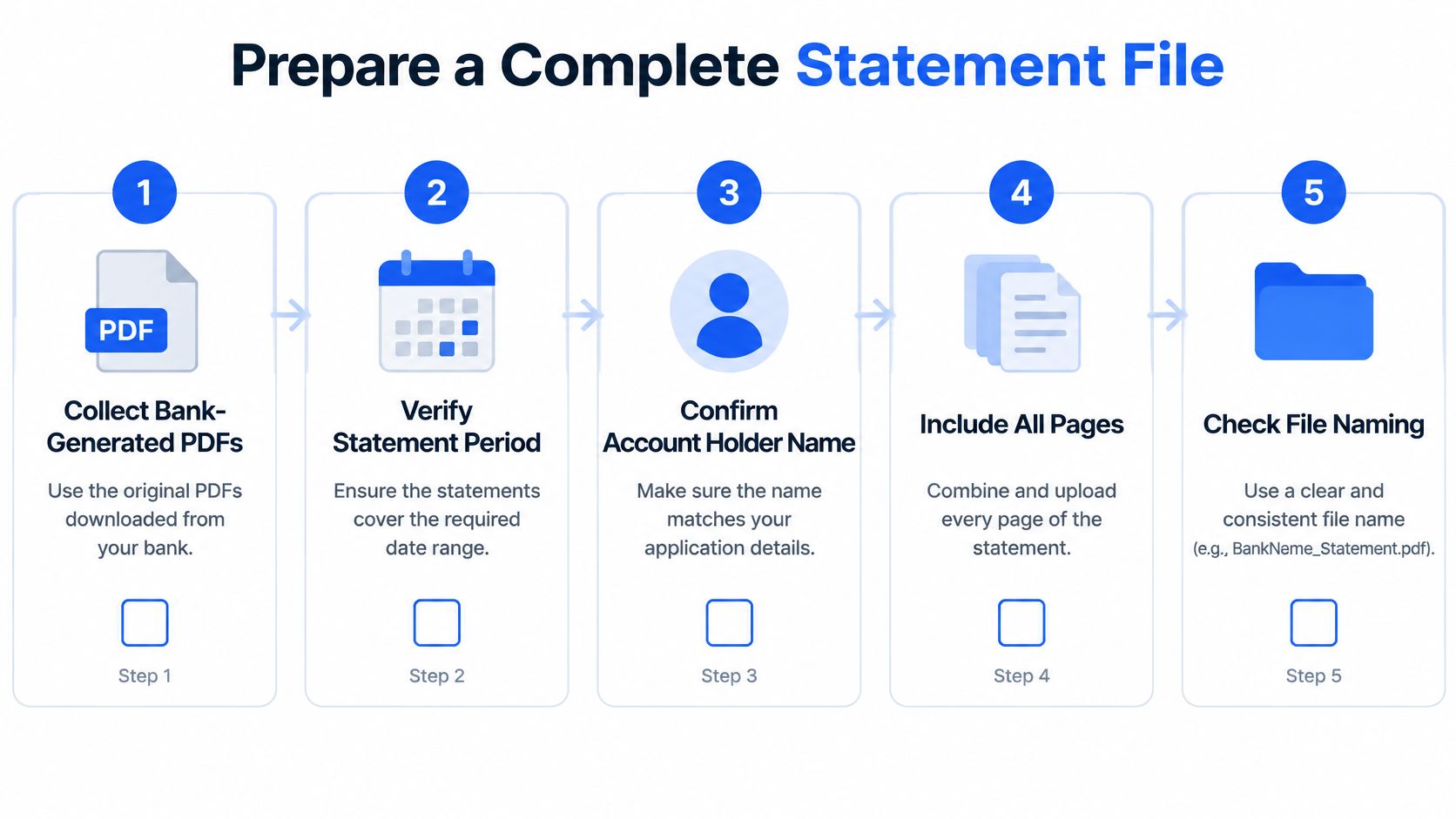
Begin with the bank's original PDF, not the spreadsheet we eventually want to analyze. Before converting or annotating anything, we should establish that the source document is complete and belongs in the requested packet.
A useful filing pattern is Borrower_AccountLabel_StatementPeriod_Original.pdf. Use a consistent account label rather than exposing a full account number in the filename.
Check the Source Before Editing
Our document-control routine should cover the following:
- Match the requested period. Confirm that the statements cover the lender's specified window without unexplained gaps.
- Confirm ownership and institution details. Compare the account-holder information with the application and flag differences for clarification.
- Preserve every page. Keep the original page set together, including pages that appear administrative.
- Inspect balances and activity. Check that opening and closing balances are readable and that transaction pages haven't been omitted.
- Assess freshness. Apply the statement-age requirement described earlier, and request bank-generated supplemental evidence when necessary.
- Identify supporting records. Note deposits or transfers that need a separate evidence document before submission.
The ownership check deserves attention when a business account is involved. We shouldn't assume that a business name on a statement establishes the individual borrower's access to those funds. Ask the lender what additional evidence it needs.
Separate Originals From Working Papers
Keep annotations in a companion worksheet rather than changing the bank-generated record. For example, a note can identify a transfer's matching withdrawal and the supporting statement filename.
Preserve what the bank issued. Put our interpretation beside the evidence, not inside a replacement version of it.
We should also record unresolved questions before sending the packet. A clearly identified ownership mismatch is easier to discuss than an unexplained discrepancy discovered during review.
Redaction and conversion come after these source checks. Neither process can repair missing history, and neither should conceal an inconsistency that the lender needs to evaluate.
Review Transactions Before Submission
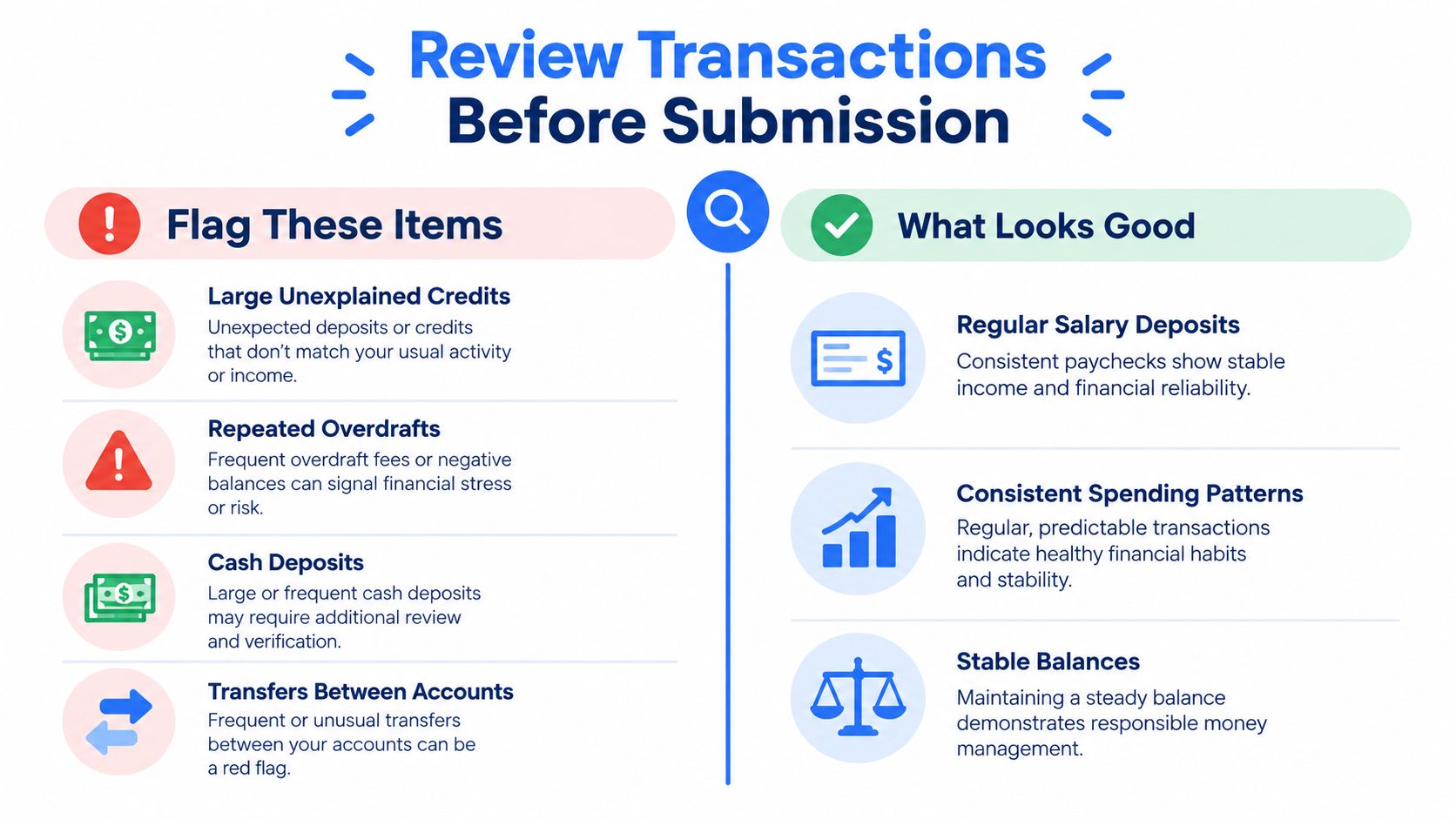
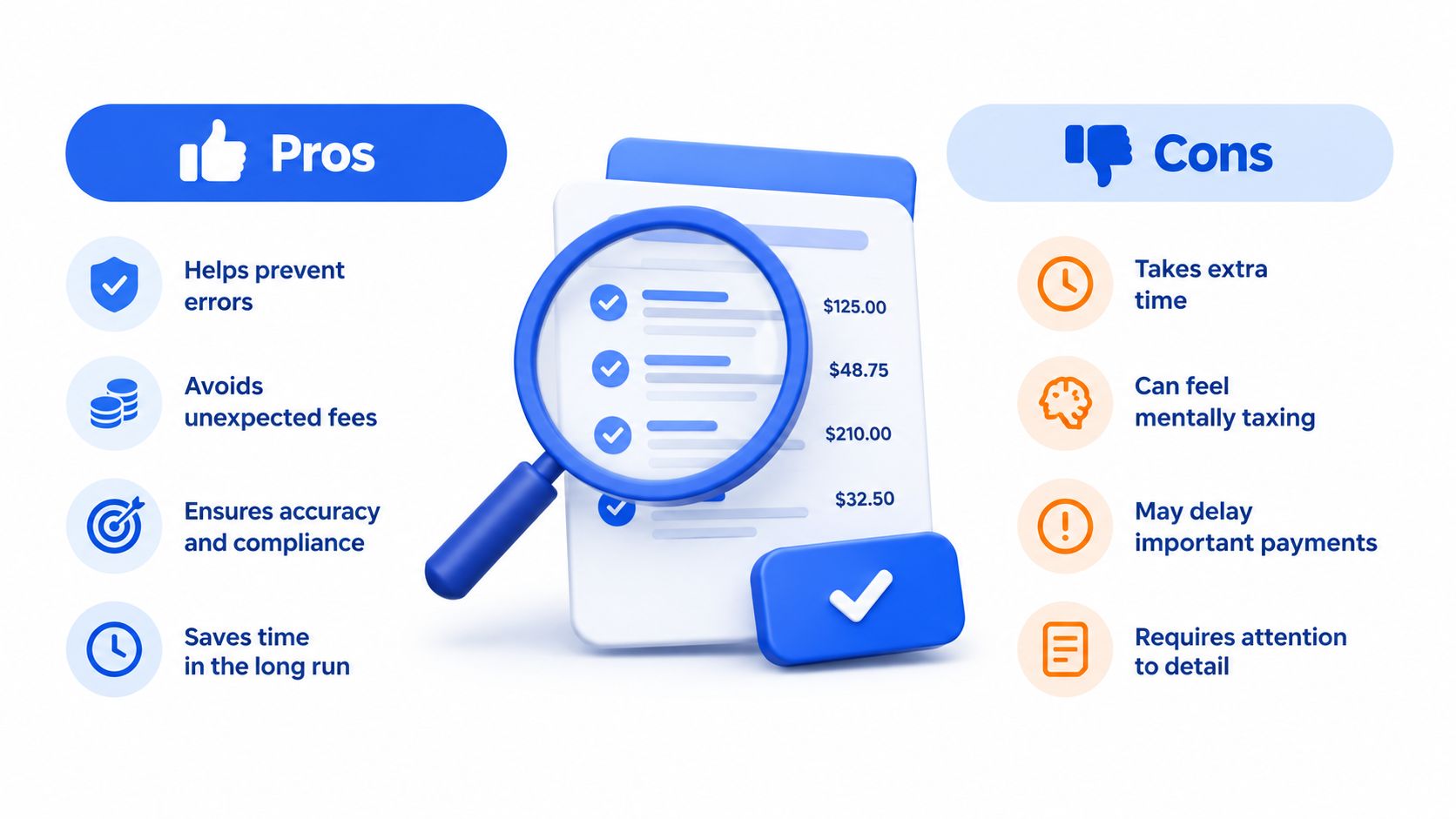
Read the activity before deciding what the closing balance means. A useful review follows the money through the account, identifies credits requiring explanation, and checks whether the supporting records agree with the applicant's account of events.
We're not making an underwriting decision. We're locating questions the lender may need answered.
Distinguish a Review Flag From a Rejection
Under Fannie Mae's depository-account rules, a single deposit exceeding 50% of total monthly qualifying income is considered large when bank statements are used. If those funds are needed for the transaction, the lender must evaluate and document their source; an unsourced amount may otherwise be excluded from usable assets. The guidance also addresses earnest-money verification when statements don't establish that funds originated from the borrower's account, as explained in Fannie Mae's depository-account requirements.
That threshold isn't an automatic rejection rule. It identifies a sourcing question. A documented transfer and an unexplained cash credit may look similar in a balance calculation but require different evidence.
| Activity to flag | Question for our review |
|---|---|
| Unexplained credit | Can we establish the origin and availability of these funds? |
| Transfer between accounts | Can we match the withdrawal, deposit, ownership, and dates? |
| Loan proceeds | Has the applicant identified the borrowing accurately? |
| Repeated overdrafts | What explains the pattern, and does the lender need clarification? |
| Declining balances | What remains after relevant withdrawals and commitments? |
| Abrupt activity changes | Does the application narrative still match the records? |
Record Questions Without Relabeling Transactions
Our review worksheet can contain the statement reference, bank description, proposed classification, supporting document, and unresolved question. Keep the bank's description unchanged in its own column.
For a transfer, we might note that the matching withdrawal appears in the savings statement. We shouldn't relabel it as salary just because the receiving account is personal.
Likewise, a vague handwritten explanation isn't equivalent to evidence. Payroll records, settlement documents, gift documentation, and a traceable transfer history give the lender something it can evaluate.
The objective is explainability, not cosmetic improvement. We should never omit inconvenient activity or rearrange the record to make it look more favorable.
Explain Deposits With Evidence
Suppose a borrower's statement shows a payroll credit, a transfer from savings, and proceeds from selling an asset. All increase the account balance, but they don't represent the same kind of money. We should prepare a short explanation and evidence reference for each relevant item rather than labeling every credit as income.
Our practical evidence packet should answer three questions: what happened, what supports that explanation, and where the funds are now.
Match the Explanation to the Transaction
| Deposit example | Evidence we can assemble | Classification caution |
|---|---|---|
| Payroll | Matching payroll record and statement entry | Explain differences rather than assuming an exact match |
| Savings transfer | Sending and receiving account records | Moving existing funds doesn't create new income |
| Asset sale | Sale or settlement record and receipt trail | Sale proceeds aren't recurring earnings |
| Gift | Gift documentation and transfer evidence requested by the lender | Don't describe repayable funds as a gift |
| Tax refund | Refund documentation and corresponding credit | A refund isn't automatically recurring income |
| Business receipt | Invoice, client remittance, and account entry | Gross receipts don't establish personal qualifying income |
| Loan advance | Agreement and disbursement record | Identify the borrowing openly |
| Peer-to-peer payment | Underlying invoice, reimbursement record, or transfer evidence | The payment channel alone doesn't establish its purpose |
For irregular client payments, we can connect the invoice to the remittance and then to the statement credit. For cash deposits, we should identify whatever contemporaneous evidence exists and let the lender decide whether it's sufficient.
Keep Income Analysis Separate From Asset Sourcing
Specialized bank-statement mortgage programs may use 12–24 months of statements instead of tax returns. Such programs generally exclude transfers, refunds, loan proceeds, and payments through services such as Zelle or Venmo, then apply an expense factor, often around 50%, although lender treatment differs. The distinction between deposits and qualifying income is described in HousingWire's bank-statement mortgage guide.
We should obtain the program's actual calculation rules rather than apply a standard haircut ourselves. Our guide to bank statements as proof of income offers further context for keeping account activity separate from income conclusions.
Evidence standard: A deposit label states our explanation. The supporting records allow the lender to test it.
Organize Files and Protect Privacy
A reviewable packet should let the recipient find the evidence without opening unrelated personal records. We recommend separate folders for original statements, deposit support, working spreadsheets, and the final submission, with consistent account labels across all of them.
The CFPB advises applicants to provide the two most recent bank statements and documentation showing the down-payment source. For funds in savings or investment accounts, it calls for at least two months of ownership history; gifted down-payment funds should have a signed statement from the giver confirming the gift, according to the CFPB's loan-application packet checklist.
Build a Traceable Submission Index
An index can identify the account label, covered period, document purpose, related deposit evidence, and any open question. It doesn't need to repeat sensitive details already visible in the source documents.
- Keep the original separate. Preserve an unchanged copy outside the working folder.
- Connect related evidence. Give a transfer explanation the same account labels used in the statements.
- Mark working files clearly. Distinguish internal analysis from documents intended for the lender.
- Track the actual handoff. Record which packet was submitted so follow-up answers refer to the same files.
Limit Disclosure Without Breaking Verification
Don't mask information because it looks private. Obtain the lender's permission before redacting, and preserve required ownership details, account identifiers, reporting periods, balances, and transaction context.
When a follow-up request arrives, clarify the missing evidence and respond through the lender's approved channel. We shouldn't send unrelated account histories just because they're available.
Account linking and automated extraction don't remove the need for judgment. The lender still determines whether activity represents income, a transfer, or an asset movement, and verification workflows may combine payroll information, permissioned financial data, and manual follow-up, as discussed in MortgagePoint's examination of income-verification workflows.
Privacy and completeness aren't opposites. We can preserve the required record while avoiding unnecessary duplication and unrelated disclosures.
Create Lender-Ready Spreadsheet Exports
A PDF establishes what the bank issued. A spreadsheet helps us sort, classify, and reconcile the activity. We should use each for its proper purpose and ask the lender whether it wants the export or only the source evidence.
For a short review, manual entry into Excel may be workable. For repeated or larger files, PDF extraction is another option, but every method needs a reconciliation check.
Compare the Working Formats
| Format | Appropriate role | Limitation |
|---|---|---|
| Original bank PDF | Preserves the institution's statement record | Less convenient for sorting and calculations |
| Manually prepared spreadsheet | Supports targeted analysis and annotations | Requires careful transcription checks |
| Extracted CSV or XLSX | Supports transaction review and reconciliation | Still requires comparison with the original |
One extraction option is autobankstatement, which converts digital, OCR-scanned, and password-protected PDF statements into CSV or Excel/XLSX. It supports bulk upload and files up to 25 MB, offers a free guest preview before payment, provides registered users with 24-hour download access, and automatically deletes uploads within 24 hours. Plans include Starter at $15/month for 400 pages, Professional at $30/month for 1,000 pages, and Business at $50/month for 4,000 pages, with annual discounts and custom enterprise limits; the workflow is described in the guide to converting bank statements to Excel.
Reconcile Before Using the Export
Preserve the original first, then review the exported dates, descriptions, credits, debits, and balances. Pay particular attention to wrapped descriptions, entries near page breaks, and scanned characters that could be misread.
Our central arithmetic control is:
Opening balance + credits − debits = closing balance.
A matching result is necessary, but it isn't sufficient. Offset errors can leave the total correct while individual transactions remain wrong.
- Compare entries to the PDF. Check for missing rows, duplicates, and misplaced debit or credit amounts.
- Verify date interpretation. Confirm that the spreadsheet hasn't changed the bank's date format.
- Preserve original descriptions. Add classifications in separate columns instead of overwriting source text.
- Investigate differences. Don't insert a balancing entry merely to force agreement.
- Save the reviewed output. Keep it with the statement and its supporting evidence, subject to your organization's handling rules.
An export is lender-ready only when we can explain its relationship to the source. It doesn't become a bank-generated statement merely because the columns look professional, and conversion doesn't determine whether a deposit qualifies.
Run the Final Mortgage Document Check
Before handing over the packet, we should confirm that the lender can follow the evidence from the requested account history to the funds being evaluated. Treat this as a review control, not a prediction of approval.
Confirm the Handoff
- Coverage is correct. The packet matches the lender's requested accounts and periods.
- Source documents are complete. Required ownership details, pages, activity, and balances remain visible.
- Deposit explanations are supported. Relevant credits point to evidence, not unsupported labels.
- Privacy choices are approved. Any permitted redactions preserve the context needed for verification.
- Exports reconcile. Spreadsheet entries have been checked against the original records.
- Open questions are explicit. The lender knows what still needs clarification.
Confirm the Program Before Submission
Conventional asset review and specialized bank-statement income analysis serve different purposes. A longer history doesn't automatically improve eligibility; it may also expose inconsistent receipts, unexplained credits, or weakening balances.
Our final task is to confirm the lender's current instructions, preserve the original evidence, and make the supporting analysis easy to follow. The applicant and preparation team establish the record. The lender makes the underwriting decision.
For spreadsheet-assisted mortgage preparation, autobankstatement offers PDF-to-CSV and Excel/XLSX conversion with a free guest preview before payment. Try a statement, compare the output with the original, and reconcile it before using the export in your mortgage review packet.
Convert your next statement in minutes
Upload a bank statement PDF — digital, scanned, or password-protected — preview the extracted table, and download clean CSV or Excel.