Bank Statement Loan Requirements: What Lenders Check
Bank statement loan requirements explained: required documents, statement periods, income verification and how lenders review deposits before approval.
A client emails you a folder of PDFs two weeks before a closing date and asks how many months of statements the lender wants. You have three clients in the same position, two different loan programs, and a checklist from each lender that doesn't match the others. The answer isn't one number, and it never was.
Bank statement loan requirements come from overlapping places: agency selling guides, consumer protection regulation and individual program sheets that each set their own terms. The professionals who get files through quickly aren't the ones who memorized a number. They're the ones who read the rules in order, starting with the statement period, then the eligibility gates, then the deposit analysis, and only then the arithmetic check on the spreadsheet.
Table of Contents
- Statement Periods and Recency Lenders Require
- Eligibility Criteria Beyond the Statements
- Documents Lenders Require With the Statements
- Why Lenders Read Statements as Cash Flow
- Sorting Deposits That Count as Income
- How to Assemble a Lender-Ready Statement Package
- Checking a Converted Statement Before You Submit
- Decide, Confirm and Apply
Statement Periods and Recency Lenders Require
Start with the default, because most files never move off it. On a conventional purchase loan running through automated underwriting, expect two consecutive monthly statements, roughly 60 days of account activity, with the most recent one dated within 45 days of the initial loan application. The Fannie Mae asset verification rules treat statements as formal evidence for the down payment, closing costs and reserves, which means the package has to be complete rather than illustrative.
Refinances shorten the window. Limited cash-out and cash-out refinances generally need one monthly statement covering about 30 days, not two. A borrower comparing notes with a neighbor who refinanced will hear a different number and assume someone is wrong. Nobody is.
What Makes a Statement Usable
Four elements decide whether a page counts:
- Institution and borrower names, printed on the statement itself rather than inferred from a logo.
- At least the last four digits of the account number, so the account ties back to the file.
- The covered period plus every deposit and withdrawal, because the lender reads movement, not just the closing figure.
- The ending balance, which has to reconcile with the next statement in the sequence.
An app screenshot, a downloaded balance summary or a spreadsheet holding one total fails that test. Underwriters want the transaction detail, dates and account identification that let them trace where money came from and whether it stayed.
The pattern across loan cases looks like this:
| Loan case | Statement period | Recency and coverage | Source basis |
|---|---|---|---|
| Conventional purchase, automated underwriting | Two consecutive monthly statements, about 60 days | Most recent statement dated within 45 days of application | Fannie Mae asset verification |
| Limited cash-out or cash-out refinance | One monthly statement, about 30 days | Most recent statement dated within 45 days of application | Fannie Mae asset verification |
| USDA Rural Development guaranteed loan | Two months of checking, money-market or savings statements, or a verification of deposit plus a recent statement | Reserves cannot exceed the balance on the most recent statement unless the lender uses a lesser amount | USDA Rural Development guidance |
| Bank-statement (non-QM) program | Commonly 12 consecutive months | Personal, business or combined statements, depending on the program | Published program descriptions vary |
| Self-employed borrower, conventional file | Two years of signed tax returns with schedules, plus year-to-date profit and loss and balance sheet | Statements support cash-activity review but do not replace these records | CFPB Regulation Z Appendix Q |
The Recency Clock Starts at Application
That 45-day window runs from the initial application date, so a file assembled in January can age out by early March while the borrower is still comparing rates. Nothing about the borrower changed. The paperwork did, and the file reopens.
Pull the required periods and the cut-off date from the lender's own checklist before anyone collects a document. If a program asks for a longer run than two statements, our guide to preparing a three-month bank statement PDF covers keeping the pages in order when the window stretches.
Eligibility Criteria Beyond the Statements
A flawless statement package doesn't approve anything by itself. Two borrowers with identical deposit history land in different places because of credit, equity and existing debt, and published program terms show how wide that spread runs. One program sheet lists 12 consecutive months, a 700 minimum credit score, 10% down and a 50% maximum debt-to-income ratio, while other current descriptions cite minimum scores around 620, debt-to-income limits up to 55%, and either personal or business statements, as the NASB bank statement loan program page sets out.
These are examples of published terms, not a national standard. A borrower shopping by statement period alone is comparing the least variable part of the offer.
| Criterion | Program example A | Program example B | What the lender checks |
|---|---|---|---|
| Statement period | 12 consecutive months | Personal or business statements, with no month count published in the terms | Enough history to show income stability |
| Statement source | Not specified in the published terms | Personal or business statements | Whose cash flow is being counted |
| Minimum credit score | 700 | About 620 | Approval and pricing risk |
| Minimum down payment | 10% | Set by the program sheet for the score band | Borrower equity in the property |
| Maximum debt-to-income ratio | 50% | Up to 55% | Share of verified income already committed to debt |
Reading Each Criterion in Plain Terms
The debt-to-income ratio is monthly debt payments divided by verified monthly income. Take a borrower with $4,000 of monthly debt on $8,000 of verified income: that's 50 percent, right at the ceiling on the tighter of the two sheets. One extra car payment pushes the file over.
Credit score drives two things at once, approval and pricing, which is why a 620 floor doesn't mean the same rate as a 700 file. Reserves answer a different question: after closing, does the borrower still have money? Self-employment history usually comes up as a 12-month or 24-month question, and the shorter answer tends to arrive with more compensating factors.
Then there's ownership percentage. A 50 percent partner can't be credited with every dollar the business deposits, because half of it was never theirs to spend.
Rule that holds across programs: a criterion you can't find in writing is a criterion nobody will apply consistently, so ask for the program sheet before the application.
List every criterion the lender publishes and set the sheets side by side. The differences tell you where negotiating room exists and where it doesn't.
Documents Lenders Require With the Statements
Statements travel in a pack. Leave out one document and the reviewer stops at the gap rather than working around it.
For a standard pre-approval file, the FDIC mortgage guidance says applicants will usually need pay stubs from the last two or three months, W-2 forms for the last two years, tax returns for the last two years, information about assets and long-term debts, recent bank statements, and proof of additional income.
Self-employed files add a heavier layer. Regulation Z Appendix Q specifies signed and dated individual tax returns with applicable schedules for the most recent two years; signed federal business returns with schedules for the same two years where there's a corporation, S corporation or partnership; and a year-to-date profit and loss statement plus balance sheet. Statements help a reviewer read cash activity. They don't replace any of those records.
Statement-Specific Support to Gather
- Complete statements for each account and period, in date order, with nothing skipped.
- Both sides of any transfer, so money moving between the borrower's own accounts is counted once.
- Loan agreements for loan proceeds, matching the deposit date and amount.
- Invoices or contracts for recurring client payments, which turn a deposit into explainable revenue.
- A written record for owner contributions, signed and dated by the contributing party.
- An explanation and one supporting document for each large or irregular deposit, prepared before the lender asks.
USDA guaranteed loans accept a lighter evidence set: two months of checking, money-market or savings statements, or a verification of deposit together with a recent statement, per the USDA Rural Development guarantee handbook.
Match every item to the lender's checklist rather than to habit. Statements support a file. They never stand in for the tax returns or the financial statements.
Why Lenders Read Statements as Cash Flow
A bank statement works like a water meter. It shows how much flowed through the pipe this month. It says nothing about how much of that flow is clean profit, and profit is what services a loan.

That's the distinction underwriters work with. Fannie Mae's self-employed underwriting framework treats statements as evidence of cash flow, not as qualifying income, and requires a documented cash-flow analysis before any of it counts. Where business assets fund the down payment or reserves, the lender also tests whether pulling that money out damages the business.
From Deposits to One Monthly Figure
The conversion runs in three moves. Total the qualifying deposits over the lookback period. Strip out transfers, loan proceeds and owner contributions. Then apply an expense factor that reflects what it costs to run the business.
Say a consulting business deposits $96,000 over 12 months. That's $8,000 a month gross. Apply an illustrative 30 percent expense factor and the figure the lender can use is $5,600. Expense factors differ by lender and program, which is why the same statements can produce two different qualifying incomes on two desks.
Why an Average Hides the Risk
Averages flatter seasonal work. A contractor with one $30,000 month and several $2,000 months produces a respectable mean and an obvious vulnerability, because the lender is also asking whether the income continues. A single spike from one large project doesn't repeat on schedule.
A deposit proves money arrived. Income proves money is likely to keep arriving, and only the second one repays a mortgage.
Run the monthly averages and the lowest month in the converted spreadsheet before the lender runs them. Finding the soft month yourself is cheaper than being asked about it in underwriting.
Sorting Deposits That Count as Income
A six-figure gross deposit total can be mostly money that was never income. That's the gap between what a statement proves and what a lender can count, and it's where most self-employed files get delayed. Deposits may include transfers, loans, tax refunds, owner contributions, reimbursements or other non-revenue items, and Fannie Mae's self-employed documentation guidance is explicit that the lender must judge whether income is likely to continue.
| Deposit type | Typical treatment | Documentation to prepare |
|---|---|---|
| Recurring client payments | Counted as revenue, usually after an expense factor for business accounts | Invoices, contracts and matching payment history |
| Transfers between your own accounts | Excluded from income and counted once | Both sides of the transfer shown on the statements |
| Loan proceeds | Excluded because they're borrowed money | Loan agreement or closing statement |
| Owner capital contributions | Generally excluded from revenue | Written record of the contribution |
| Tax refunds | Usually reviewed separately rather than as ongoing income | Tax return and the matching refund deposit |
| One-time asset sale | Excluded from monthly income and reviewed separately | Sale agreement and proof of the proceeds |
Why the Label Changes the Answer
Two credits of the same size get treated differently. A $25,000 deposit labeled client payment needs an invoice and a contract behind it. A $25,000 transfer from a savings account is excluded from income entirely, but the borrower still has to prove where that savings balance came from. Same number, two different document trails.
Commingling makes both harder. When brand payments, payroll and groceries move through one account, the reviewer has to untangle them, and an untangled file usually produces a conservative income figure. Separate business and personal banking months before an application, not the week of.
Cash deposits need a written explanation with a document attached. A signed note saying "sales" tells a reviewer nothing.
Practical habit: add a classification column to the converted spreadsheet and label every credit above your normal monthly receipt range before the file leaves your desk.
For a closer look at how deposits become documented income, our guide to using bank statements as proof of income walks through the matching logic.
How to Assemble a Lender-Ready Statement Package
Assemble in a fixed order and the file reviews itself. The sequence below is the one that survives contact with a checklist.
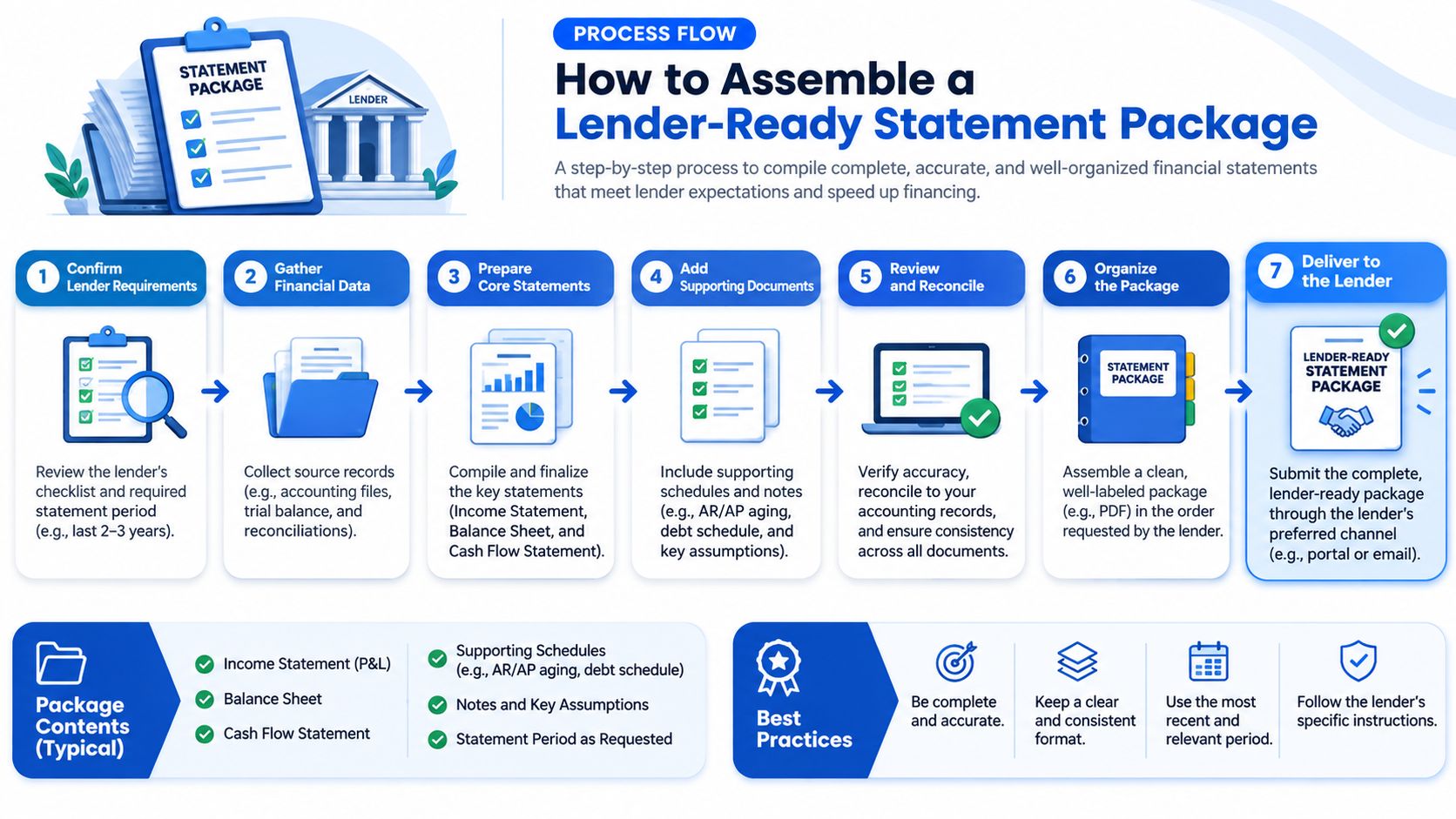
- Pull every page for the full lookback period, in date order. A missing page reads as a missing period, and the reviewer can't assume what it said.
- Confirm the identity block on each statement. Institution, account holder, last four digits, dates and ending balance have to be visible, because a page without them can be rejected on its own.
- Keep personal and business accounts separate unless the program explicitly allows combined statements. Mixing them invites a source-of-funds question you then have to answer in writing.
- Check legibility page by page and rescan anything blurred, cropped or shadowed. An unreadable page stalls the whole file until someone reproduces it.
- Supply a password only when asked, through the channel the lender specifies. Sending credentials in a general email chain creates a problem nobody needs.
- Write one line of explanation for each large or irregular deposit and attach the matching document. Reviewers look for a deposit to reconcile, not a story to interpret.
- Build a one-page cover index listing each account, the period covered and the page count. It lets a reviewer confirm in ten seconds that nothing was skipped.
- Convert the statements to CSV or Excel as a working copy and keep the original PDF as the submitted record. The conversion is for your reconciliation, not for delivery.
Reviewers test claimed reserves against statement balances, so the balances have to fall on the right dates. A file that shows strength in the middle of the month and a thin closing balance invites a follow-up question.
A complete package looks unremarkable at a glance: an index, statements in sequence, an explanation sheet, and supporting documents behind each anomaly. If you're matching the statement set to the rest of the application, our guide to bank statements for a mortgage application covers what the lending side expects to see alongside it.
Checking a Converted Statement Before You Submit
Every converted statement has to satisfy one equation: opening balance plus credits minus debits equals the closing balance. If it doesn't, the spreadsheet is wrong or incomplete, and nothing derived from it can be trusted.
Work it through. Opening balance $12,400, credits $18,250, debits $16,980. Add $12,400 to $18,250 and you get $30,650. Subtract $16,980 and you get $13,670, which must match the closing balance printed on the statement. One cent of difference means a row was dropped, duplicated or read with the wrong sign.
That isn't just good practice. IRS Publication 583 expects electronic records to be complete, accurate, legible, retrievable and reconcilable to the underlying books and tax return, which means a converted file has to preserve dates, descriptions, debit and credit signs, and running balances.
| Check | Pass condition | Likely cause if it fails |
|---|---|---|
| Opening balance | Matches the starting balance printed on the statement | First row dropped or a header read as data |
| Credits total | Equals the sum of all deposit rows | Deposit missed or sign read incorrectly |
| Debits total | Equals the sum of all withdrawal rows | Multi-line description split into two rows |
| Identity check | Opening + credits − debits = closing | Duplicated or omitted transaction |
| Running balance | Each row's balance equals the previous balance plus or minus the amount | Column misaligned by OCR |
| Page coverage | Every page in the PDF is represented | Page break dropped a block of transactions |
Where Errors Cluster
Scanned statements fail in predictable places. OCR misreads a 1 as a 7 or a 5 as a 6, always in an amount column rather than a description. A two-line merchant name splits into two rows and doubles the debit. A page break drops the last three transactions of a page, which is invisible unless the running balance is checked. A sign convention flips a debit into a credit push, and the total moves twice.
Check the running balance row by row on the first and last pages of every statement. That's where the boundary errors sit, and it's faster than scanning the middle.
Non-negotiable: run the identity check on every account and every month before the file leaves your desk.
Decide, Confirm and Apply
The bank-statement route fits a specific borrower: self-employed, deposits steady month to month, and tax returns that show modest net income because legitimate deductions such as equipment depreciation did their job. The deposits tell a truer story than the return does. That's the case the program was built for.
It isn't a free upgrade. Expense factors cut usable income, sometimes steeply. Pricing typically runs above conventional, reserves are larger, and property or loan-size limits can be tighter. Statements also never discharge the tax-return and financial-statement requirements a self-employed file carries, and no program sheet changes that.
Which Route Fits
- Take the bank-statement route when deposits are consistent across the lookback period, the business has traded long enough to show a trend, and taxable income understates real cash flow.
- Stay conventional when the returns already show strong net income, because the pricing and documentation burden are lighter and the file is simpler to defend.
- Blend instead of choosing when there's W-2 income alongside the business. Asking whether both can be used is a better question than which one to drop.
Questions to Send in Writing
Put these to the lender and wait for written answers, since a verbal answer from a processor isn't a program term:
- Are personal, business or combined statements permitted on this program?
- Is 12 months sufficient, or does the file need 24?
- How does ownership percentage change the income credited to the borrower?
- Is a CPA or tax-preparer letter required, or will alternative evidence do?
- Which deposits will be excluded, and what document supports each one?
- Must reserves stay within the balance on the most recent statement?
- What expense factor applies to this business type?
The Next Step
Assemble only the period the lender states, run opening balance plus credits minus debits equals closing balance on every account, and keep the original PDF as the record you submit. A converted spreadsheet is a working copy for reconciliation, nothing more. When we need that working copy from digital, scanned or password-protected PDFs, we use autobankstatement to turn the statements into CSV or XLSX rows, adding the password at upload for locked files. Send the questions in writing, and don't start collecting documents until the answers come back.
Bank statement loan requirements shift with the program, but the arithmetic never does. autobankstatement converts PDF bank statements, including scanned and password-protected files up to 25 MB, into CSV or Excel you can check line by line, and a free guest preview lets you test the output before paying. Run the balance identity on every account, keep the original PDF as your submitted record, and let the spreadsheet handle the reconciliation. Start at autobankstatement and see what your statements look like as clean rows.
Convert your next statement in minutes
Upload a bank statement PDF — digital, scanned, or password-protected — preview the extracted table, and download clean CSV or Excel.