
How Long Should You Keep Your Bank Statements in 2026
How long should you keep your bank statements? We compare tax, audit and business retention periods for the US, Canada and UK, plus safe deletion tips.
There's no single period for how long should you keep your bank statements. Keep routine personal statements for about 1 year, statements supporting a US tax return for 3 years after filing, and Canadian tax records and UK business accounting records for 6 years, then use the table below to find your exact trigger date.
What if the deletion date you've circled on the calendar is based on the wrong starting point? Many count from the statement date or the day they downloaded a PDF. That's rarely the clock the tax authority uses. We get retention right by asking what the statement proves, finding the event that starts the clock, and applying the longest period that matches.
Table of Contents
- Retention Periods at a Glance
- Personal Statements and the Tax Clock
- Business Statements in the US, Canada and UK
- Special Cases That Extend the Retention Period
- Verify Originals and Keep the Right Format
- Store and Securely Delete Statements Safely
- Set a Retention Rule Before You Delete Anything
Retention Periods at a Glance
If you're asking how long should you keep your bank statements, start with the job each statement does. Routine spending history fades after reconciliation. A statement that proves income, a deduction, a tax payment, debt repayment, or ownership of an asset may be needed years later during an audit, dispute, loan review, or estate administration.
The FDIC consumer guidance describes approximately one year as reasonable for ordinary statements with no tax or other long-term significance, while statements supporting tax deductions, tax payments, or other legally relevant transactions may need to be retained for up to seven years. Treat tax-related rows as authority windows rather than fixed calendar math: the filing rule sets the clock, and the trigger date tells you when it starts.
Retention Periods by Statement Type and Case
| Statement or case | Practical minimum | Clock starts at | Why this row controls |
|---|---|---|---|
| Routine personal statements with no tax significance | About 1 year | Statement date | FDIC guidance |
| Personal statements supporting US tax returns | Keep through the return review window | Return filing date | Tax rule sets the exposure period |
| Personal statements with long-term significance (US) | Up to 7 years | Transaction or related event | FDIC guidance |
| US material income omission | Keep through the extended review window | Return filing date | Larger omission can extend exposure |
| US bad-debt or worthless-asset claims | Keep through the claim window | Return filing date | Deduction timing drives the clock |
| US payroll-tax records | Keep while the assessment window remains open | Tax due or paid, whichever is later | Later trigger protects the employer |
| Canadian tax records and supporting documents | Keep through the business records window | End of last tax year covered | Period end is the anchor |
| UK business accounting records, including bank statements | Keep through the statutory records window | End of financial year | Company year end is the anchor |
| UK individual Self Assessment records | Keep through the self-assessment window | End of relevant tax year | Tax year end is the anchor |
How to Use This Table
Work through three checks for each statement. First, name what it could prove: salary, a deductible payment, a loan repayment, payroll tax, or a property deposit. Second, find every matching row for that purpose and jurisdiction. Third, apply the longest applicable window and calculate the delete date from that row's trigger, not from the month printed at the top.
- Statement date matters only for routine records: Once a statement supports a return, the filing date or period end normally controls.
- One statement can match several rows: A business statement that also supports payroll taxes stays until the longest clock ends.
- Deletion needs a completeness check: Confirm the file opens cleanly, covers the bank's full account period, and reconciles to your books before you remove monthly copies.
Don't ask whether a statement is old. Ask what question it could still answer, and who might ask it.
Your bank's archive is a weak substitute for your own retention rule, because access can narrow after you switch or close an account. That separate clock is covered in our guide to how long banks keep records. Download and verify the statements you need while you still control access.
Personal Statements and the Tax Clock
A household filing cabinet holds two kinds of paper: documents that prove something, and routine pages that expire once their job is done. Personal bank statements split the same way, and the split gives a practical two-tier rule. The trigger that starts each clock is the filing date attached to the return. The statement's own date never sets the retention period.
The IRS good recordkeeping guidance generally recommends keeping tax related records for 3 years from the date a tax return was filed, and it lists receipts, canceled checks, and other supporting documents among records that should be retained. Bank statements count when they document income, deductions, credits, or payments reported on that return. A return filed in April starts a clock that ends three Aprils later, whatever month the statement itself carries.
The Two Tiers for Households
Routine monthly statements with no tax or legal role can usually go after reconciliation, and roughly a year of history covers balance queries and budgeting questions. That covers ordinary card spending, utility payments, and transfers already matched to your own records. Keep the annual summary if your bank provides one, because it compresses a year of activity into a single reference.
Statements supporting a return sit in the second tier. Deposits showing income, payments of tax, charitable donations, medical payments, or evidence of deductible expenses stay with the filed return. If a deposit is later questioned, the statement shows the amount, date, and source account in a way a spreadsheet note doesn't.
Records That Outlive the Annual Folder
Some transactions need longer because their tax effect isn't finished in the year they occur. IRS guidance notes that records connected with a home purchase or sale, stock transactions, individual retirement accounts, businesses, or rental property may need to be kept longer than ordinary annual tax records. Basis is often the reason. Years later, you may still need to establish what you paid, what you contributed, or when a transfer occurred.
Say a household sells a home. Keep the statements covering the sale proceeds, the mortgage payoff, and any closing payments alongside the sale documents. They stay until the limitation period for that year's return ends, and longer if the proceeds feed into another asset purchase or an unresolved question. Deleting the bank evidence after one year leaves the legal documents without payment proof.
The practical setup is one folder per tax year: the filed return, its supporting statements, and the major transaction documents. Routine monthly PDFs go only after you've reconciled them and confirmed nothing on them feeds a filed return or an open question. The folder takes an afternoon to set up, and the check before deletion is what makes it defensible.
Business Statements in the US, Canada and UK
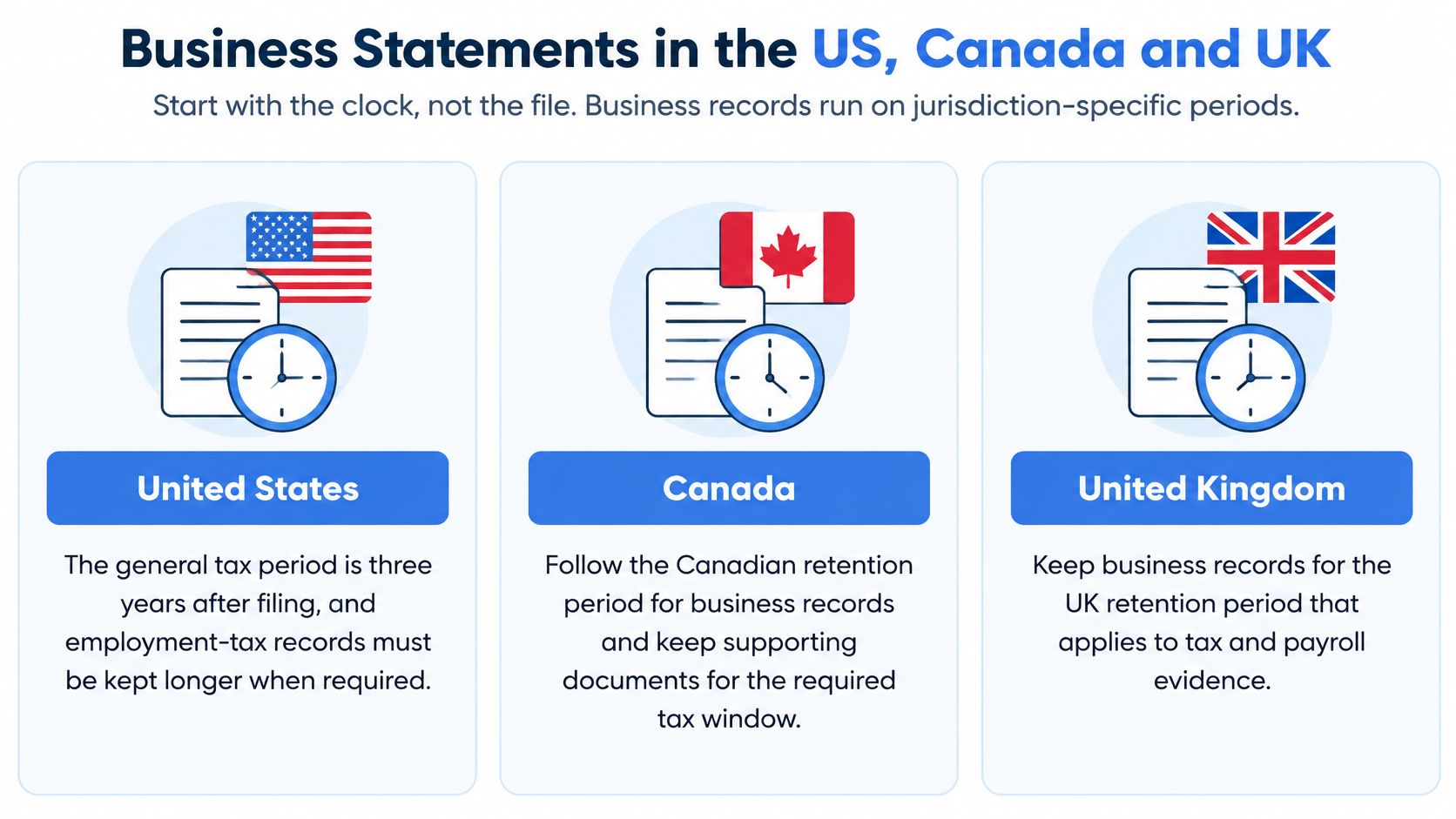
Start with the clock, not the file. A single company wide deletion age fails because business records answer to different trigger dates: filing dates, tax year ends, and financial year ends. The jurisdiction sets the baseline, and the transactions on the statement can push the date further out.
United States
The IRS recordkeeping topic ties business record retention to the limitation period for the return: generally three years after filing, longer where income is understated, and at least four years for employment tax records. One statement can support several of these clocks at once. A statement covering supplier payments, customer deposits, and payroll tax transfers stays until the longest applicable period ends, and its deletion date has nothing to do with when it was downloaded or uploaded into the ledger.
Canada
The Canada Revenue Agency recordkeeping guide sets the trigger differently: tax documents and supporting records, including bank statements, duplicate deposit slips, and canceled cheques, generally stay for at least six years from the end of the last tax year they relate to. Filing the return starts nothing. The tax year end does.
Electronic records carry a second obligation. They must remain electronically readable, so printing a PDF to paper does not retire the digital copy. Records connected to unresolved tax matters or long lived assets stay until the matter closes or the asset leaves the books.
United Kingdom
UK companies keep accounting records, including bank statements, for six years from the end of the financial year. The keep-until date is therefore an anniversary: count six years forward from each financial year end, and a March year end produces a March deletion date six years later. Longer retention applies where a transaction spans accounting periods, an asset outlives the window, a return went in late, or a compliance check has begun.
VAT runs on the same six year minimum for the records making up the VAT account, so where categories overlap, the longest obligation wins. Statements are what tie ledger entries to invoices, payroll, tax calculations, and actual cash balances, which is why a summarized ledger alone is no substitute.
Working rule for finance teams: Date retention from the filing date or period end the law specifies. The day someone uploaded the PDF has no legal meaning.
Sole traders work to the same trigger date discipline as companies, just with a smaller bookkeeping setup. Our guide to self-employed bookkeeping covers how to keep that evidence organized through the year. Whichever jurisdiction applies, write the retention date into the folder name or document index so a new bookkeeper never has to reconstruct it.
Special Cases That Extend the Retention Period
Three years is a starting point, and treating it as a blanket rule fails in exactly the cases most likely to produce a serious enquiry. Extended clocks apply because the claim, omission, or payment itself stays open longer, and each runs from its own trigger date.
IRS Publication 583 specifies six years when more than 25% of gross income was omitted from a return and seven years for a claim involving a loss from worthless securities or a bad-debt deduction. Records supporting a refund claim generally must be kept until the later of three years after filing the return or two years after paying the tax.
The trigger decides which clock wins. A tax paid late pushes the endpoint out to two years after that payment, so records that looked ready for deletion stay live.
Bank statements carry these claims because they show the deposits, loan proceeds, repayments, and payments underlying a deduction. Keep the complete statement and its reconciliation workpapers for the extended period. A single highlighted transaction line, separated from the statement and its balances, is weaker evidence and harder to verify against the account.
Three Triggers That Pause Deletion
- An open audit, appeal, or dispute: Keep every statement covering the disputed transactions until the matter closes and any follow up deadline passes.
- A legal or tax hold: A hold overrides the normal schedule, including statements that would otherwise be due for deletion during the hold.
- A late-filed return: Count from the actual filing date, not the original due date or the end of the tax year.
Loan reviews create a practical fourth reason, even when no tax clock is running. Lenders may ask for statements supporting income, reserves, or the source of a deposit, and fraud investigations or bank error disputes deserve the same treatment until they are fully resolved.
Account closure is the quiet risk. Once you close or switch an account, old statements may be hard to reach through normal online access, yet they can still document interest, fees, or packaged account benefits. Download the full history, confirm consecutive periods and matching balances, and file it before closure. Retrieving a complete archive afterward is slower, narrower, and sometimes impossible on the terms you need.
Verify Originals and Keep the Right Format
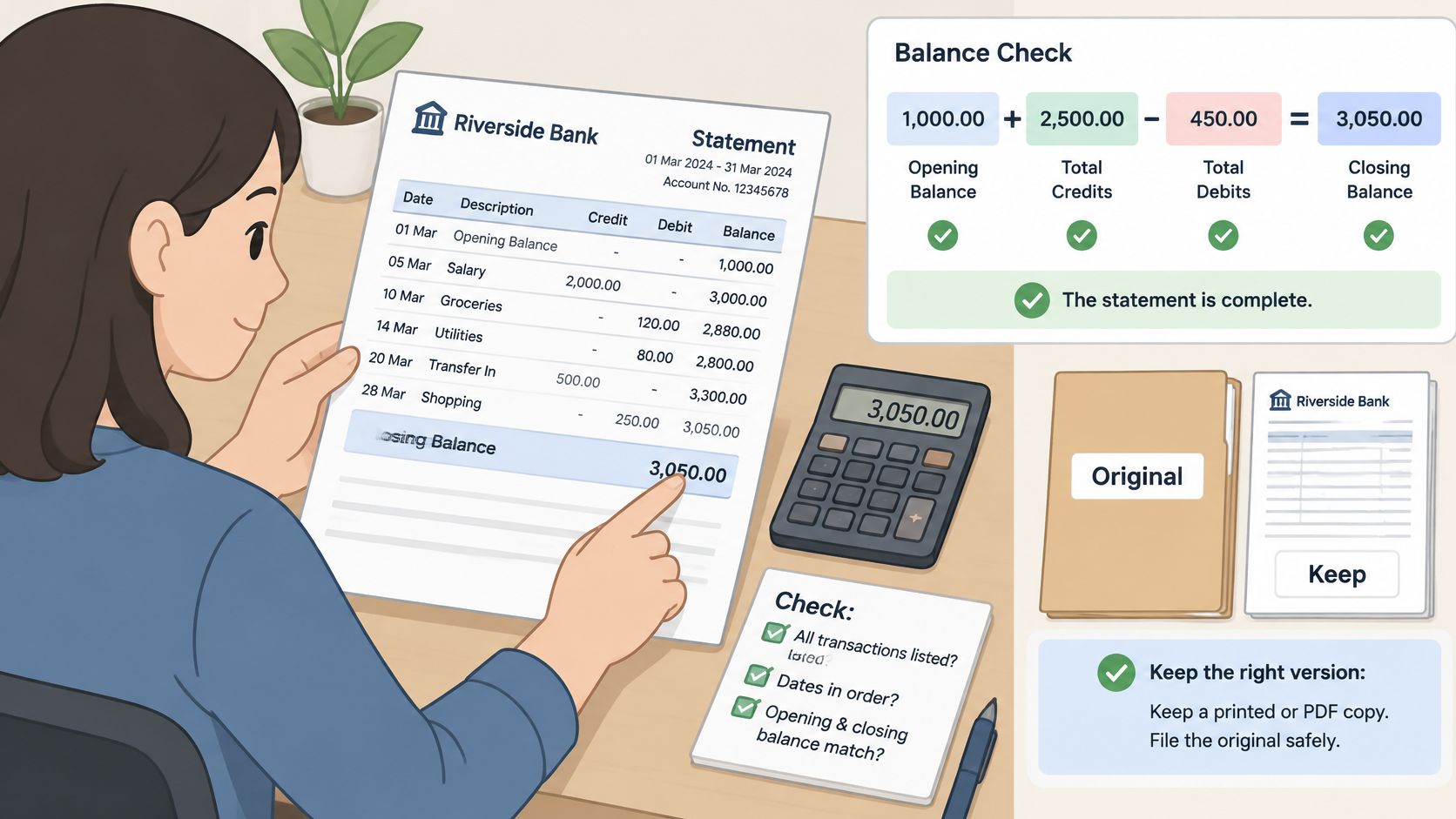
A retention period doesn't help if the file you kept is incomplete. Before any converted statement is filed or archived, run the balance check that can't be skipped: opening balance + credits − debits = closing balance. If that equation doesn't pass, don't archive the file and don't delete the source. Something is missing, duplicated, or signed incorrectly.
Checks Before a File Enters the Archive
- Page sequence: Match the page count and consecutive dates against the original statement to catch a missing middle page.
- Account identity: Confirm the account name, masked number, currency, and statement period before filing it under a client or entity.
- Signs and columns: Look for debits placed in the credit column, which can leave totals plausible while reversing the meaning of a payment.
- Duplicates: Watch for repeated rows where pages overlap or a statement was uploaded twice.
- OCR readings: Recheck scanned figures where characters can be confused, especially dates, decimal points, and similar digits.
Verification is what turns a downloaded file into evidence. A statement that fails any of these checks can still look complete in a folder, and the gap only surfaces when someone tries to reconcile it years later.
The HMRC compliance handbook guidance requires relevant accounting records, including bank statements, to be retained for six years from the end of the related financial year, with longer retention for spanning transactions, long lived assets, late returns, and compliance checks. That obligation points to the original evidence. A cleaned summary inside accounting software can't reproduce the bank's record of cash movement, and deleting the statement breaks the audit trail between the ledger and that record.
Original PDF vs Working File
Keep both, because they do different jobs. The bank's PDF is the source record: it preserves the issuer's layout, running balances, and statement period, which makes it the stronger evidence when figures are questioned. The reviewed CSV or Excel file is the working copy, built for reconciliation, coding, and reporting. A spreadsheet on its own can be sorted, overwritten, or separated from the statement it came from, so it supports the PDF rather than replacing it.
For teams converting statements, autobankstatement handles digital, scanned, and password-protected PDFs and produces CSV or Excel outputs. The uploaded original is used only to complete the conversion and is deleted within 10 seconds after processing finishes. Registered users keep 24-hour access to recent downloads, so run the balance check and save the approved working file to your own records inside that window rather than relying on the download link staying live.
File the original PDF beside its reviewed working copy and treat the pair as one retention unit. When an audit, appeal, or open filing question applies, both versions go on hold together. The PDF gives an auditor source evidence, and the spreadsheet gives a bookkeeper data they can work with.
Store and Securely Delete Statements Safely
Good deletion is a procedure, not a spring clean. Statements contain account details, income patterns, suppliers, and sometimes payroll information. We protect them while they're needed, then remove every copy in a controlled order.
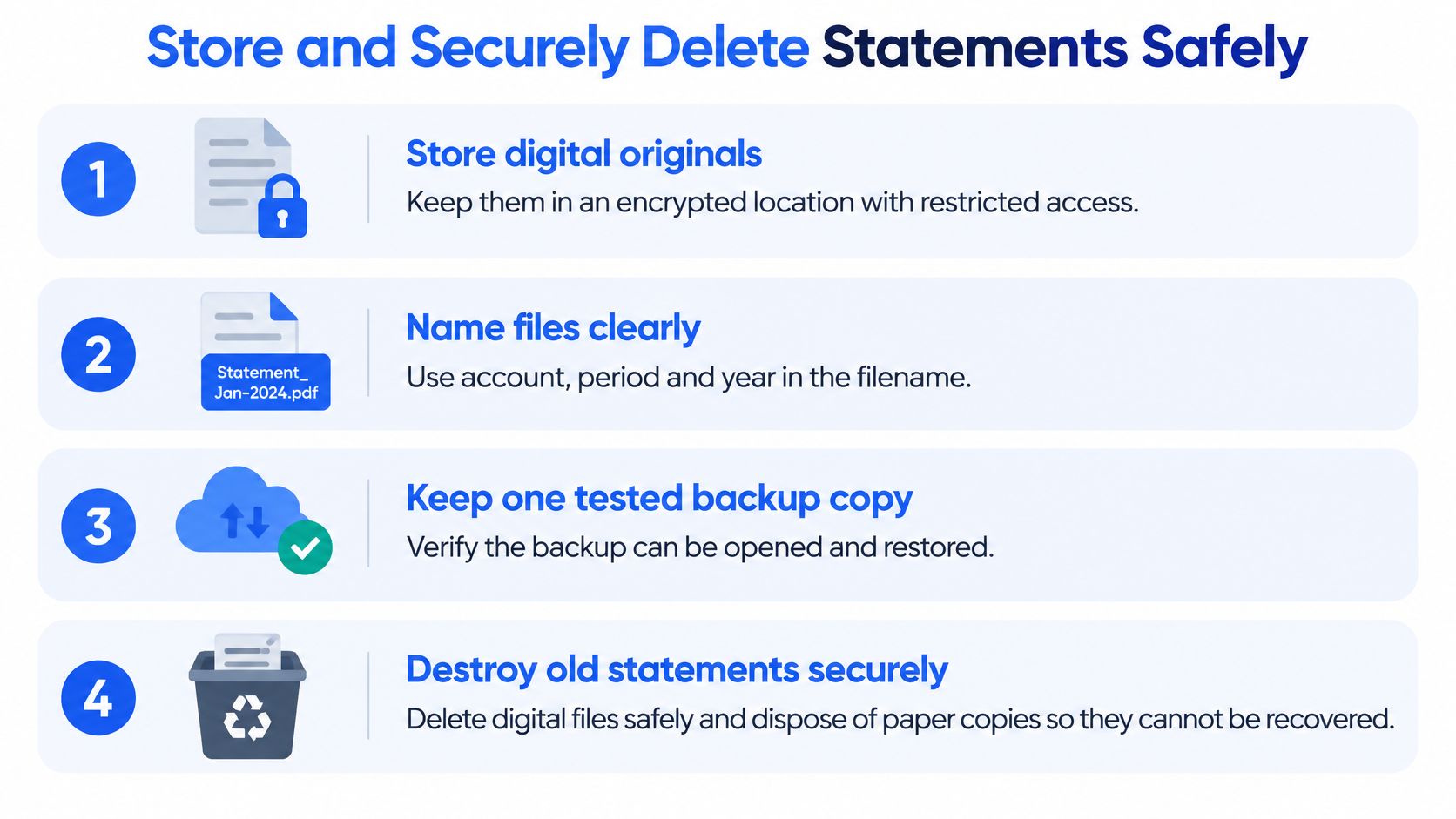
Store digital originals in an encrypted location with restricted access, and limit permissions to people who need them for finance work. Name files by account, period, and year so the trigger period is visible without opening each PDF. Keep one tested backup copy, and open restored files during the test, because a backup that won't read has no retention value.
Paper needs the same discipline. Keep statements in a labelled, locked box, separated by entity and tax year. When the period ends, use a cross-cut shredder or a certified shredding service rather than general waste or recycling.
Destruction Sequence
- Confirm no hold applies: Check legal, tax, audit, loan, fraud, and dispute matters before touching the files.
- Confirm verification passed: The balance check must agree and the approved working file must already be saved with the original.
- Recalculate the deadline: Count from the filing date, tax year end, or financial year end that governs the record.
- Delete the primary copies: Remove files from the working and archive folders, then empty the recycle bin or trash.
- Remove secondary copies: Clear synced cloud folders promptly and let backup copies expire on their documented rotation cycle.
- Log the destruction: Record the date, account, periods destroyed, approval, and person responsible.
A deletion log proves you followed a schedule. Without it, an absent statement looks like carelessness even when deletion was legitimate.
Don't mix retention with everyday tidiness. Receipts and statements support different parts of the same audit trail, so align their folders by year and entity. Our practical guide to how to keep receipts organized shows a naming approach that pairs well with statement archives. When in doubt, pause deletion and resolve the doubt in writing.
Set a Retention Rule Before You Delete Anything
A written rule turns scattered judgement into a control your team can follow. For each statement type, record the trigger, the minimum period, the format to keep, who approves deletion, and the final action. If a new bookkeeper can't work out the deletion date from the policy alone, the policy isn't finished.
Sample Retention Policy by Statement Type
| Statement type | Clock starts at | Keep for | Final action |
|---|---|---|---|
| Routine personal statements, reconciled, no tax use | Statement date | About 1 year | Securely delete original and working file |
| Personal statements supporting a US tax return | Return filing date | At least 3 years | Keep with return, then securely delete |
| Canadian tax records, including bank statements | End of last tax year covered | At least 6 years | Keep electronic readable copy, then delete |
| UK business accounting records, including bank statements | End of financial year | 6 years, longer if triggers apply | Keep original and extract, then delete |
| Any statement under audit, dispute, loan review or legal hold | Matter closed | Until the hold is released | Release hold, then apply the rule above |
The longest applicable rule governs when a statement serves several purposes. A UK business statement that documents a long lived asset and ordinary trading receipts doesn't become disposable just because the trading receipts are old. The same logic applies to a Canadian statement tied to an objection, or a US statement supporting both income and an extended claim.
Put the Rule Into Operation
Set each deletion date in the calendar when the return is filed or the financial year closes. Don't leave someone to calculate it years later from an unlabelled folder. Include the account, period, retention basis, and approver in the calendar note or document index.
Run one test deletion on a closed, low risk period before applying the rule widely. Follow the full sequence, check synced folders, inspect the backup rotation, and complete the deletion log. This test exposes practical failures, such as the only readable original sitting in someone's email or a spreadsheet that never passed the balance check.
Keep the supporting transaction export, not only the PDF. Users can download a clean spreadsheet for bookkeeping, taxes, reconciliation, or reporting, which means the reviewed working file belongs beside the immutable bank original. Registered access provides recent results and downloads for 24 hours, so file the approved spreadsheet promptly rather than treating temporary download access as storage.
Assign ownership by role, not by whoever happens to notice a full drive. The preparer verifies completeness, a reviewer confirms the clock and holds, and one named approver authorises destruction. For small teams, two people can cover those duties, but the approval still needs to be explicit.
Review the policy when the business enters a new jurisdiction, changes its financial year, hires employees, registers for a new tax, or closes a bank account. Each event can add a clock or cut off retrieval access. Update the policy first, then change the folders and calendar dates to match.
We'd sign off the rule in writing before deleting a single statement. That one discipline prevents the common failure mode where each month is handled from memory, balances go unchecked, and a missing statement surfaces only when a tax authority, lender, or auditor asks for it.
When you build your retention archive, use autobankstatement to convert the bank's original PDFs into clean CSV or Excel working files you can verify, reconcile, and file beside the source records. Check the balance equation, download the approved spreadsheet within the access window, and you'll keep statements that remain usable for the full period your policy requires.
Convert your next statement in minutes
Upload a bank statement PDF — digital, scanned, or password-protected — preview the extracted table, and download clean CSV or Excel.